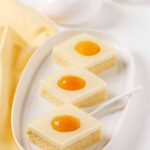
Fried egg cake is the one cake where the look sells the flavour. A pale vanilla custard layer, golden apricot halves placed dome-side up, and suddenly there is a row of fried eggs on the tray. We bake it at Easter, for children’s birthdays, and any time we want maximum effect for minimum effort.
The idea is an old one, but the wow moment works every single time. This cake has landed on our Easter coffee table for years. By now we know exactly the three points where beginners go wrong. That is almost always what it comes down to.
Fried Egg Cake with the Thermomix®
Ingredients 0 / 17 ✓
- 200 g butter + a little extra for greasing
- 300 g plain flour (type 405)
- 5 eggs
- 30 g milk
- 170 g sugar
- 10 g vanilla sugar
- 1 pinch salt
- 1 sachet baking powder
- 800 g milk
- 2 sachets vanilla pudding powder
- 110 g sugar
- 10 g vanilla sugar
- 400 g soured cream
- 480 tinned apricot halves drained weight
- 500 g water
- 50 g sugar
- 2 sachets clear cake glaze
Instructions 0 / 9
-
1
Mix the sponge batter in the Thermomix®.
Add butter, flour, eggs, milk, sugar, vanilla sugar, salt and baking powder to the mixing bowl and mix for 1 min / speed 3.5.
-
2
Preheat the oven.
Preheat the oven to 180°C and grease the baking tray.
-
3
Bake the sponge.
Spread the batter evenly over the baking tray and bake for about 20 minutes.
-
4
Cook the custard.
Insert the butterfly whisk. Add milk, pudding powder, sugar and vanilla sugar to the mixing bowl and heat for 10 min / 100°C / speed 3. Leave the mixture to cool to room temperature.
-
5
Fold in the soured cream.
Remove the butterfly whisk. Add the soured cream and mix for 1 min / speed 3.
-
6
Spread the cream filling over the sponge base.
Spread the custard cream over the baked sponge base and arrange the apricot halves on top with a little space between each one.
-
7
Rinse the mixing bowl.
Rinse the mixing bowl.
-
8
Cook the glaze.
Insert the butterfly whisk. Add water, sugar and cake glaze to the mixing bowl and stir for 5 sec / speed 4. Bring the glaze to the boil for 6 min / 100°C / speed 4.
-
9
Pour over the glaze and serve.
Remove the mixing bowl from the base unit and leave the glaze to cool for 10 to 15 minutes. Pour the finished glaze evenly over the cake and leave to set. Cut the cake into square pieces, each with an apricot half in the centre, and serve.
Tip: You can use low-fat quark instead of soured cream. Sprinkle the cake with chopped pistachios.
Video
Nutrition per serving
Why apricots beat peaches every time
Classically the fried egg cake uses peaches, because the halves are larger and a deeper yellow. We still reach for tinned apricots. The smaller dome looks like a real egg yolk on a 38 by 45 cm tray, whereas a peach half starts to resemble something laid by an ostrich. At 480 g drained weight, one tin gives you roughly 12 halves, which is exactly one per slice. Anyone who wants the peach look should not halve the large halves. Otherwise the cake ends up looking like scrambled eggs.
The one thing that matters is draining the fruit well. We tip them into a sieve a quarter of an hour before topping, and sometimes pat them dry with kitchen paper too. Every drop of syrup that reaches the custard will soften the glaze later.
Three layers, three trips through the mixing bowl, one cake
The cake is made up of a sponge, a vanilla custard and soured cream filling, and a clear glaze. Three separate components, each made one after another in the same mixing bowl. That is exactly why we no longer make this one by hand.
The sponge batter comes together in one minute at speed 3.5, butter, flour, eggs, milk, sugar and baking powder all added together. While the 20 minutes of baking time runs, the custard cooks from 800 g milk, two sachets of pudding powder and 110 g sugar in the same bowl. Ten minutes at 100°C at speed 3 with the butterfly whisk inserted, and it is done. After that the bowl only needs a quick rinse before it handles the glaze. Three layers, one appliance, no extra pot on the hob, no whisk taking up half the dishwasher.
The custard must be cold, or everything runs together
This is the one point where nearly every fried egg cake fails. Freshly cooked custard sits at around 90°C, while the soured cream comes out of the fridge at 5°C. Mix the two directly and you get a warm, slightly grainy cream that spreads across the base instead of holding its shape. The apricots sink in, the glaze finds no flat surface, and in the end you are looking at a yellow blob in a custard pool rather than a row of fried eggs.
We always leave the custard to cool completely to room temperature before adding the soured cream. Depending on the kitchen, that takes 45 to 60 minutes. During that time the baked base also cools down, and that is exactly what it should do. A hot base under cold cream means condensation underneath the layer, and that single drop is enough to make the cake slippery on the plate. If you do not have an hour to spare, place the mixing bowl with the custard in a cold water bath for 20 minutes. That reliably cuts the waiting time in half.
The glaze: the moment that decides between success and cracks
Two sachets of clear cake glaze, 500 g water, 50 g sugar, six minutes at 100°C at speed 4. The quantities sound like a lot, but they need to be, because a baking tray with a high rim has a greater surface area than a round tin. Freshly cooked glaze is hot and thin, and pouring it on directly would send the apricots floating and soften the custard.
We take the mixing bowl off the base unit and leave it to stand for 10 to 15 minutes. As soon as the glaze starts to pull slightly at the edge of the bowl, the moment has come. Now ladle it evenly over the cake, working first between the apricots, then over them. If the glaze is too hot it washes the fruit off the custard. If it is too cold it will not spread smoothly and tears when you cut the cake.
What we do with the leftover apricots from the tin
From 480 g drained weight you get around 12 good halves. A tin often contains 14 to 16, so two to four are left over. We do not eat them as they are, but blend them with a few drops of lemon juice and a tablespoon of sugar into a puree that goes under the custard. This gives a thin apricot layer between the base and the cream, and makes the cake less sweet but more fruity. Anyone who prefers to keep it simple can skip this step. The classic works perfectly well without it.
Soured cream or quark, and when to use which
In our original recipe we fold 400 g soured cream into the cooled custard. Soured cream has 24 per cent fat, which keeps the cream stable and gives it a gentle tang that balances the sweet glaze. Low-fat quark works as a substitute, but it is noticeably more acidic and makes the cream paler, almost white. At first glance it actually looks more like egg white, which strengthens the fried egg effect even further.
If you use quark, bear in mind that the cream sets less firmly because of the lower fat content. We then add one sachet of cream stabiliser or a tablespoon of cornflour to the custard. That keeps the layer in shape even after 24 hours in the fridge.
1 day in the fridge, serve on the day you bake it or the next
Fried egg cake actually tastes better on the second day than fresh. Overnight the base absorbs a little moisture from the cream, and all the layers bond together. We therefore prefer to bake it the day before, cover it with cling film and put the tray in the fridge. After 24 hours in the cold the cut is cleaner, because the glaze has set through.
Freezing does not work. The glaze crystallises when it thaws, the custard turns watery and the apricots lose their smooth surface. The cake keeps for three days at most anyway, because the fruit holds too much moisture. At ours there is usually nothing left by day two.
What else we serve alongside this cake
When we lay out a full coffee spread, we often add a crustless cheesecake as well, because it uses no flour and works for guests avoiding gluten. In summer we pair it with a strawberry tray bake, which uses the same glaze technique as this cake. Anyone who prefers a lighter base can swap our sponge for a genoise, but should then reduce the baking time to 12 minutes.
The same idea of custard and fruit also works with our paradise cream cake, where ready-made paradise cream takes the place of the vanilla mixture. And for a slightly more playful twist on the theme of fizzy drink in a batter, we recommend our Fanta cake.
How other versions differ
Goes well with: coffee and vanilla ice cream.
When we look at the top recipes out there, we see three variables where the versions differ. The cream layer: custard with soured cream gives the firmest support, quark with pudding powder turns out looser and more tangy, plain yoghurt usually becomes too runny during baking. The apricots: tinned halves give the classic fried egg look and are available all year round, fresh apricots need to be in season and turn softer during baking. The base: a sponge reliably holds the moist cream layer, a shortcrust pastry soaks through from below and tears when you cut it. In the Thermomix® we go with a sponge base, vanilla custard and soured cream filling, and tinned apricots, so the cake works in winter too and all three layers hold their shape cleanly.