We have been making almond butter at home for years because we want to know exactly what goes into it. The Thermomix® turns it into a 30-minute project rather than an all-day task.
The difference from shop-bought versions: you decide whether to roast the almonds or not, whether to use skin-on or blanched. And you avoid the additives that keep commercial jars shelf-stable but affect the flavour.
Almond Butter in the Thermomix®
Ingredients 0 / 1 ✓
- 500 g almonds skin-on or blanched, raw or oven-roasted
Instructions 0 / 4
-
1
Grind the almonds.
Add the almonds to the mixing bowl and grind for 1 min / speed 10.
-
2
Stir the almonds.
Push the ground almonds down with the spatula and stir for 5 min / speed 5. Push down with the spatula again.
-
3
Stir the almonds again.
Repeat step 2 a further five to six times. The butter should be stirred for about 30 minutes in total.
-
4
Fill into jars.
Fill the almond butter into sterilised screw-top jars and store in the fridge.
The almond butter keeps in the fridge for about 4 weeks.
Video
Nutrition per serving
Why you need to push the almonds down after every run
The Thermomix® does not grind almonds evenly into butter if you simply run it for 30 minutes straight. After the first minute at speed 10 the almonds are pulverised. But the oil only releases after several passes.
The almonds stick to the side of the mixing bowl. If you do not push them down with the spatula they stay there and turn dry instead of creamy. The oil collects at the bottom while the dry almonds sit on top. After five minutes at speed 5 you push everything back together, then another five minutes, then push again. Five to six times in total.
Only after 25 to 30 minutes has the almond oil worked through all the almonds. Before that the butter is grainy or crumbly. That is the difference from commercial jars, which often add sunflower oil to become creamy more quickly.
Skin-on or blanched, roasted or raw
We usually use skin-on almonds because they have a stronger flavour and the skins add fibre. The butter will be brown. For a pale butter, use blanched almonds without skins. They are milder but also more expensive.
Roasting is a matter of taste. Roasted almonds give a nuttier butter. We roast them for 10 minutes at 160 °C fan in the oven or in an uncoated frying pan without fat. Raw almonds give a milder butter that works better in sweet recipes.
Important: let roasted almonds cool completely before blending. Hot almonds release too much oil and the butter turns too runny.
Why oil separates on top and what it means
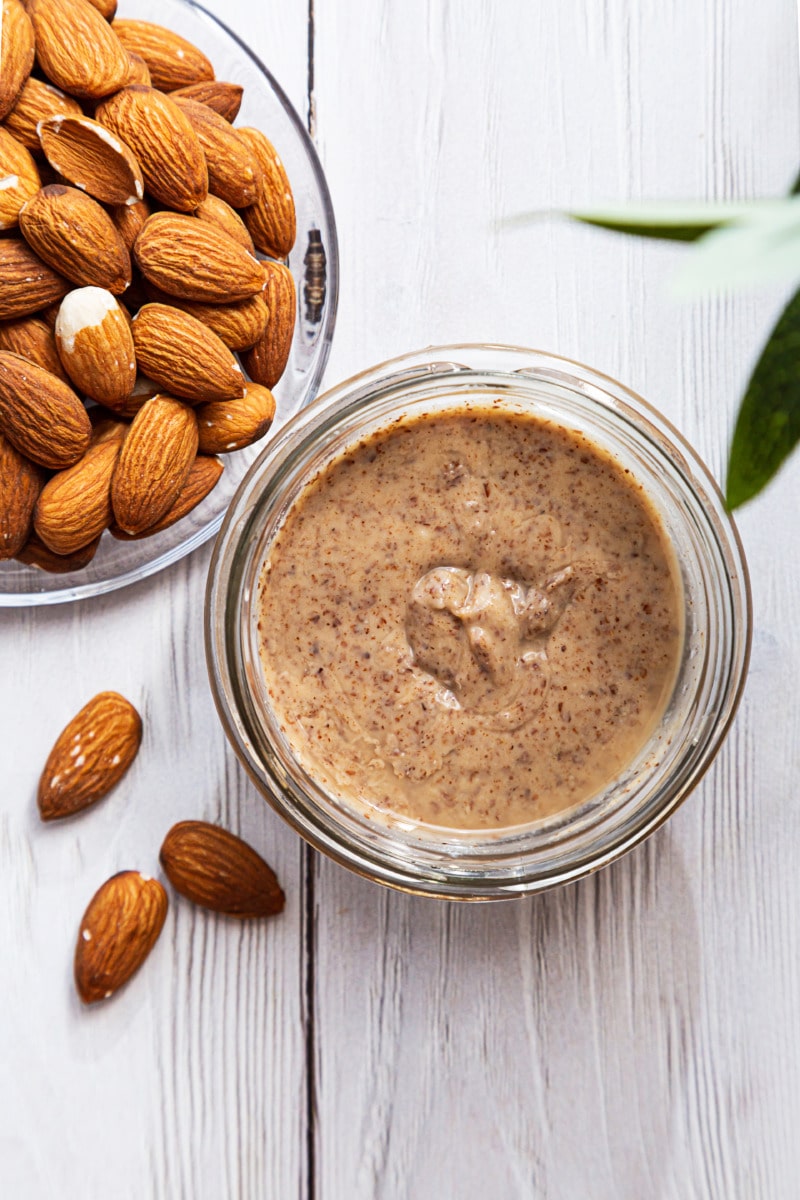
After a few days in the fridge the almond oil separates from the solid part. This is not a fault, it is a sign that there is no emulsifier in it. Commercial jars stay homogeneous because lecithin or other additives bind the oil.
Stir vigorously before each use. The oil reincorporates and the butter turns creamy again. If the butter has become too firm, a teaspoon of neutral oil helps.
Shelf life and proper storage
Homemade almond butter keeps for four weeks in the fridge. Sterilised screw-top jars are essential. We boil the jars for five minutes in boiling water or heat them for 10 minutes at 120 °C in the oven.
In the freezer the butter keeps for several months. Freeze in portions so you can defrost as needed. Stir defrosted butter well because the oil separates during freezing.
If the butter smells rancid or tastes bitter, it has gone off. This happens when the almonds were already stale before blending or the jar was not sealed properly.
How we use almond butter
We stir almond butter into porridge, smoothies, or yoghurt. As a spread with honey or jam. In vegan sauces as a substitute for cream. Or as a base for energy balls and bars.
For dressings, stir one to two tablespoons of almond butter with lemon juice, mustard, and water until smooth. For Asian sauces, mix with soy sauce and ginger. In baking, almond butter replaces part of the butter and makes the cake moister.
What other recipes do differently
Goes well with: oat biscuits, yoghurt and smoothies.
In other Thermomix® recipes we often see the tip to add one to two tablespoons of coconut oil or almond oil so the butter becomes creamy more quickly. We deliberately leave this out because the almond oil from the almonds themselves provides enough binding after 25 to 30 minutes. Instead of honey, many sources use just a pinch of salt, and some add cinnamon as well. One recommendation comes up everywhere: the almonds must be 100 per cent dry and fully cooled, otherwise the oil separates irreversibly. Opinions on storage vary, and four weeks in the fridge is our safe middle ground.
More basic recipes with the Thermomix®: mayonnaise, cream cheese, mustard.