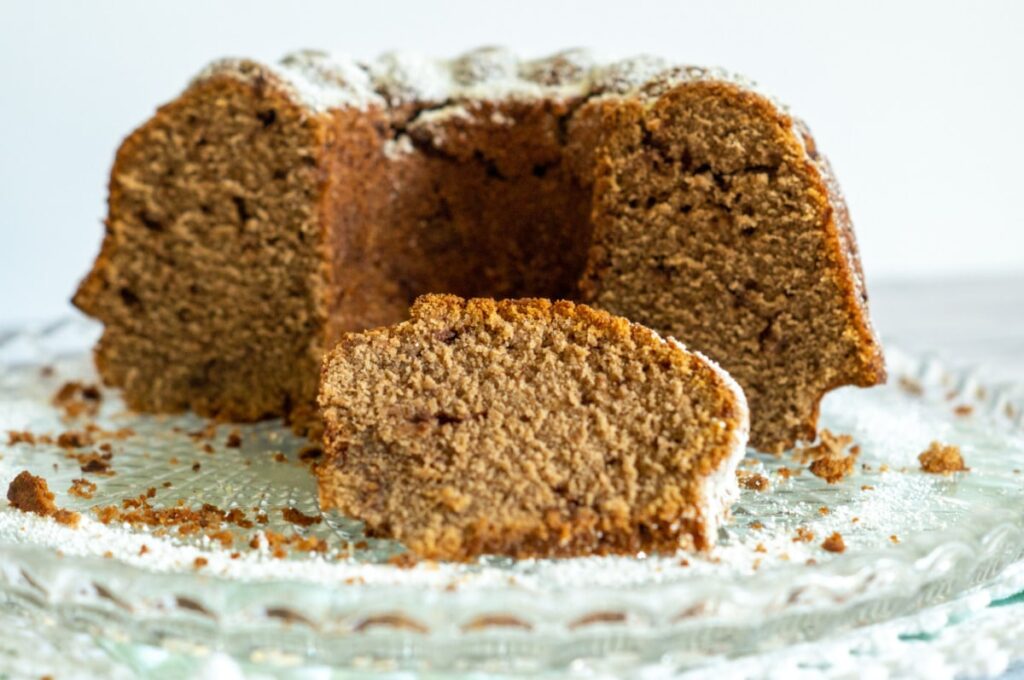
Red wine cake has one detail that almost nobody notices consciously: the wine brings acidity, and that acidity activates the baking powder. The result is a crumb that is moist and light at the same time, without needing yoghurt, buttermilk or sparkling water. The red wine does both jobs at once.
We have been baking this cake regularly for years, especially in autumn and on cool weekends when there is already an opened bottle of red wine in the kitchen. The leftovers from Sunday always fill a 26 cm tin exactly. Over time it has become a firm household recipe, and we are sharing it here exactly as we make it with the Thermomix®.
Red Wine Cake with the Thermomix®

Ingredients 0 / 9 ✓
- 100 g milk chocolate chilled
- 250 g sugar
- 1 sachet vanilla sugar
- 250 g butter at room temperature, plus extra for greasing
- 5 eggs
- 300 g plain flour (type 405)
- 1/2 sachet baking powder
- 1 tbsp unsweetened cocoa powder
- 160 g red wine
Instructions 0 / 6
-
1
Chop the chocolate.
Add the cold chocolate in pieces to the mixing bowl and chop for 6 sec / speed 8, then set aside.
-
2
Preheat the oven.
Preheat the oven to 180 °C top and bottom heat and grease a cake tin with butter.
-
3
Beat the batter ingredients until fluffy.
Add the sugar, vanilla sugar, butter and eggs to the mixing bowl and beat until fluffy for 3 min / speed 4.
-
4
Mix the batter.
Add the flour, baking powder, cocoa powder, red wine and chopped chocolate and mix for 20 sec / speed 4.
-
5
Bake the red wine cake.
Pour the batter into the cake tin and bake on the middle shelf of the oven for approx. 50 minutes. Check with a skewer.
-
6
Leave the cake to cool.
Leave the cake to cool slightly, then turn it out onto a cake plate.
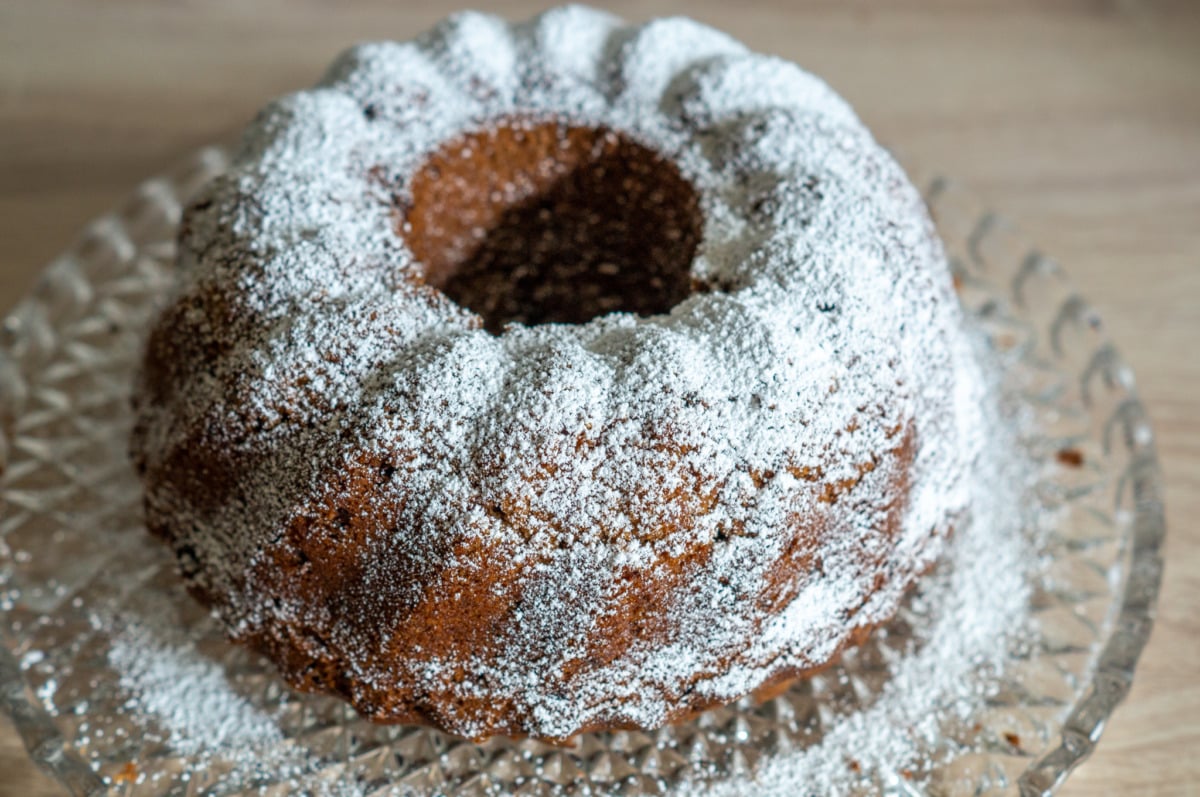
Tip: Once cooled, you can dust the cake with icing sugar or spread a red wine glaze over the top.
Video
Nutrition per serving
Why the acidity in the wine makes the difference
Baking powder consists of bicarbonate of soda and an acid carrier. For it to work properly, it needs moisture and a second source of acidity to neutralise the bicarbonate cleanly. In most sponge batters, eggs and milk only do half the job. Red wine has a pH of around 3.3 to 3.6, similar to buttermilk. As soon as the 160 g of red wine meets the half sachet of baking powder, the reaction starts immediately. That is exactly why we mix the batter in the Thermomix® for only a short time at speed 4 for 20 seconds, just long enough to bind everything without letting the raising agent fizzle out.
The second effect: alcohol evaporates during baking, but the aromas stay. What comes through in the finished cake are the tannins and the fruit notes, which is exactly what makes red wine and chocolate such a reliable combination. We use this pairing by adding 100 g of milk chocolate plus 1 tbsp of cocoa powder to the batter. The bitter compounds in the cocoa pick up the tannins from the wine, and the result tastes grown-up without being harsh.
Which red wine works best in the batter
The rule of thumb in our kitchen: if it is drinkable in the glass, it is good in the cake. Premium bottles are a waste of money, because the subtle aromas disappear during baking anyway. What we do avoid: harsh, cheap table wine and heavily sulphited varieties. Both leave a bitter edge that even the chocolate cannot mask.
Three styles have worked well for us. A young Dornfelder brings plenty of fruit and makes the cake more family-friendly, as the acidity is milder. A straightforward Merlot or Pinot Noir delivers the middle ground, not too dry, not too sweet. If you prefer something bolder, a Primitivo or Zinfandel lets the berry notes come through more clearly in the finished cake. Sweet dessert wines such as port do not work, they bring too much residual sugar and the batter becomes sticky.
Where things often go wrong when mixing
The most common mistake is cold butter. If the 250 g of butter comes straight from the fridge, the sugar, vanilla sugar, eggs and butter will not whip up properly in 3 minutes at speed 4. Lumps remain and the batter later turns out uneven. We take the butter out of the fridge at least two hours before baking, in summer one hour is enough. If you have forgotten, you can add the butter in pieces to the mixing bowl and warm it for 2 min / 37 °C / speed 2 before adding the sugar and eggs. That makes it creamy without melting it.
The second typical stumbling block is over-mixing once the flour is in the bowl. The flour, baking powder, cocoa powder, red wine and chopped chocolate all go in together and need only 20 seconds at speed 4. Anyone who keeps mixing longer because it does not look homogeneous enough is building gluten strands. That makes the cake chewy instead of light. Better to help with the spatula briefly and accept a few dark streaks, they disappear in the oven anyway.
Thirdly, it is easy for the cake to go too dark on the outside while still being moist inside. At 180 °C top and bottom heat on the middle shelf, we allow 50 minutes in a 26 cm tin. Fan heat dries out the edge too much, so we deliberately bake the classic way. Check with a skewer after 45 minutes and add another 5 minutes if needed. The first couple of times it is worth keeping an eye on it with the oven light, every oven has its own quirks.
Glaze, icing or just icing sugar
Plain, the cake is already pleasantly intense. If you are baking it for everyday coffee, a dusting of icing sugar made with the Thermomix® is all you need. For birthdays and celebrations we add a bit more depth.
Chocolate glaze: We take 150 g of milk chocolate or dark couverture, add it to the clean mixing bowl and melt it for 4 min / 50 °C / speed 2. Pour directly over the cake while it is still slightly warm after turning out, so the glaze soaks into the top layer. Instructions in the post Melting Chocolate in the Thermomix®.
Red wine icing: A variation with a double wine note. Stir 200 g of icing sugar and 3 tbsp of red wine in the mixing bowl for 30 sec / speed 3. The icing turns a pale rosé as it dries. Children can eat it too, as the alcohol content is minimal.
Classic water icing: If you are taking the cake to school or to elderly relatives, use our Thermomix® icing with water and lemon juice. The acidity of the lemon juice picks up the berry note in the cake beautifully.
How the cake behaves on day three
Red wine cake is one of the few sponge cakes that improves with each day. Straight from the oven it tastes slightly alcoholic, and some of our children still wrinkle their noses on the day it is cut. After 24 hours under a cake dome the flavour has settled, the cake tastes rounder and the chocolate comes through more clearly. On day three it is at its best.
Store at room temperature under a glass dome or cake cover, not in a sealed plastic container. Plastic traps moisture and the base becomes soggy. Stored this way, the cake keeps easily for four to five days. In the fridge it loses flavour and turns crumbly, so we avoid that.
Freezing works very well. Best to pre-freeze individual slices on a tray first, then transfer them to a freezer bag. That way you can take out single portions later. Thaw the evening before at room temperature and the crumb will be just as moist as freshly baked by morning. A glaze that has already been applied does not freeze as well, so when baking ahead we glaze only after thawing.
What to serve with the cake
For an afternoon coffee, a strong espresso or a dark filter coffee works well, the bitterness balances the chocolate. In the evening we often add a bowl of cream, loosely whipped with a little vanilla. If you want something more grown-up, serve a small glass of the same red wine that is in the batter, slightly warmed.
Also goes well with: Vanilla ice cream and coffee.
Our tip: Gingerbread basic recipe with the Thermomix®.
As a second cake on a birthday table it works beautifully alongside our cheesecake without a base. A pale, light cheesecake next to a dark, dense red wine cake, two completely different worlds on one plate, and both came out of the Thermomix® within the same hour.
What other recipes do differently
Most Thermomix® recipes for red wine cake that we have looked at use dark 70% chocolate in pieces and a 22 cm bundt tin, often on Cookidoo and similar sites. We deliberately use milk chocolate plus 1 tbsp of cocoa powder, because otherwise the tannins in the wine come through too sharply. For spicing, most others stick to plain cinnamon. We leave it out entirely so that the berry note of the wine stays in the lead. Instead of a simple dusting of icing sugar, we recommend the red wine icing with 3 tbsp of wine and the 24-hour resting time under the cake dome. Neither of those details appears in the top results we reviewed.