With potato gratin, the variety of potato matters more than the sauce. We use floury potatoes because they release starch as they bake and bind the sauce on their own. A creamy cream mixture over the top, Emmental on top, done.
We have been making this gratin for years as a Sunday side dish with braised meat and as a main course with a green salad. What puzzled us for a long time was this: some versions turned watery, others too dry, and others stayed raw in the middle. Until we understood that the potato, not the sauce, is the key. With floury varieties and slices cut to 2 mm, the gratin works even when the sauce comes cold from the mixing bowl.
Potato Gratin with the Thermomix®

Ingredients 0 / 9 ✓
- 150 g Emmental cheese
- 900 g floury potatoes
- 150 g herbed cream cheese
- 150 g double cream
- 1/2 tsp salt
- 1 tsp vegetable stock powder optional
- 1 tsp white pepper
- 1 pinch nutmeg
- 30 g butter
Instructions 0 / 6
-
1
Grate the cheese.
Cut Emmental into pieces, place in the mixing bowl, grate for 8 sec / speed 6 and set aside.
-
2
Peel the potatoes.
Peel the potatoes, slice or mandoline into thin rounds of about 2 mm and layer them in a baking dish.
-
3
Oven.
Preheat the oven to 170°C fan.
-
4
Mix the sauce.
Add the remaining ingredients except the butter to the mixing bowl and mix for 15 sec / speed 4.
-
5
Layer the gratin.
Spread the cream mixture over the potatoes, scatter the grated cheese on top and dot with small pieces of butter.
-
6
Bake.
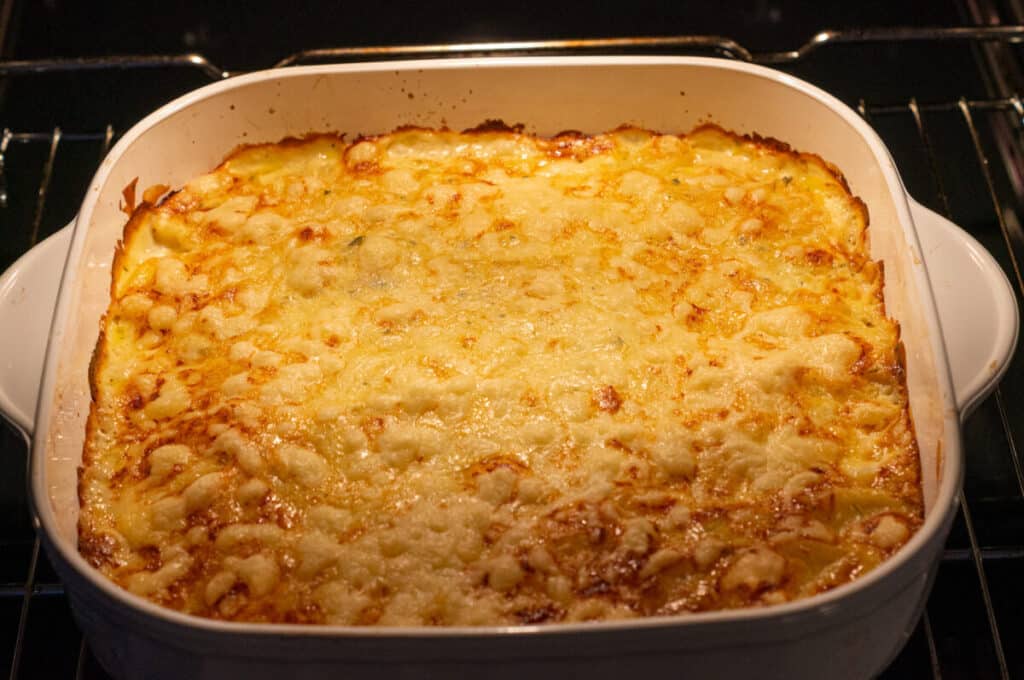
Bake the gratin on the middle shelf of the oven for 45 minutes. If the surface browns too quickly, cover loosely with foil.
Tip: The gratin goes beautifully with roasted or braised meat. You can also serve it with salad or vegetables as a vegetarian main course.
Nutrition per serving
Floury potatoes are the key ingredient, not the cream
Waxy potatoes keep their shape and hold onto their starch. In a salad that is exactly what you want; in a gratin it is the problem. Floury varieties such as Maris Piper, King Edward or Desiree release their starch into the sauce as they bake. It is this starch that binds the 150 g of double cream and the 150 g of herbed cream cheese into a creamy layer. With waxy potatoes the sauce stays liquid and pools at the bottom of the dish.
That is also why our sauce does not need to be heated beforehand. We simply mix herbed cream cheese, double cream, salt, vegetable stock powder, white pepper and nutmeg for 15 sec at speed 4 in the mixing bowl. The binding happens in the oven through the potato starch. If you use plain double cream without cream cheese, you need to work differently and warm the cream gently first, otherwise it will split at 170°C. With herbed cream cheese as a stabiliser, we skip that step entirely.
2 mm slice thickness is a requirement, not a suggestion
The slice thickness determines whether the gratin is cooked through after 45 minutes or whether the centre is still raw while the surface is already dark brown. At 2 mm the slices cook evenly and lie close together, so the sauce seeps into every gap. At 4 mm the gratin needs 60 to 70 minutes and the cheese on top turns bitter.
Getting 2 mm with a knife takes a lot of practice. We use a mandoline or a slicing attachment. The Thermomix® itself cannot cut the potatoes into clean rounds, so it is not needed for that step. It takes on two other jobs: grating the cheese and mixing the sauce. Both happen alongside the peeling and slicing, which is why the 15-minute prep time is realistic.
Grating the cheese yourself changes the crust
Ready-grated Emmental from a bag is treated with anti-caking agents to stop the pieces sticking together. These agents also prevent the cheese from melting properly in the oven. The crust turns drier, more crumbly and less golden brown. We grate the 150 g of Emmental in the mixing bowl for 8 sec at speed 6. It is faster than any grater and the cheese comes out the right size for a cohesive crust.
If you prefer a stronger flavour, mix in some mountain cheese or Gruyere with the Emmental. The proportion should not exceed 50 g, otherwise the nutty aroma overpowers the potato. With pure Emmental the gratin stays neutral enough to work alongside bold sauces such as a red wine jus or braised meat.
What goes wrong when the dish is too large
For 900 g of potatoes we need a baking dish with an internal measurement of roughly 24 by 18 cm. The slices should be stacked three to four layers deep, not spread out flat. A flat layer dries out because the sauce has too little volume to penetrate. Our standard ceramic baking dish works well; we once tried a dish that was too large and the gratin burned at the edges while the centre was underdone.
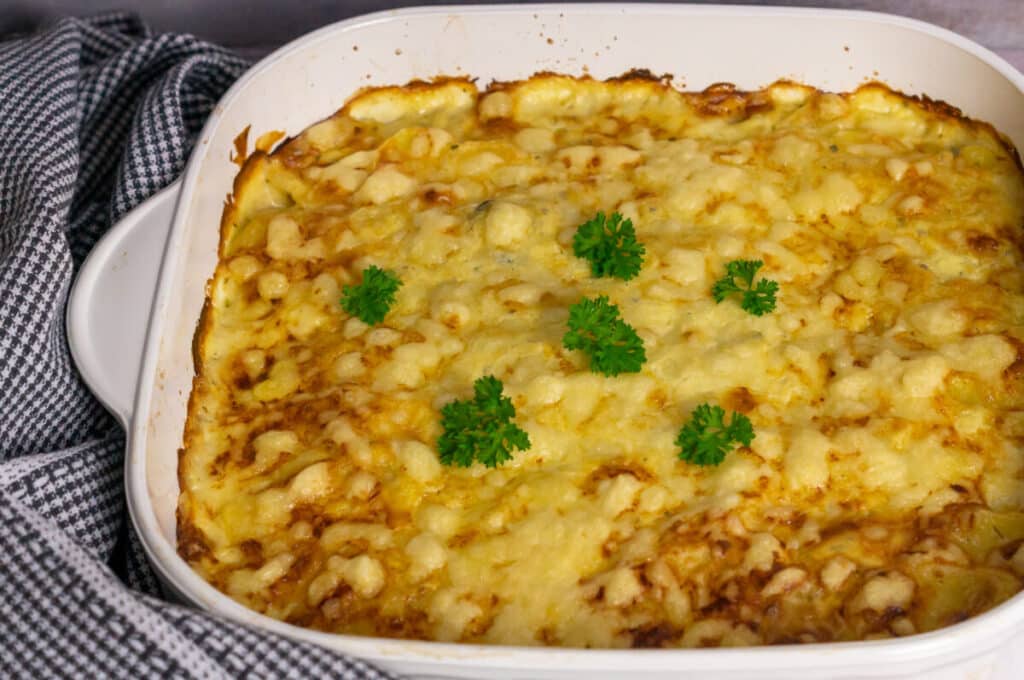
A second point is the amount of butter on top. Dot the 30 g of butter in small flakes over the cheese rather than melting it and pouring it over. The solid flakes melt slowly during baking and draw the cheese downwards without burning it. Melted butter runs off immediately and the cheese on top turns dry.
How we store and reheat the gratin
Covered in the fridge the gratin keeps for three days. To reheat, put it back in the oven at 160°C for 15 to 20 minutes, covered with foil so the cheese does not brown further. A microwave works too but makes the crust soggy. We do not recommend freezing. The potatoes release water when they thaw and the gratin turns watery.
If you want to make good use of leftovers, cut the cold gratin into cubes and fry them in a pan with a little butter. This creates a kind of crispy potato cake with a crunchy outer layer. It works better than reheating in one piece once the texture has softened after three days.
What we serve the gratin with
Classic pairings are roast beef, braised meat or leg of lamb. The creamy sauce holds up well against bold gravies without being overwhelmed. As a vegetarian main course the gratin works with a green salad or steamed vegetables. A green salad with a sharp dressing provides a good contrast to the rich cheese crust. It also pairs well with pan-fried fish such as salmon fillet or chicken breast, as long as the sauce is not too cream-heavy.
At celebrations the gratin is our go-to side dish because it spends 45 minutes in the oven on its own, leaving us free to focus on the sauce and the meat. It also prepares well in advance: the layered dish with sauce can wait in the fridge for an hour before going into the oven. We simply start the oven 15 minutes earlier so the cold dish has time to cook through.
How other recipes approach this differently
Many recipes call for waxy potatoes so the slices hold their shape. We deliberately use floury varieties because their starch binds the sauce and keeps the gratin moist. Others slice thinly to 2 to 3 millimetres, which works well for us too. Instead of pure double cream, many recipes mix milk and soured cream; some also pre-cook the slices for 8 minutes at 100°C in the mixing bowl to shorten the baking time. Cheese choices range from Gouda to Gruyere or mountain cheese for extra flavour. Some recipes bake at 200°C for 45 minutes and rub garlic directly into the cream so the flavour infuses.
More creamy side dishes from the Thermomix®:
More side dish recipes | More gratin recipes | Sauces for braised dishes