A good beef goulash is not just about the meat. It relies on three acids to break down the connective tissue: tomato puree, red wine and the acidity from tinned chopped tomatoes. We combine all three in the mixing bowl and have a fork-tender goulash ready in about 90 minutes.
We make this goulash whenever we have a bit of time but do not want to stand over the hob for hours. The Thermomix® handles all the braising on its own. We have made this recipe so many times that we know exactly where things can go wrong and where the mixing bowl outperforms a traditional casserole.
Beef Goulash with the Thermomix®
Ingredients 0 / 15 ✓
- 1 garlic clove
- 2 onions
- 2 stalks celery
- 2 tbsp tomato puree
- 20 g sunflower oil
- 600 g beef goulash (diced braising beef)
- 150 g red wine
- 400 g tinned chopped tomatoes
- 1 tsp salt
- 2 tsp vegetable stock powder
- 1 tsp chilli flakes
- 1 tbsp sweet paprika powder
- 500 g tagliatelle
- 1 red pepper
- 1 tbsp plain flour (type 405 or equivalent)
Instructions 0 / 7
-
1
Chop the vegetables.
Peel the garlic and onions, halve them and place in the mixing bowl. Wash the celery, cut into pieces, add and chop for 4 sec / speed 5, then scrape down with the spatula.
-
2
Sweat.
Add the tomato puree and sunflower oil and sweat for 3 min / Varoma / speed 1.
-
3
Add the beef.
Add the beef and heat for 5 min / 120°C / reverse direction / speed 1.
-
4
Build the sauce.
Add the red wine, tomatoes, salt, vegetable stock powder, chilli flakes and paprika powder and cook for 45 min / 98°C / reverse direction / speed 1.
-
5
Cook the pasta.
Meanwhile, cook the tagliatelle in plenty of salted water according to the packet instructions and keep warm. Wash the pepper, halve it, remove the seeds and stalk, and cut into strips.
-
6
Finish the goulash.
Stir the flour smooth in a cup with a little water, add to the mixing bowl together with the pepper strips and cook for a further 10 min / 98°C / reverse direction / speed 1.
-
7
Serve.
Serve the goulash on the tagliatelle.
Tip: If children are eating, or you prefer a milder dish, leave out the chilli flakes. A splash of double cream on top works well too.
Video
Nutrition per serving
Why the onions and paprika powder need to be sweated first
The two onions and garlic clove are chopped at speed 5, then sweated with the tomato puree and 20 g sunflower oil for 3 min / Varoma / speed 1. This is the step we underestimated at first. If the onions go into the sauce raw, the finished goulash tastes flat and sharp rather than rounded. Sweating caramelises some of the natural sugars in the onions, takes the metallic edge off the tomato puree and opens up the aromatic oils in the garlic.
We add the sweet paprika powder later, together with the wine and tomatoes. Paprika burns easily, turning bitter above about 130°C. If you add it directly to the hot oil, you end up with a slightly scorched aftertaste that even an hour of braising cannot remove. In the Thermomix® at 120°C the margin is narrow anyway. So only the tomato puree goes into the hot frying phase, as it can handle the heat.
Reverse direction is not optional for goulash
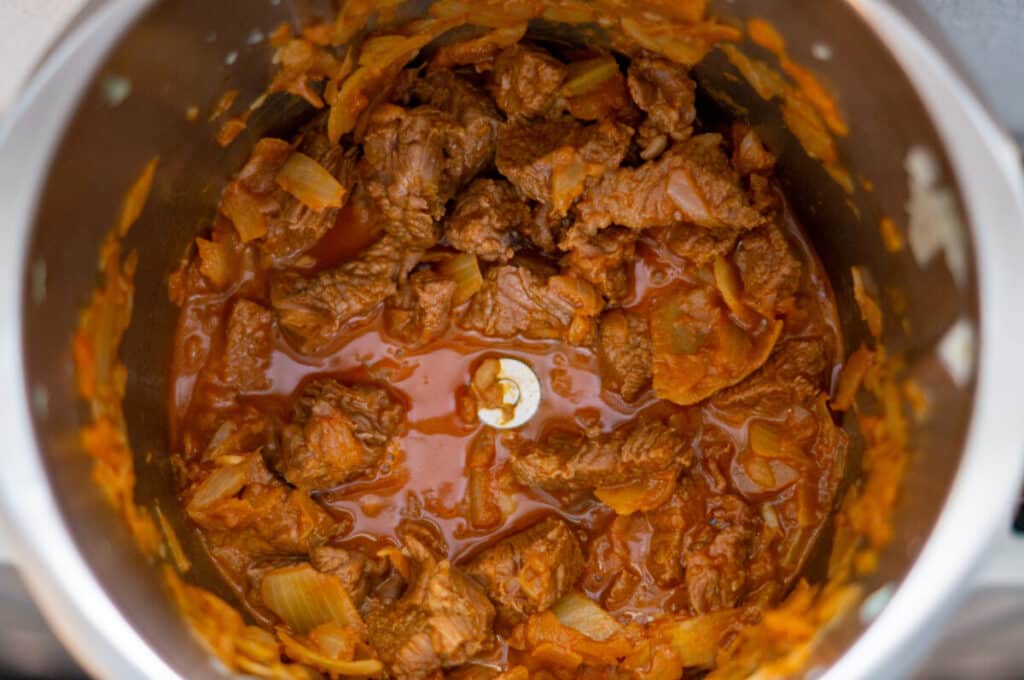
Once the 600 g of diced beef goes into the mixing bowl, everything runs in reverse direction. At 5 min / 120°C / reverse direction / speed 1 the cubes are seared, then at 45 min / 98°C / reverse direction / speed 1 they braise in the sauce. Reverse direction exists precisely for this purpose. The blades stir with the blunt side instead of cutting through the meat. If you accidentally select normal direction, you will have Bolognese with sinew after 45 minutes, not goulash.
For the 600 g we prefer beef shoulder or shin. These are cuts with plenty of connective tissue that do not suit short cooking times, but become genuinely tender over 90 minutes just below simmering point. Fillet or rump would be wasted here. They do not need the acid or the time, and in a goulash they tend to turn dry rather than tender.
What the 150 g of red wine and the acid content do to the connective tissue
In the second braising phase, 150 g red wine, 400 g tinned chopped tomatoes, 1 tsp salt, 2 tsp vegetable stock powder, 1 tsp chilli flakes and 1 tbsp sweet paprika powder go into the mixing bowl. This is the key flavour phase, but also the actual cooking process. The acid from the wine and tomatoes loosens the collagen in the connective tissue. With a plain water-based goulash without any acid, you would need to braise considerably longer to reach the same result. With this combination of acids, 45 minutes at 98°C is enough.
We deliberately stay at 98°C rather than 100°C, even though the difference sounds minimal. Just below boiling point the meat cooks more gently and the proteins do not contract as tightly. Anyone who has braised at a rolling boil knows the result: fibrous on the outside, dry in the middle. The Thermomix® temperature setting is a real advantage here, because it stays constant and does not fluctuate the way a hob does.
The pepper strips only go in at the end
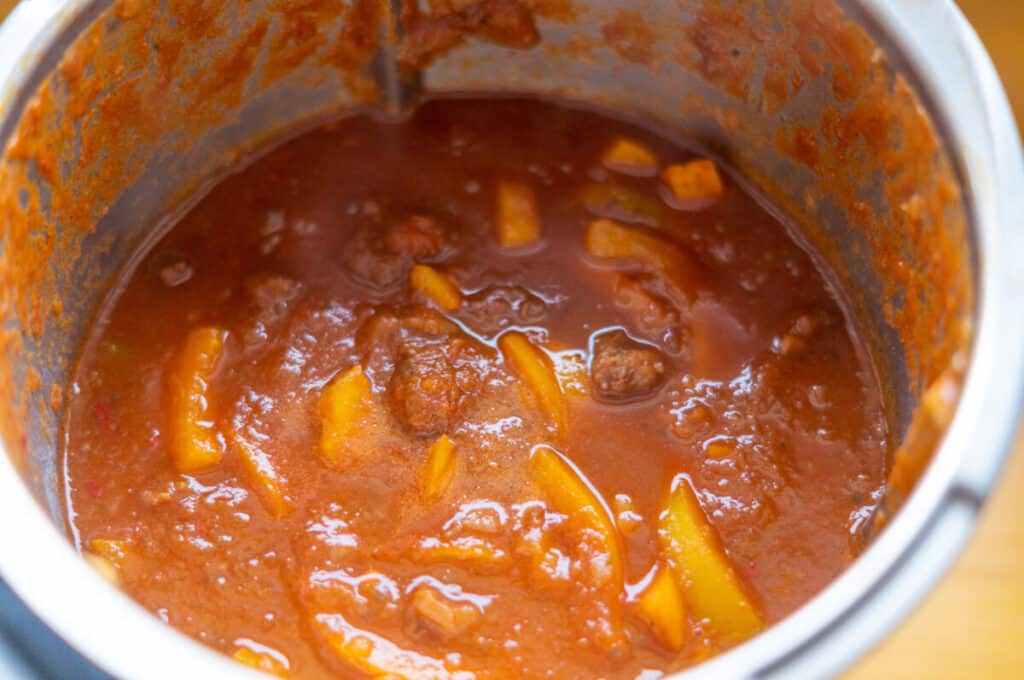
The red pepper does not go in with the braise. We wash it, halve it, remove the seeds and stalk and cut it into strips while the meat is cooking. Only in the final cooking phase do the strips go into the mixing bowl together with the tablespoon of plain flour stirred smooth in water, for 10 min / 98°C / reverse direction / speed 1.
The reason is simple: if the pepper strips braised for the full 45 minutes, they would turn mushy and lose their colour. With just 10 minutes they keep a little bite and the fresh pepper flavour comes through instead of disappearing into the sauce. The flour thickens the sauce at the same time, without needing any cornflour or starch. The key is to stir the flour completely smooth in a cup of cold water first, otherwise lumps form in the sauce.
If the goulash tastes too sharp or the sauce stays too thin
If the sauce tastes too sharp after braising, the wine is almost always the cause. Some red wines, especially younger Pinot Noir or robust Tempranillo, bring more tannins than the goulash can handle. We add a pinch of sugar or a teaspoon of tomato ketchup to balance the acidity without making the sauce taste sweet. Double cream also helps, but it is not part of the original recipe and makes the dish richer.
If the sauce is still too thin after the 10-minute flour stage, adding more flour at that point will not help. Instead, we leave the mixing bowl lid off and reduce the goulash for another 5 to 8 minutes at Varoma / reverse direction / speed 1. The liquid evaporates, the sauce concentrates and the meat does not overcook. With classic stovetop braising the meat would dry out in this phase, but in reverse direction that is not a problem.
Tagliatelle, dumplings or potatoes on the side
The recipe uses 500 g tagliatelle because that is the quickest side dish. While the 45-minute braising time runs, cook the pasta according to the packet instructions in salted water, cut the pepper and set the table. We also enjoy Bread Dumplings made in the Thermomix® alongside it, especially in winter. They soak up the sauce beautifully. With a Thermomix® Friend we make boiled potatoes in the Friend at the same time, or we use the Varoma for jacket potatoes in the Varoma while the goulash finishes in the mixing bowl.
Reheating and freezing
Goulash tastes better the next day. The sauce thickens further, the flavours deepen into the meat and the paprika powder tastes rounder. Stored in a sealed container in the fridge, the goulash keeps well for 3 days. When reheating, add a splash of water or stock because the sauce continues to thicken overnight. Frozen without the pasta, goulash keeps for 3 months. We never freeze the tagliatelle with it, because it turns mushy when defrosted. We cook fresh pasta once the goulash is warm again.
If you prefer to make this recipe with pork, replace the 600 g beef with diced pork shoulder and reduce the braising time to 30 minutes plus the 10 minutes with the pepper. Pork has less connective tissue and will dry out with longer cooking. Topped with double cream, the result is closer to a Szegediner-style dish, but it is no longer the classic Hungarian recipe.
How other recipes approach Thermomix® goulash
We looked at the most popular Thermomix® goulash recipes around. Some use 700 g beef with just 2 onions and 50 minutes at 100°C in reverse direction at speed 1. Others go for 4 onions with 750 g mixed meat and a 60-minute cooking time, but leave out both the red wine and the paprika breakdown. The Cookidoo classic skips red wine altogether. We go a step further: beef shin or shoulder for 90 minutes, sweet and smoked paprika for depth, red wine and tomato puree sauteed together. Side dishes like Spaetzle, boiled potatoes or bread dumplings all work well depending on the region and appetite.
Goes well with: tagliatelle, mashed potatoes and bread dumplings.
If you enjoyed braising in the Thermomix®, try our Chili con Carne with the Thermomix® as well. For something sweet afterwards, the Advocaat with the Thermomix® is a great match, and on pasta days the Pizza Dough with the Thermomix® is worth making for the next family evening.