French bread baked in a casserole dish turns out crispy on its own. The casserole dish is a closed system. Steam cannot escape, the crust stays moist and remains elastic long enough to open up properly as the bread rises in the oven. In an open oven the surface dries out too quickly, the crust does not split cleanly and the bread stays dense.
We have been baking this bread for years because it works without a pre-ferment and still produces an open crumb. The Thermomix® kneads the dough thoroughly in 3 minutes on kneading mode. By hand that takes 10 minutes and requires real effort.
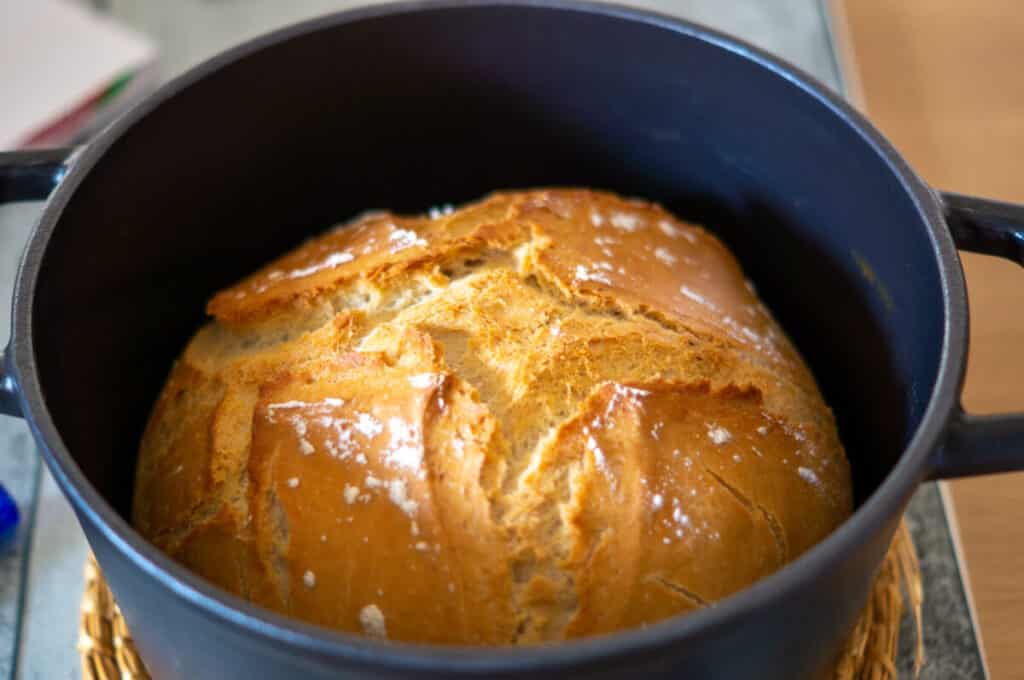
French Bread "Pain en Cocotte Facile" in a Casserole Dish, Thermomix®
Ingredients 0 / 5 ✓
- 400 g water
- 1 cube yeast fresh
- 2 tsp salt
- 500 g flour, Type 550
- 150 g spelt flour, Type 1050
Instructions 0 / 5
-
1
Dissolve the yeast.
Add water, yeast and salt to the mixing bowl and warm for 3 minutes / 37°C / speed 1.
-
2
Knead the dough.
Add the flour and knead for 3 minutes / kneading mode. Transfer the dough to a bowl, cover and leave to rise in a warm place for 1 hour.
-
3
Shape the dough.
Turn the dough out onto a floured work surface, stretch it out, then fold it and stretch it out again. Repeat the folding 10 times until you can shape it into a neat loaf.
-
4
Prepare for baking.
Place the loaf in a floured casserole dish, score the top, brush lightly with a little water and dust with a little flour.
-
5
Bake.
Close the casserole dish, place it on the lowest rack of the cold oven and heat the oven to 240°C top and bottom heat. Bake the bread for approximately 1 hour.
Tip: You can add extra ingredients to the bread as you like. Add them in step 2. Chopped garlic, black olives, sun-dried tomatoes or chopped walnuts all work well.
Nutrition per serving
Why flour Type 550 plus spelt flour 1050
Type 550 is a light wheat flour with a medium gluten content. It forms a stable gluten network that supports the dough as it rises. Spelt flour Type 1050 adds flavour and roasted notes during baking. Pure 550 flour produces a flat loaf, pure spelt flour becomes too dense.
The ratio of 500 g to 150 g is the compromise. More spelt makes the dough heavier, less takes away the character of the bread. You can also use 650 g of Type 550 flour on its own, which gives a classic French white bread with no wholegrain content.
Dissolve the yeast at 37°C, no hotter
Yeast activates best at 37°C. Higher temperatures weaken the yeast culture or kill it. The Thermomix® holds the temperature constant at speed 1, the water circulates gently and the yeast dissolves evenly.
The salt goes in at step 1 already, even though many bread recipes recommend adding the salt after the yeast. With a proving time of only 1 hour and direct kneading this makes no difference. The amount of yeast is high enough.
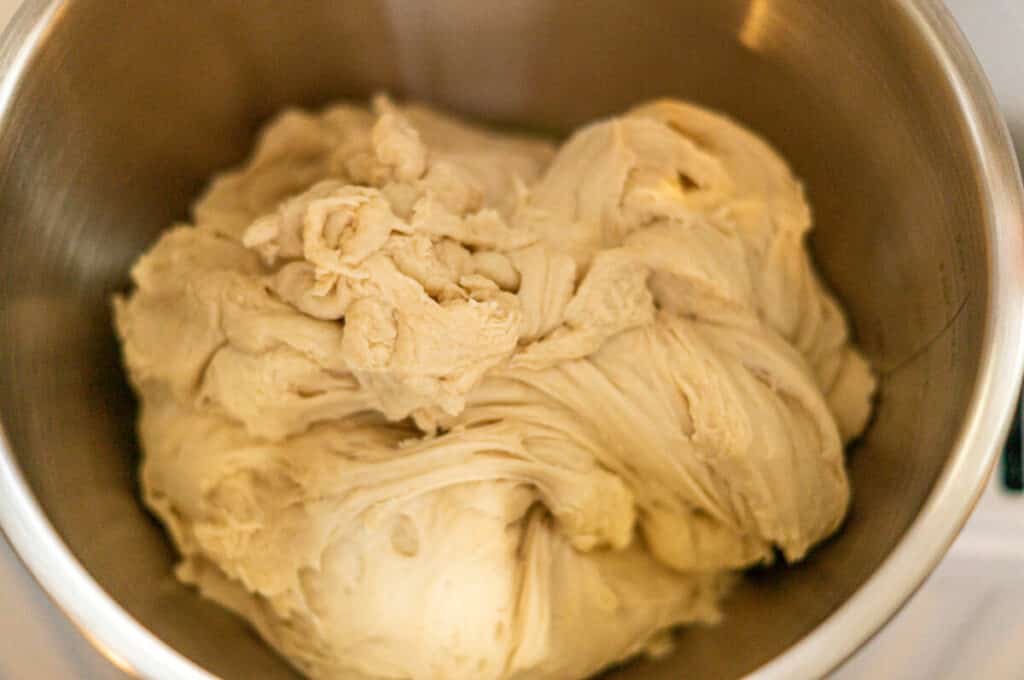
Kneading mode for 3 minutes without a break
Bread dough needs intensive kneading so the gluten can develop. The kneading mode of the Thermomix® works slowly with high force. 3 minutes is enough to form a stable gluten network. The dough becomes smooth and elastic and no longer sticks to your fingers.
If you knead by hand you need at least 10 minutes. The dough must be able to come away from the board without tearing. That is the test for a properly developed gluten network.
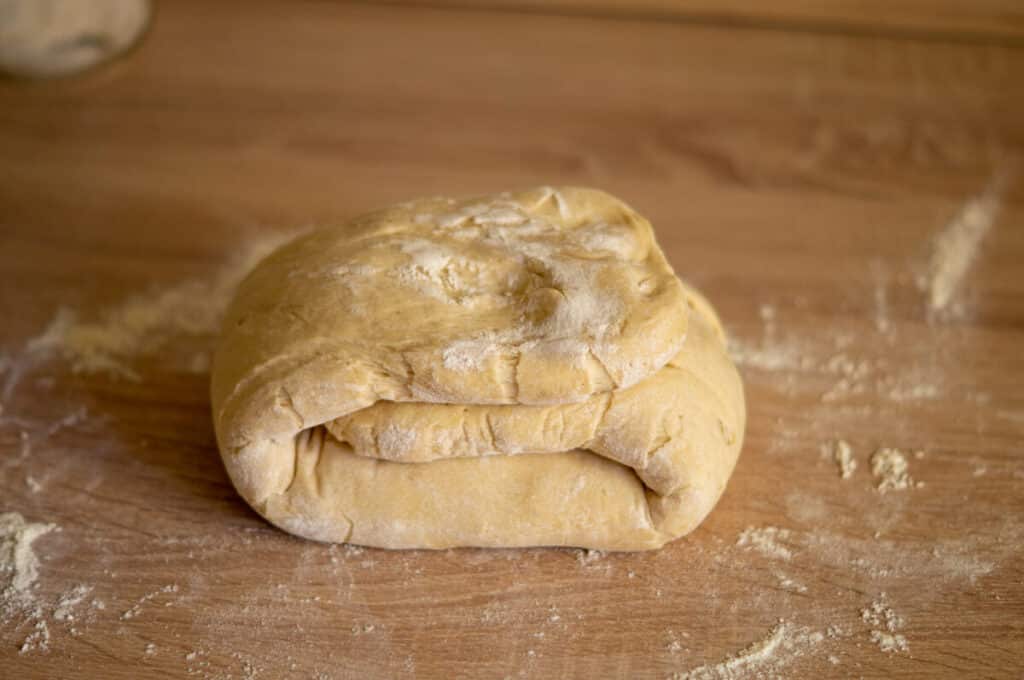
10 folds shape the surface
After proving the dough is soft and sticky. Folding creates surface tension. You stretch the dough out, fold it to the centre, turn it 90 degrees and repeat. After 10 repetitions the dough has a smooth, taut surface.
This tension ensures the bread rises upward in the oven rather than spreading outward. Without folding the dough spreads flat in the casserole dish.
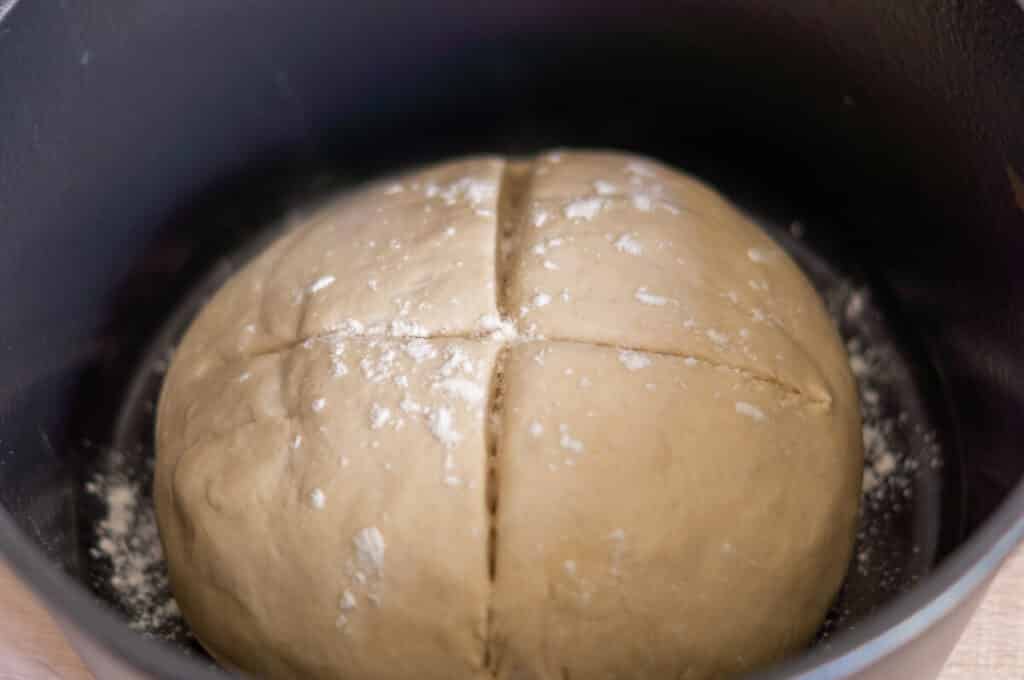
Scoring guides the split
The cut in the dough is not decoration. It gives the steam inside a defined weak point. Without a cut the crust splits at uncontrolled spots, usually on the side rather than the top. With a cut the bread opens cleanly and the crumb can develop evenly.
You need a sharp knife or a razor blade. The cut must be about 1 cm deep and drawn in one swift movement. Slow sawing sticks the dough back together.
A cold oven is essential
The bread goes into the cold oven with the casserole dish closed. As the oven heats up the dough rises one final time. This last proving phase inside the casserole dish gives the bread its volume.
If you preheat the oven and place the bread in a hot oven the crust forms too quickly. The dough can no longer rise and the bread stays flat and dense.
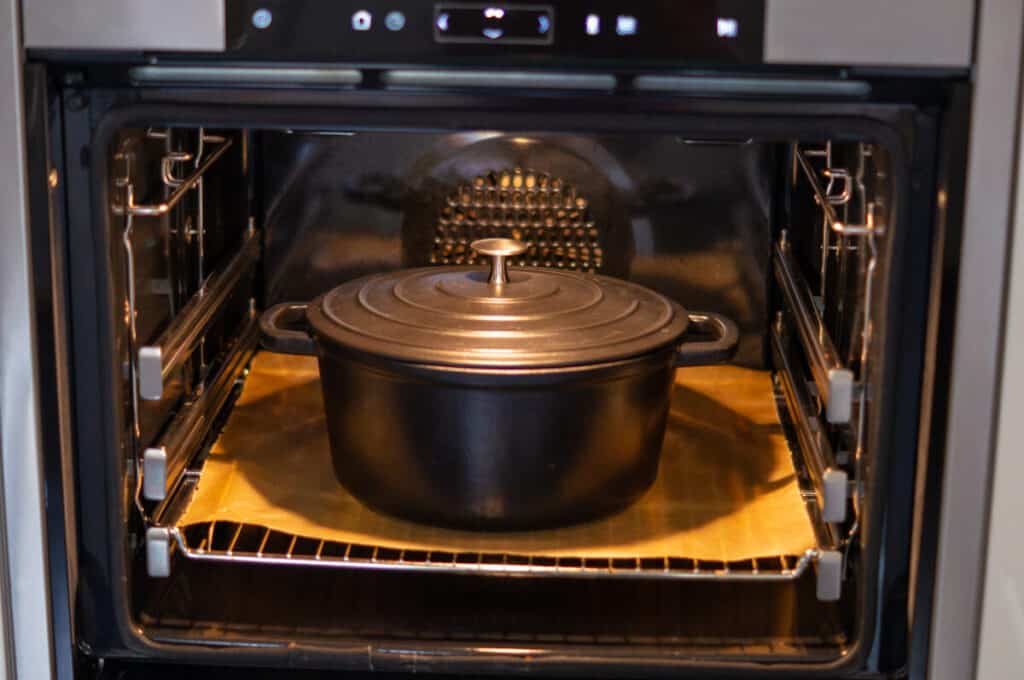
1 hour baking time at 240°C
240°C top and bottom heat is needed for the crust to turn dark and crispy. The casserole dish stores the heat and distributes it evenly. The bread bakes from all sides at once.
After 1 hour the bread is done. You can tell by the hollow sound when you tap the bottom. If it sounds dull it needs another 5 to 10 minutes.
Add-ins go in at step 2 only
If you want to add olives, sun-dried tomatoes, garlic or walnuts, add them together with the flour in step 2, after dissolving the yeast. The kneading mode will distribute them evenly through the dough.
Cut olives into smaller pieces first, otherwise large chunks stay in the dough and the bread tears when sliced. Sun-dried tomatoes must be dry, not packed in oil. Oil makes the dough too soft.
Leave the bread to cool before slicing
The bread needs to cool on a rack for at least 30 minutes after baking. The crumb sets during this time. If you cut too early you crush the inside and the bread turns gummy.
The bread keeps for 3 to 4 days in a bread box or wrapped in a linen cloth. The fridge dries it out. Freezing works well. Sliced, you can toast individual slices straight from frozen.
How other approaches differ
Goes well with: butter and cheese.
Many classic French recipes use a much higher hydration of 65 to 75 percent and a long overnight prove in the fridge. We deliberately stay with a firmer dough because it is fully worked through by the Thermomix® in three minutes on kneading mode and home bakers do not need a proofing container. Classic pain-en-cocotte recipes often start at 230°C, 30 minutes with the lid on for the steam effect, then remove the lid for a final browning phase. Our cold-oven method produces the same steam without having to lift a hot casserole dish out of the oven mid-bake. For more flavour, replace 50 g of flour with wholemeal or add seeds.