We have been making cream cheese in the Thermomix® ourselves for years, because shop-bought versions are often too firm or too watery. The texture comes down to one single number: 70°C at speed 3 for 8 minutes. Below that the dairy products separate; above it the mixture turns grainy.
The advantage over shop-bought cream cheese: you control the fat content and the saltiness yourself. We use 40% quark and butter with 82% fat. This gives a smooth, spreadable mass that holds together without tearing.
Quick Homemade Cream Cheese in the Thermomix®

Ingredients 0 / 4 ✓
- 140 g butter
- 250 g quark (40% fat)
- 160 g soured cream
- 1/2 tsp salt
Instructions 0 / 3
-
1
Cut the butter..
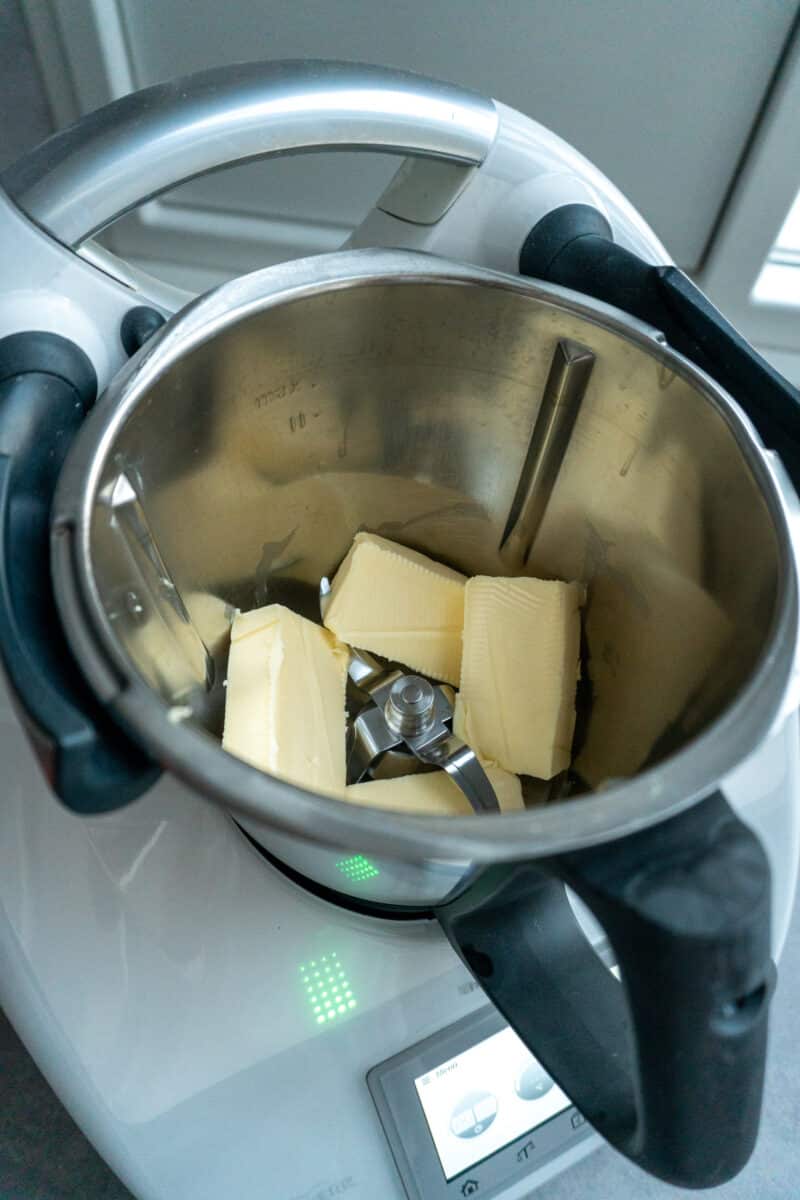
Cut the butter into pieces and place in the mixing bowl.
-
2
Heat the ingredients.
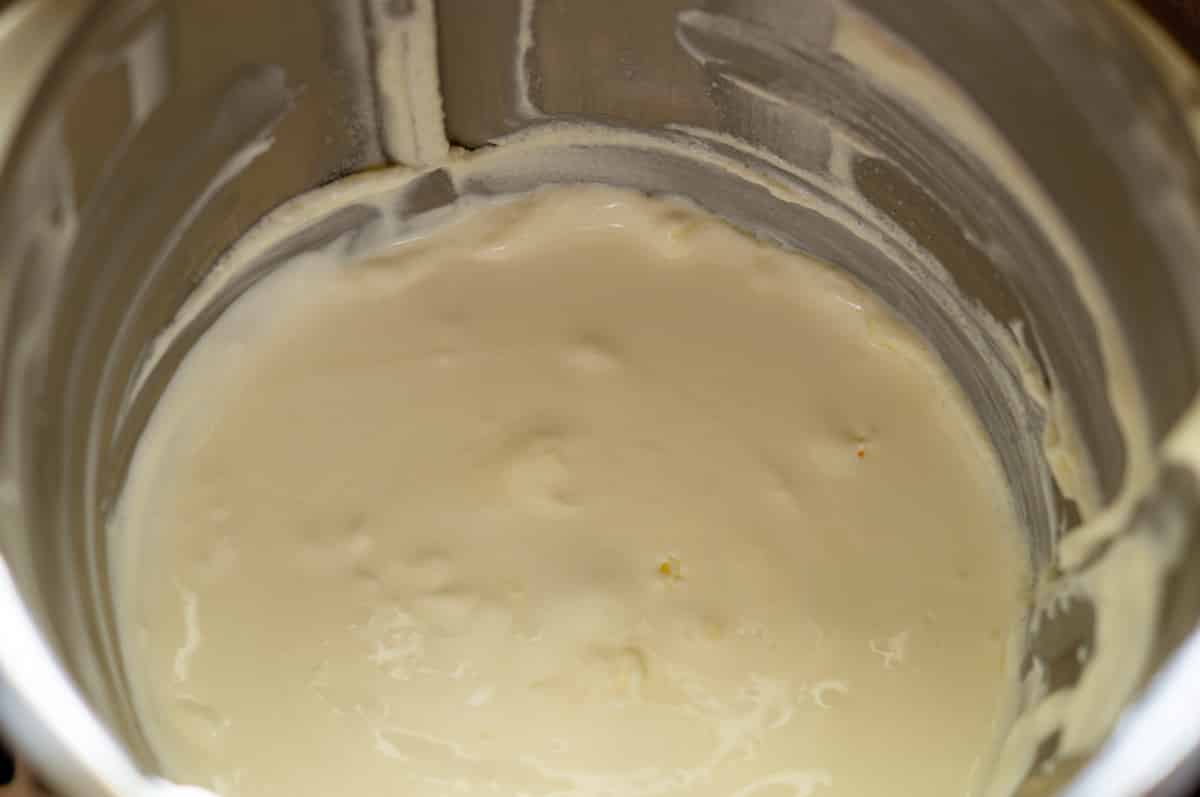
Add the remaining ingredients and heat for 8 minutes / 70°C / speed 3.
-
3
Fill the jars and chill.
Fill into jars, seal tightly, leave to cool, and refrigerate overnight.
Note: If you work cleanly and fill your cream cheese into sterilised jars, it will keep in the fridge for several days.
Video
Nutrition per serving
Why three dairy products instead of just quark
Quark alone turns crumbly when heated. The butter provides the fat that coats the proteins. The soured cream, with its 24% fat, sits between quark and butter and binds both together. Without soured cream, the quark and butter separate again as they cool. The ratio of 250 g quark to 140 g butter to 160 g soured cream is no accident: more butter makes the mixture too fatty, less causes it to crumble.
The 70°C threshold explained
At 70°C the butter and soured cream melt completely without denaturing the milk proteins in the quark. Between 70 and 75°C you have a safe window. At 80°C or above the quark curdles, the mixture turns grainy and cannot be smoothed out again. The 8 minutes at speed 3 keep the temperature steady so no hot spots develop at the base of the bowl. Reverse direction is not needed here because there are no delicate pieces to protect.
Salt before or after heating
We add the salt directly to the cold ingredients. It dissolves evenly during heating. If you stir it in after cooling, the distribution stays uneven. Half a teaspoon for 550 g of cream cheese tastes subtle, not salty. If you are using the cream cheese for savoury spreads, you can increase to 1 tsp. For sweet versions, leave out the salt and stir in honey or maple syrup once cooled.
Why chilling overnight is essential
The cream cheese is liquid straight after heating. It is only as it cools that the fat solidifies again and binds the mixture. After 2 hours in the fridge the texture is still too soft to spread. After 8 to 10 hours the cream cheese reaches the right firmness. If you spread it on bread straight after cooling it will run. The jars must be sterilised before filling, otherwise the cream cheese keeps for only 3 to 4 days instead of a week.
Adding herbs and spices
Add fresh herbs such as chives or parsley only after the mixture has cooled. During heating they lose colour and flavour. Dried spices such as paprika or garlic powder can go in with the cold ingredients. They infuse during heating and distribute more evenly. Use pepper and chilli sparingly as their heat intensifies overnight in the fridge.
Shelf life and clean working
With sterilised jars the cream cheese keeps in the fridge for 7 to 10 days. Without sterilisation only 3 to 4 days. Rinse the spatula and mixing bowl with hot water beforehand. If you add herbs, the shelf life drops to 5 days because fresh herbs spoil faster than a plain dairy mixture. Freezing does not work: the fat and water separate on thawing.
What other recipes do differently
Goes well with: Baguette and crudites.
Most Thermomix® cream cheese recipes use whole milk and lemon juice or apple cider vinegar. The milk is acidified, it curdles, and the curds drain through a cheesecloth or fine strainer. Including draining time this takes a good hour and produces a grainier, slightly tangy cream cheese. The leftover whey goes into bread dough, pancakes, or smoothies. We take a different approach: quark, soured cream, and butter combine at 70°C in 8 minutes into a spreadable mixture, no cloth and no whey. For the herb version with chives, parsley, and garlic both methods work, and both keep for around 5 days in the fridge.
More basic recipes like our hearty seed loaf, sterilising jars in the Thermomix®, and other spreads can be found in the baking category.