When steaming in the Varoma®, the 12-minute threshold is what determines whether chlorophyll stays intact: up to 12 minutes, green vegetables remain a vibrant green; beyond that, the shift towards olive grey begins. The reason is chemical: natural acids from the vegetables displace the magnesium ion in the chlorophyll molecule. The Varoma® has a structural advantage over a closed saucepan: the steam slots in the lid and base continuously carry these acids away.
We steam green vegetables almost exclusively in the Varoma®, because it preserves colour, vitamins and bite far better than boiling in water. Steamed vegetables retain up to 50% more nutrients than boiled ones (upkitchen.de, July 2025). The difference is even more pronounced for vitamin C: studies from the universities of Giessen and Koblenz-Landau show roughly twice the amount compared to simmering in a pot (mykitchens.de).
Green Vegetables in the Thermomix® Varoma®
Ingredients 0 / 2 ✓
- 500 g green vegetables
- 500 g vegetable stock
Instructions 0 / 3
-
1
Prepare the vegetables.
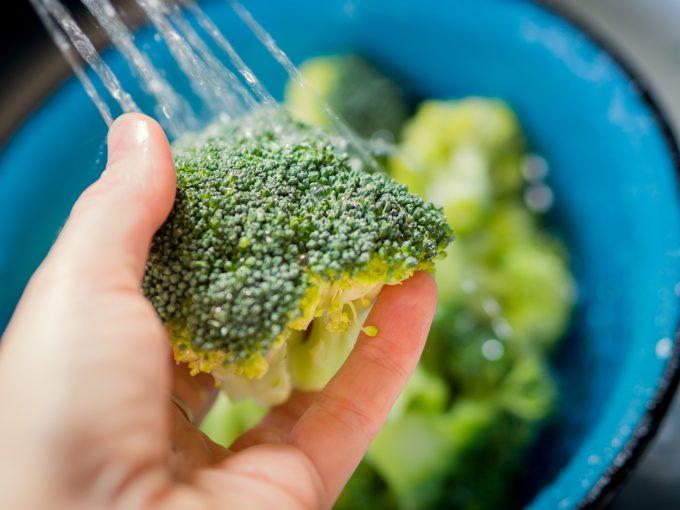
Wash and trim the vegetables, then distribute them between the Varoma® tray and the Varoma® steaming basket insert.
-
2
Cook the vegetables.
Pour the vegetable stock into the mixing bowl, place the Varoma® on top and cook for 18 min / Varoma / speed 1.
-
3
Serve or use further.
Use the vegetables as desired or serve immediately.
Video
Nutrition per serving
Why green vegetables stay green in the Varoma®
Chlorophyll, the green pigment, has a central magnesium ion in its molecular structure. Under heat, this structure starts to break down from as low as 40 to 50°C, and by 70°C the denaturation is complete (lebenskraftpur.de, March 2026). The vegetables turn olive grey because natural acids from cell walls and cell fluid displace the magnesium and replace it with hydrogen ions. The result is pheophytin, an olive green to brown pigment.
When steaming, the temperature is around 100°C (ichlebegruen.de, February 2026), well above the critical threshold. But the Varoma® has a key advantage: the steam slots in the lid and base continuously carry water vapour and volatile acids away. In a closed saucepan, those acids stay in the condensation water, run back into the vegetables and accelerate chlorophyll breakdown. We do not open the Varoma® during cooking, yet the vegetables stay green because the design of the steam vents removes the acids automatically.
The window between green and olive grey is short: up to 12 minutes of cooking time the colour stays vivid; from 15 minutes onwards the transition begins. This is clearly visible with broccoli, green beans and peas. With longer cooking times, such as 18 minutes for thick pieces of beans or whole broccoli heads, some colour loss is unavoidable, but the vitamins are still much better preserved than when boiled.
The right cooking time for green vegetables
Every green vegetable has an optimal cooking time in the Varoma®. We follow these guidelines (dampfgarer.cc, 2026; zaubertopf-club.de, March 2025):
- Broccoli florets: 12 to 15 minutes
- Green beans (halved): 15 to 18 minutes
- Peas / mangetout: 10 to 12 minutes
- Green asparagus (medium stalks): 10 to 15 minutes
- Kale / spinach (blanched): 5 to 7 minutes
The times above are for tender-crisp vegetables. If you prefer them softer, add 2 to 3 minutes. Our rule of thumb: once the minimum time is up, pierce a piece with a fork. If it gives slightly, the vegetables are done. If it still feels firm, give it another 2 minutes.
Keep the steam slots clear: how to get the steam circulating properly
Spread green vegetables loosely in the Varoma®, not stacked. The steam slots in the base and sides must be at least 70% unobstructed, otherwise the steam cannot circulate. With too much vegetable piled on one level, the bottom layer stays hard while the top is already soft. We have experienced this several times with large quantities of broccoli: the florets were so tightly packed that cooking time was 30 to 50% longer.
The Varoma® steaming basket insert is there so you can use two levels at the same time. Vegetables with a shorter cooking time go on the insert; vegetables with a longer cooking time go directly into the Varoma® tray. For example: broccoli florets (12 minutes) on the insert, green beans (18 minutes) in the tray. That way you can lift out the insert after 12 minutes while the beans carry on cooking.
If you are combining different vegetables with very different cooking times, stagger them: carrots into the Varoma® first, broccoli added after 5 minutes, mushrooms after a further 7 minutes. This technique does not appear in any official Vorwerk recipe, but it works reliably for mixed vegetables.
Vegetable stock in the mixing bowl instead of plain water
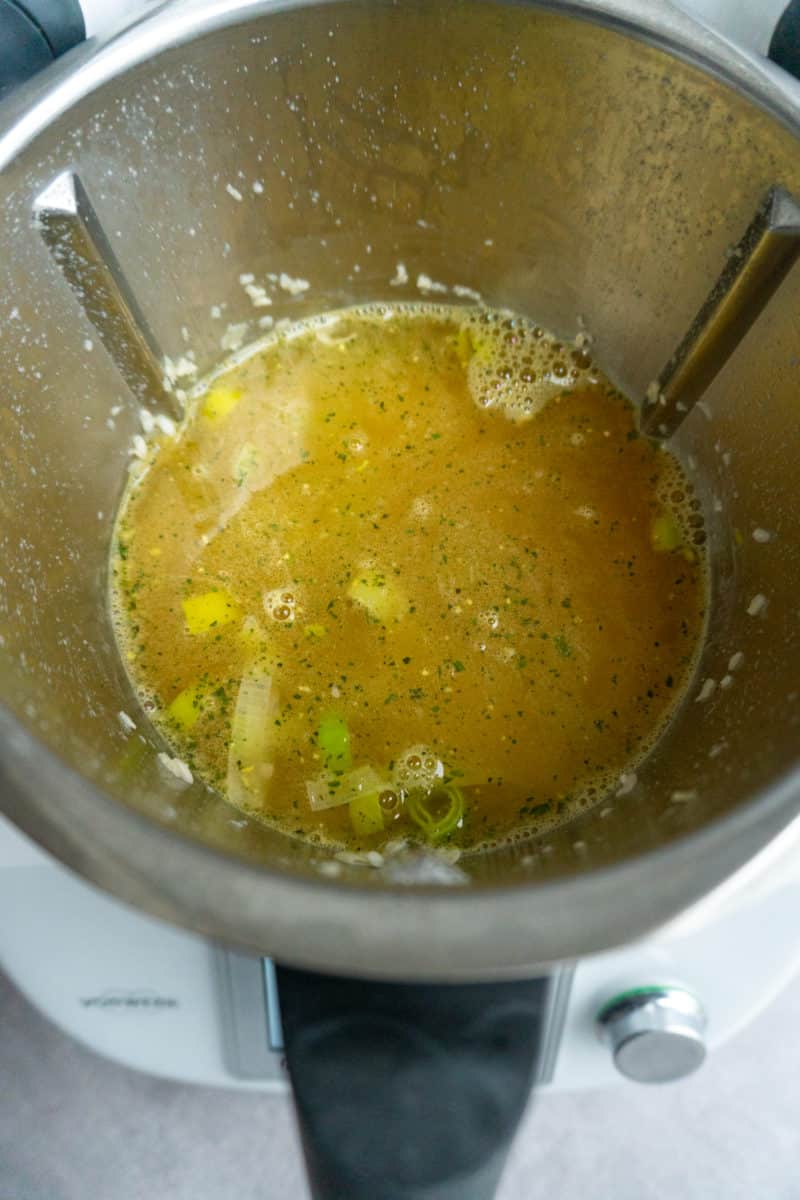
We put 500 g of vegetable stock rather than water into the mixing bowl. The steam carries aromas from the stock into the vegetables. This makes a noticeable difference with neutral vegetables such as white cabbage, kale or peppers. With broccoli and beans the effect is more subtle, but still detectable.
You can use ready-made vegetable stock or add 500 g of water with 1 to 2 tsp of vegetable paste to the mixing bowl. The paste dissolves as the liquid heats up. After cooking you can use the stock for sauces or soups as it will have taken on the flavour of the steamed vegetables.
Ice-water refreshing: only needed when preparing ahead
Plunging vegetables into ice water stops the cooking instantly and fixes the chlorophyll structure (bonduelle.de, 2024). We only use this method when preparing green vegetables for meal prep or pre-cooking for salads. The vegetables go straight from the Varoma® into a bowl of ice water with ice cubes, stay in for 2 minutes, then drain.
When serving immediately, refreshing is unnecessary and counterproductive: the vegetables absorb water, taste more watery and go cold. We lift the Varoma® off the mixing bowl, let the vegetables steam off for 1 minute and serve straight away. The residual heat is enough to melt butter or warm through seasoning.
Serving green vegetables from the Varoma®
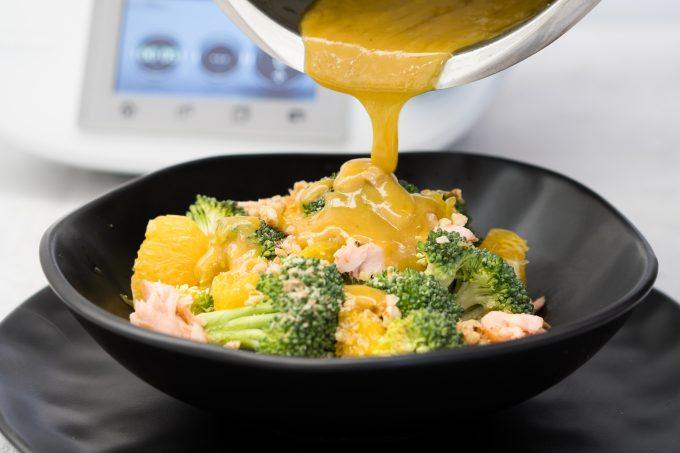
We always season green vegetables after cooking, not before. Salt draws water out of the cells and makes the vegetables softer. Add butter or olive oil directly to the hot vegetables in the serving bowl; the residual heat is enough to melt it.
A trick for evenly distributed butter: place a small knob of butter in a heatproof bowl and put it in the Varoma® for the last 2 minutes. The butter melts completely and you can pour it over the vegetables. This also works with herb butter or garlic oil.
Serve with: Salmon, Quinoa and Hollandaise sauce.
Green vegetables from the Varoma® work as a side dish with almost anything: fish, meat, rice, potatoes. We often serve them as a main course with potatoes cooked directly in the mixing bowl at the same time as the Varoma® vegetables. The exact quantities and settings are in the recipe card below.
More Thermomix® Varoma® recipes: Varoma® guide, Broccoli in the Thermomix®, Asparagus Thermomix®.