Honey mustard dressing is ready in five minutes, and once you have emulsified it yourself, the bottle from the supermarket stays on the shelf. Mustard binds oil and vinegar into a stable, creamy sauce that is almost impossible to achieve so consistently by hand. In the Thermomix®, 30 seconds at speed 4 does the job.
We have made this dressing for years as a standard staple. A 120 ml jar keeps for one week in the fridge and covers four to five salad servings. The basic ratio is easy to remember: 40 g each of mustard and honey, 60 g apple cider vinegar, 30 g olive oil. Everything else is fine-tuning.
Quick Honey Mustard Dressing with the Thermomix®
Ingredients 0 / 7 ✓
- 1/4 bunch chives
- 40 g medium-hot mustard
- 40 g honey
- 60 g apple cider vinegar
- 30 g olive oil
- 1/2 tsp salt
- 1/2 tsp freshly ground pepper
Instructions 0 / 3
-
1
Chop the chives.
Wash the chives, shake dry and cut into small rings.
-
2
Emulsify the dressing.
Add all ingredients, except the chives, to the mixing bowl and emulsify for 30 seconds / speed 4.
-
3
Serve.
Add the chives and mix for 4 seconds / reverse direction / speed 3.
Tip: You can also try your honey mustard dressing with hot mustard, or use dill instead of chives.
Video
Nutrition per serving
Why the mustard matters more than the honey
Most people assume the honey sets the character of a honey mustard dressing. In practice, it is the mustard. Honey gives a similar sweetness whichever brand you use. Mustards, on the other hand, vary considerably:
Medium-hot mustard (used in this recipe) gives a rounded, mild profile. The dressing tastes balanced, works with lamb’s lettuce, mixed leaves and raw vegetables. It is the dressing that surprises nobody and therefore always works.
Dijon mustard brings noticeably more heat and a subtle bitterness. The dressing finishes drier and less sweet. It goes well with robust salads containing rocket, radicchio or grilled meat. Once you have tried both versions, you effectively have two different dressings in your repertoire, not just one variation.
If you want to compare both versions side by side, make a half batch of each. The emulsion keeps in the jar without any trouble for up to one week in the fridge.
What can go wrong when emulsifying
Oil and vinegar do not combine on their own. Mustard acts as the emulsifier here: it contains mucin, a substance that bridges water and fat molecules. Speed 4 in the Thermomix® generates exactly the shear forces needed to make that bond stable. Speed 3 is often not enough and the oil separates again after filling. Speed 5 causes the dressing to foam.
A trap almost everyone falls into at least once: adding all the ingredients including the chives in one go. The chives always go in last, 4 seconds in reverse direction at speed 3. This keeps the rings visible, the herb flavour stays fresh, and your dressing does not end up looking like pureed greenery.
Adjusting the acidity if the apple cider vinegar is too sharp
The 60 g of apple cider vinegar is the largest single quantity in the recipe, and that is intentional: vinegar is the carrier for the mustard and stabilises the emulsion. If the dressing tastes too acidic for you, replace 10 to 15 g with water without affecting the consistency. White wine vinegar also works but gives a sharper, less fruity finish than apple cider vinegar.
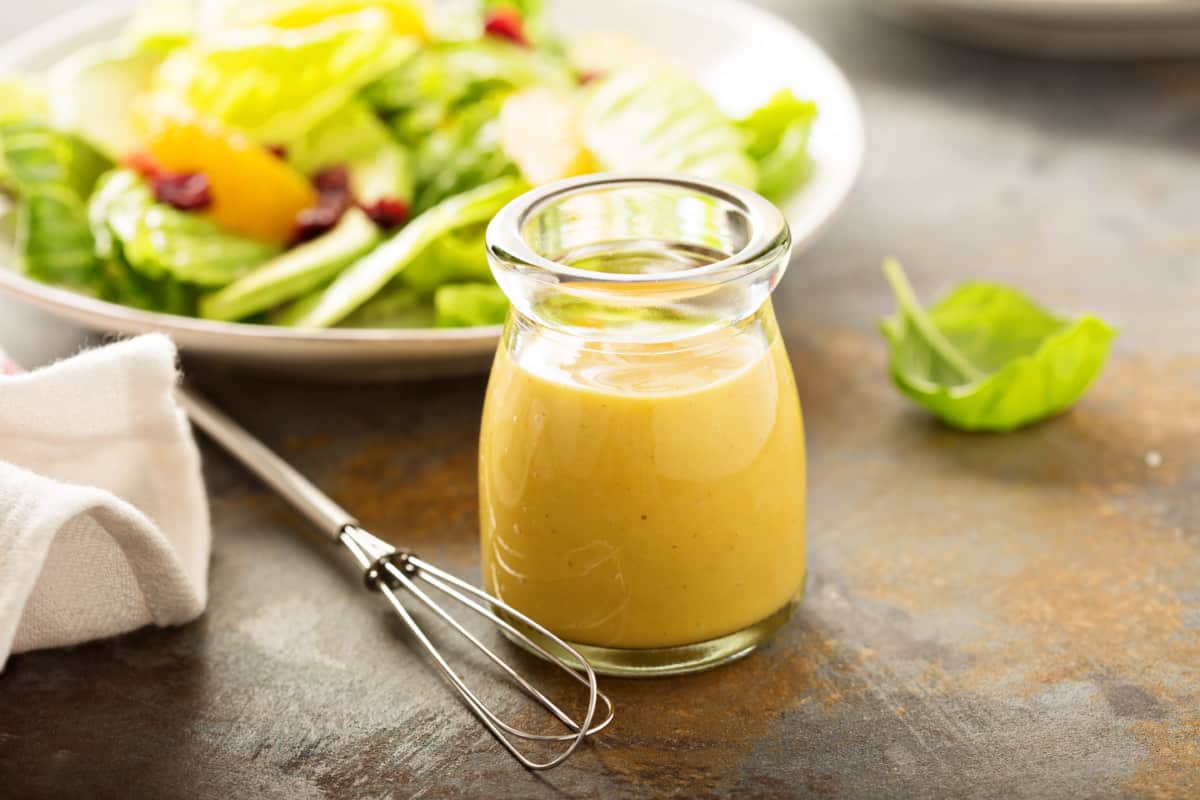
Pour the finished dressing straight into a screw-top jar. Give it a quick shake before each use: the emulsion separates slightly after a day or two. This is normal and does not mean the dressing has gone off.
If you prefer to dress the salad directly rather than keeping it in a jar, you can blend the dressing into the ingredients while chopping them in the mixing bowl. For an overview of all our sauce recipes, visit the Sauce Hub: Mayo, Pesto and Spreads with the Thermomix®.
If you are looking for a complete dish using this dressing: our Broccoli Salad with Salmon and Honey Mustard Dressing from the Thermomix® shows how the dressing works as the main dressing for a warm dish.