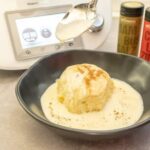
Vanilla sauce made in the Thermomix® in the classic Creme Anglaise style needs 230 g milk, 50 g sugar, half a vanilla pod and 8 minutes at 80°C on reverse direction. This version is egg-free and virtually foolproof. If you want the classic egg yolk version, we explain it at the end of this post.
We make vanilla sauce regularly to go with steamed dumplings, apple strudel or red berry compote. The egg-free version is our go-to, because it can also be served to children and pregnant women without any concerns. Plus there is no curdling and no lumping risk.
Vanilla Sauce (Creme Anglaise) with the Thermomix®
Ingredients 0 / 4 ✓
- 230 g milk
- 1 pinch salt
- 50 g sugar
- 1/2 vanilla pod
Instructions 0 / 3
-
1
Vanilla pod.
Score the vanilla pod lengthways with a knife and scrape out the seeds.
-
2
Stirring.
Insert the butterfly whisk into the mixing bowl. Add the scraped vanilla pod and remaining ingredients to the mixing bowl and heat for 8 minutes / 80°C / reverse direction / speed 2.
-
3
Serving.
Remove the vanilla pod and serve.
Tip: If the sauce does curdle, remove the butterfly whisk after step 2 and blend the vanilla sauce for 10 seconds / speed 10.
Video
Nutrition per serving
Why 80°C on reverse direction instead of the classic 85°C with a whisk
The classic vanilla sauce with egg yolk needs exactly 82 to 85°C, otherwise the egg curdles. At 80°C on reverse direction speed 2 and without egg we avoid that risk entirely. The milk is heated gently, the sugar dissolves completely and the vanilla releases its flavour. Above 85°C the vanilla would scorch and turn bitter.
Reverse direction is not strictly necessary, but it is recommended: it stirs gently without the milk picking up air and turning frothy. Normal direction at speed 2 works too, but gives a slightly frothy surface that some people find off-putting.
Half a vanilla pod makes all the difference
The scraped vanilla pod AND the pod itself go into the mixing bowl. The pod releases roughly 20 per cent more flavour than the seeds alone. Remove the pod after cooking; the seeds remain in the sauce. If you find vanilla pods too expensive: 1 tsp vanilla paste or 1 tbsp vanilla sugar work too, but the flavour will be flatter.
We use Bourbon vanilla (from Madagascar or Réunion). Tahitian vanilla has a fruitier note and works better with chocolate desserts. Mexican vanilla is the most intense, but rarely available. For a standard vanilla sauce, Bourbon vanilla is the right choice.
Creme Anglaise: a 16th-century French patisserie tradition
Classic Creme Anglaise has been documented since the 16th century and is considered the forerunner of English custard sauce and French sabayon. The name comes from French cuisine, but the recipe most likely originates from Italy (predecessor: zabaione). At its core: heat milk with vanilla, temper egg yolks and thicken gently.
Our recipe (without egg) is a simplified modern version that delivers the same result without the salmonella risk. We explain the classic egg yolk version further below. If you want it completely traditional, you can follow the Creme Anglaise setup.
Vanilla sauce without egg: why it turns out just as creamy
Classically, vanilla sauce gets its creaminess from egg yolk (lecithin as an emulsifier). Without egg we use 230 g of milk with 3.5 per cent fat, which is enough fat for a silky consistency without needing any thickener. If you want it thicker: replace 30 g of milk with 30 g of double cream and the sauce will be richer.
If you need a very thick consistency (for charlottes or layered desserts): dissolve 10 g of cornflour in 30 g of cold milk beforehand and heat it together with the other ingredients. This makes the sauce as thick as custard, without egg.
Vanilla sauce with egg: the classic Creme Anglaise
If you want the gold standard: 230 g milk, 50 g sugar, half a vanilla pod, 2 egg yolks. Heat the vanilla and milk first for 5 minutes at 80°C on speed 2, then let the egg yolks trickle in and simmer for a further 6 minutes at 82°C on speed 2. Important: keep the temperature exact, otherwise the egg will set.
With egg the sauce turns more golden and richer, with a flavour that is closer to classic French patisserie. It keeps for only 2 days in the fridge though (compared to 5 days for the egg-free version). We decide based on the occasion: family gathering with children = egg-free. Dinner with guests = with egg.
Restaurant version with cream: replace 100 g of milk with 100 g of double cream (so 130 g milk plus 100 g cream plus 4 egg yolks instead of 2). This makes the sauce genuinely rich and stable. Many Michelin-starred chefs serve this version. Creamier, but higher in calories.
With custard powder: the shortcut version
If you need something quick and rich: 230 g milk, 50 g sugar, half a vanilla pod and 1 sachet of vanilla custard powder. 7 minutes at 90°C on speed 4 (higher speed because of the starch). Gives a thick, custard-like sauce that can also be eaten cold with a spoon.
Flavour-wise it is closer to custard than to a classic Creme Anglaise. But for quick family desserts it is perfectly fine, and children love the consistency. This version keeps for 3 days in the fridge.
Vanilla sauce keeps for 5 days, do not freeze
The egg-free version keeps in the fridge in a sealed container for 5 days. With egg, only 2 days. Give it a stir before serving, as the vanilla seeds settle to the bottom. If needed, warm gently in a bain-marie at 50°C or carefully in the microwave.
Freezing does not work: the milk proteins break apart on thawing and the sauce turns grainy and unappetising. It is better to make a fresh half-batch instead.
What to serve with vanilla sauce
Steamed dumplings with the Thermomix® are the classic pairing. Plus anything warm from the oven: apple strudel, Kaiserschmarrn, quark dumplings, warm chocolate cake. Serve cold with red berry compote, strawberries or use as a base for homemade vanilla ice cream.
Goes well with: Apple strudel and Kaiserschmarrn.
Also pairs well with: Peanut sauce Thermomix®.