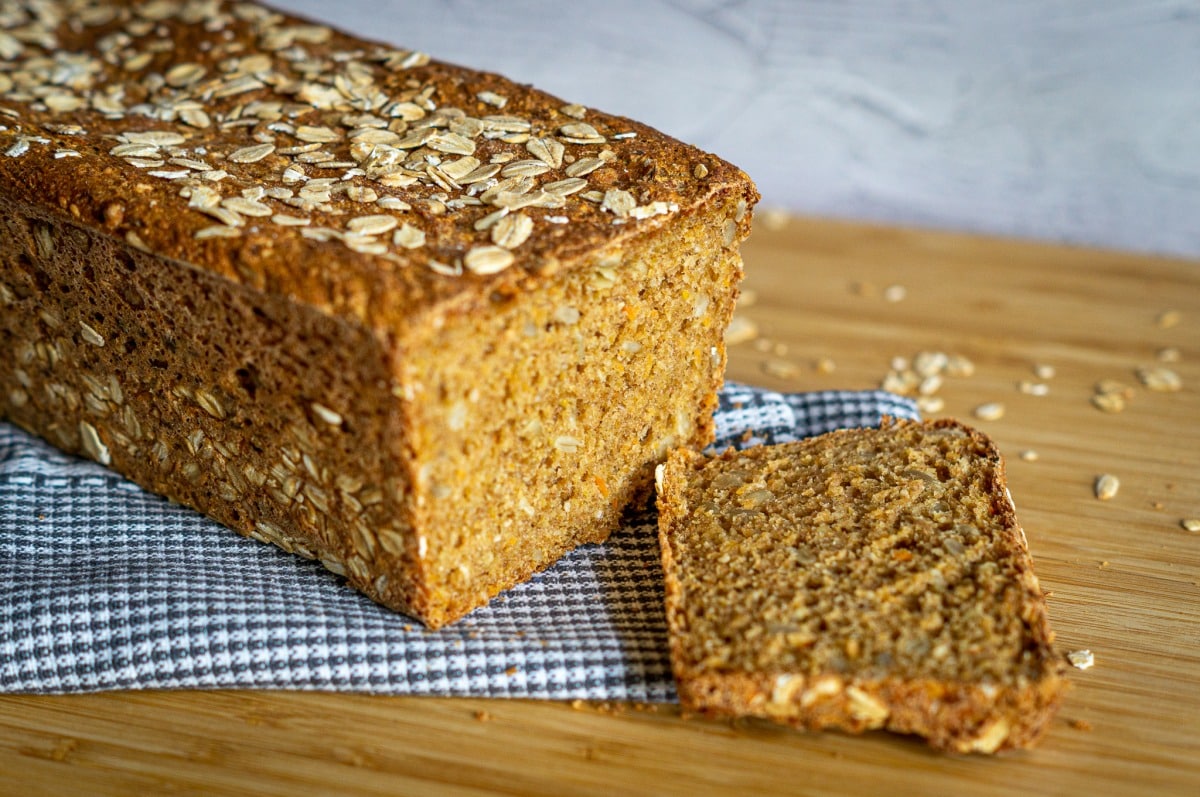
Spelt and Carrot Bread made in the Thermomix® takes 130 minutes in total (including 1 hour proving time) and yields 16 slices from a single loaf tin. 500 g of wholegrain spelt flour combined with 150 g of grated carrot brings moisture and a lightly sweet character, while sesame seeds and sunflower seeds add satisfying bite.
We bake this loaf regularly as a weekend batch. One slice (about 60 g) has 145 kcal and 3 g of protein. It stays fresh for 5 days, which is better than most shop-bought wholegrain loaves, and costs roughly 1.80 Euro in ingredients compared to 4 to 5 Euro at an organic food shop.
Spelt and Carrot Bread, Thermomix®
Ingredients 0 / 11 ✓
- 150 g carrot
- 400 g water
- 1/2 cube fresh yeast
- 2 tsp salt
- 1 tsp brown sugar
- 500 g wholegrain spelt flour
- 60 g sesame seeds
- 60 g sunflower seeds
- 20 g white balsamic vinegar
- 10 g butter
- 2 tbsp rolled oats
Instructions 0 / 7
-
1
Chop the carrots.
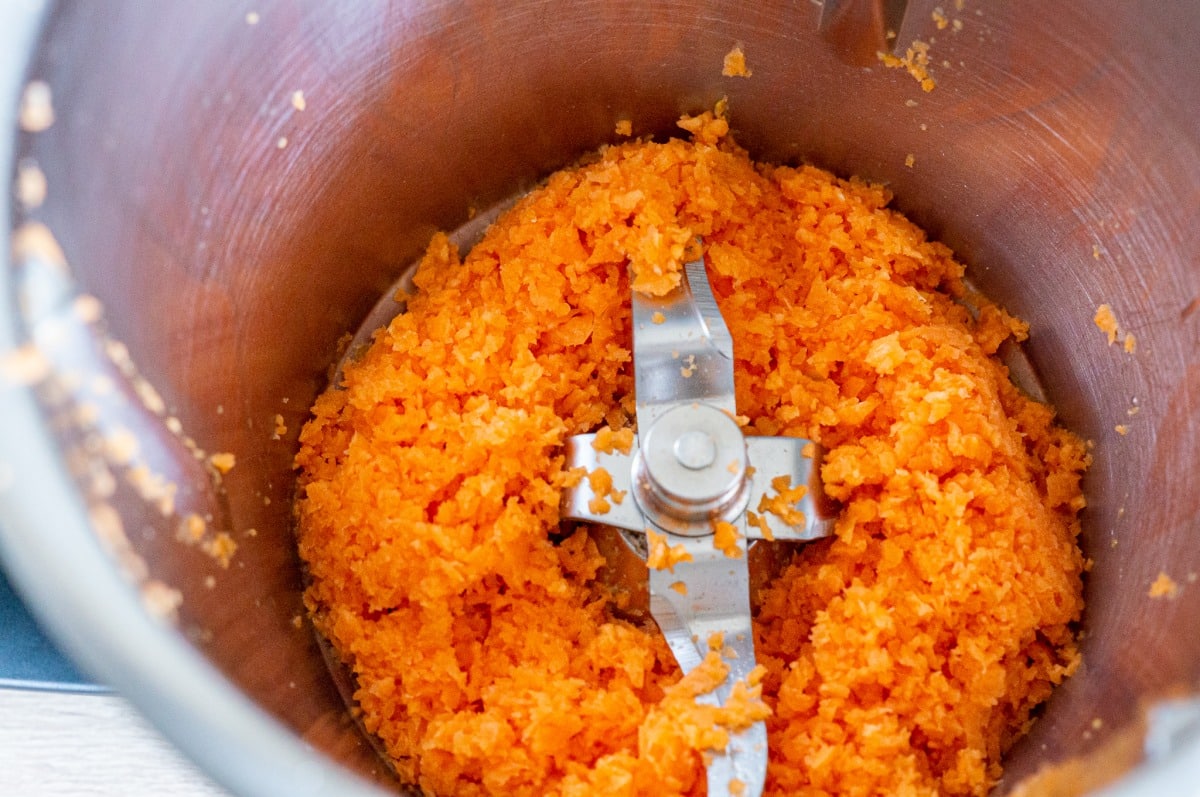
Peel the carrots, add them in pieces to the mixing bowl and chop for 6 sec / speed 8, then set aside.
-
2
Warm the yeast.
Add water, yeast, salt and sugar to the mixing bowl and warm for 3 min / 37°C / speed 1.
-
3
Knead the dough.
Add the carrots, flour, sesame seeds, sunflower seeds and vinegar and knead for 3 min / kneading mode to form a dough.
-
4
Grease the loaf tin.
Meanwhile, grease a loaf tin with butter and scatter with 1 1/2 tbsp rolled oats.
-
5
Prove the dough.
Transfer the soft dough to the loaf tin, cover and leave to prove in a warm place for 1 hour.
-
6
Bake.
Preheat the oven to 200°C top and bottom heat. Scatter the loaf with the remaining rolled oats and bake on the middle shelf for 10 minutes. Reduce the temperature to 180°C and bake for a further 45 to 50 minutes.
-
7
Leave to cool.
Leave the bread to cool completely, then carefully turn it out of the tin.
Tip: Instead of sesame seeds and sunflower seeds, you can use nuts or pumpkin seeds according to your preference.
Video
Nutrition per serving
Wholegrain spelt instead of wheat: why it works
Spelt has a lightly nutty flavour and is better tolerated than wheat by many people with wheat sensitivity (not coeliac disease). Wholegrain flour brings more fibre (8 g per 100 g versus 4 g in plain flour) and keeps you fuller for longer. Together, these qualities make this a genuinely wholesome loaf.
If you use light spelt flour (Type 630), reduce the water to 350 g instead of 400 g, as lighter flour absorbs less liquid. The flavour will be milder and the texture fluffier. Wholegrain is the healthier choice; Type 630 is the more child-friendly one.
Activating the yeast at 37°C: why not add it straight in
Before the flour goes in, water, yeast, salt and sugar are warmed together for 3 minutes at 37°C at speed 1 in the mixing bowl. This is the optimum temperature for activating yeast. When yeast is added directly to cold water it can take 30 minutes to become active. At 37°C the yeast is ready to work within 3 minutes, giving the dough a much better rise.
If you use dried yeast instead of fresh (half a cube), 7 g of dried yeast (1 sachet) is enough for the same quantity. Dried yeast does not strictly need pre-warming, but with cold water the rise will take longer. We recommend fresh yeast for better flavour and lifting power.
Carrot quantity: not too much, not too little
150 g of grated carrot is the optimum amount for 500 g of flour. More carrot adds more moisture, which makes the dough too sticky and requires a longer baking time. Less carrot loses the characteristic flavour and the moist crumb. The ratio of 3 to 10 (carrot to flour) is the sweet spot.
The carrots are chopped for 6 seconds at speed 8 in the Thermomix® (small pieces, not pureed). For a finer texture, add another 2 seconds at speed 5. For a chunkier result, reduce to 4 seconds at speed 6. Colourful carrots (yellow, purple, white) make for a visually interesting loaf, though the taste is the same.
Seed mix: sesame and sunflower seeds
60 g of sesame seeds and 60 g of sunflower seeds add bite and healthy fats. Sesame seeds (5 g per slice) provide calcium (about 50 mg, covering 5 per cent of the daily requirement), while sunflower seeds (5 g per slice) provide vitamin E. If you prefer no seeds, replace them with an extra 100 g of flour for a simpler wholegrain loaf.
Seed alternatives: pumpkin seeds (10 g of iron per 100 g), linseeds (more omega-3), chia seeds (gel-like, adds moisture). For a Mediterranean style, use 50 g sunflower seeds with 30 g sun-dried tomatoes and 1 tbsp oregano. For a sweeter version, use 50 g sesame seeds with 30 g raisins and 1 tsp cinnamon.
White balsamic vinegar: the secret ingredient
The 20 g of white balsamic vinegar is not there for flavour (you cannot taste it), but for dough structure. The acidity activates the yeast more strongly and extends the shelf life of the bread by about 1 to 2 days. This technique is well known among professional bakers and mimics the sourdough effect without the waiting time.
If you do not have white balsamic vinegar, 1 tbsp of apple cider vinegar or 1 tbsp of lemon juice works just as well. For a genuine sourdough note, add 50 g of sourdough starter, but reduce the water by 50 g at the same time, as the starter itself is liquid.
Vorwerk version with yoghurt: a comparison
The Cookidoo version adds 100 g of natural yoghurt alongside the water. This makes the bread slightly moister but also denser. We chose the yoghurt-free version because it produces a lighter, more open crumb. If you prefer yoghurt, add 100 g of yoghurt and reduce the water by 100 g.
The difference in the finished loaf: the yoghurt version keeps fresh for 1 day longer (due to lactic acid bacteria), while the water version is lighter and more neutral in flavour. Both work well; it comes down to personal preference.
What to serve with spelt and carrot bread
Classic at breakfast with butter and jam. Also great with honey and cream cheese, avocado spread, hummus, a smoked salmon and quark topping, alongside soups, toasted with cheese, or as the base for sandwiches. One slice keeps you full for much longer than white bread, thanks to the fibre.
If you are looking for more bread recipes, our Spelt Baguette with the Thermomix® is the lighter option for Mediterranean dishes.
Spelt and carrot bread: fresh for 5 days, frozen for 3 months
Store in a bread bin or a cloth bag at room temperature for up to 5 days. Never store in plastic, as the bread will go soggy. For clean slicing, wait until the loaf has cooled completely (3 to 4 hours), otherwise the crumb will crumble.
Freezing works brilliantly: slice the loaf, wrap each slice individually in cling film and place in a freezer bag. Keeps in the freezer for 3 months. To defrost, put slices straight from the freezer into the toaster for 2 to 3 minutes, or leave at room temperature overnight.
Goes well with: butter, cheese and soup.
Our tip: try our hearty Nimmersatt Bread made in the Thermomix®.