Panna Cotta in the Thermomix® takes 45 minutes plus chilling time and gives you 4 servings. 300 g double cream plus 150 g milk at a 2:1 ratio is the classic Italian mixture that keeps the dessert creamy without being too rich. We use instant gelatine as the most reliable setting agent.
We like to make it the day before, because it develops its perfect texture overnight. Around 280 kcal per serving. In an Italian restaurant a portion usually costs 6 to 9 euros; made at home the ingredients cost about 1.20 euros.
Panna Cotta in the Thermomix®

Ingredients 0 / 5 ✓
- 40 g sugar
- 300 g double cream
- 150 g milk
- 1 sachet vanilla sugar
- 30 g instant gelatine e.g. Ruf or Dr. Oetker
Instructions 0 / 4
-
1
Pulverise the sugar.
Add the sugar to the mixing bowl and pulverise for 8 seconds / speed 10.
-
2
Warm the cream mixture.
Add the double cream, milk and vanilla sugar, mix for 10 seconds / speed 3 and warm for 1 minute 30 seconds / 37°C / speed 1.
-
3
Add the gelatine.
Set the Thermomix® to 1 minute / speed 4 and slowly pour the instant gelatine through the mixing bowl lid while it runs.
-
4
Serve and enjoy.
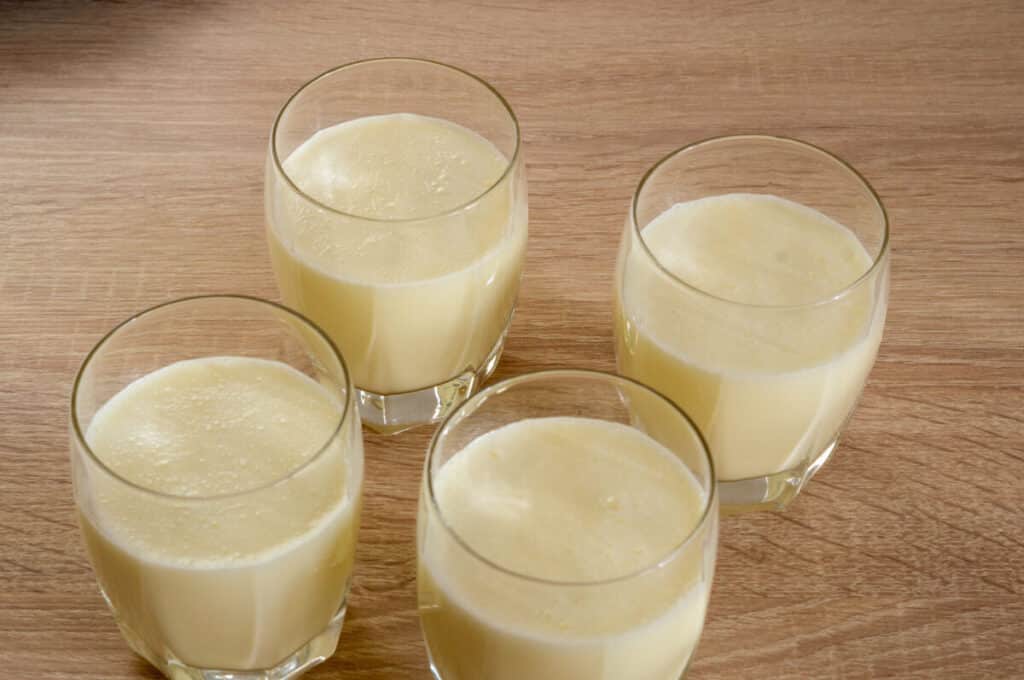
Pour the Panna Cotta into dessert glasses or bowls and refrigerate until serving. After about 30 minutes in the fridge the Panna Cotta will be set.
Tip: Top your Panna Cotta with beetroot compote or cherry compote.
Video
Nutrition per serving
Cream-to-milk ratio 2:1: the Italian original
Panna Cotta (Italian for “cooked cream”) is classically made with cream alone. Pure cream gives a texture that is too rich and heavy, though. Italian restaurants generally use 2 parts cream and 1 part milk. We use 300 g double cream and 150 g milk. That makes the mouthfeel silky rather than cloying.
If you prefer a lighter result: 250 g double cream and 200 g milk (3:2 ratio). If you want it authentically Italian: 400 g pure cream (4:0). The ratio is a matter of taste, and the original 2:1 is the tried-and-tested middle ground.
Instant gelatine vs. leaf gelatine vs. agar-agar
We use 30 g instant gelatine because it pours easily through the mixing bowl lid. The advantage: no soaking time, no separate dissolving step, ready to use straight away. The disadvantage: a larger quantity is needed compared with leaf gelatine, and the result is sometimes slightly less firm.
Classic Italian version with leaf gelatine: soak 4 sheets (about 6 to 8 g) in cold water for 5 minutes, squeeze out, then stir into the warm cream and milk mixture. Vegan version with agar-agar: add 4 g agar-agar to the cream and simmer for 2 minutes (agar-agar needs heat to activate). Note: the agar-agar version sets slightly firmer and is less delicate.
Vanilla: pod, paste or sugar
1 sachet of vanilla sugar is the simplest option. For something more authentic: split 1 vanilla pod lengthways, scrape out the seeds and add both seeds and pod while heating (remove the pod afterwards). Vanilla paste (1 tsp) is a good middle-ground solution.
Bourbon vanilla (from Madagascar) is the standard choice. Tahitian vanilla is fruitier but suits chocolate desserts better. Mexican vanilla is the most intense, though it is rarely available. Vanillin sugar (synthetic) works too, but the flavour is noticeably flatter.
Warming rather than boiling: 37 °C is enough
In the original recipe the cream and milk are brought to the boil. With instant gelatine that is not necessary: 37 °C is enough to activate it. The advantage: faster, less energy, and a milder vanilla flavour (vanilla loses intensity at high heat).
If you use leaf gelatine: heat to 80 °C, because leaf gelatine needs a higher activation temperature. If you use agar-agar: bring to 100 °C and simmer for 2 minutes. The right temperature depends on which setting agent you choose.
Classic Italian toppings
Panna Cotta is classically served with one of three toppings:
Berry sauce: simmer 200 g mixed berries (fresh or frozen) with 30 g sugar and 1 tbsp lemon juice for 8 minutes at 100 °C / speed 2, then blend. The most common version in German restaurants.
Espresso caramel: caramelise 80 g sugar in a pan (without water), carefully stir in 1 cup of espresso (watch out for spattering), and simmer for 2 minutes. A grown-up Italian twist.
Plain vanilla: no topping at all, just a little freshly grated vanilla on top. The purist Italian approach.
Serving suggestions beyond dessert
Panna Cotta is primarily a dessert, but it also works as a breakfast (with honey and granola) or a snack (with fresh berries). If you are looking for more summer desserts: our strawberry sauce made in the Thermomix® is the perfect companion to Panna Cotta.
Panna Cotta keeps for 3 days in the fridge
Covered with cling film or stored in a sealed jar, it keeps for 3 days in the fridge. After 30 minutes of chilling it is firm enough to eat. The ideal texture develops after 4 hours, and it is at its best after 8 hours (overnight).
Freezing does not work: gelatine changes its structure and the Panna Cotta becomes grainy after thawing. Better to make it fresh, or eat any leftovers within 3 days.