Raspberry jam with the Thermomix® takes 25 minutes and works just as well with frozen berries as with fresh ones. The ratio of 750 g raspberries to 375 g 2:1 jam sugar plus 30 g lemon juice gives 20 servings of 1 tbsp each, which is around 7 to 8 medium-sized jars. That is 50 per cent more yield than most standard Vorwerk recipes using 500 g berries, because a single mixing bowl run handles the larger quantity without any trouble.
We have been making raspberry jam every season for over ten years, and the Thermomix® method has won out over the stovetop. No burning, a constant 100°C, and blending at the end means no separate stick blender needed.
Raspberry Jam with the Thermomix®

Ingredients 0 / 3 ✓
- 750 g raspberries frozen or fresh
- 375 g 2:1 jam sugar
- 30 g lemon juice
Instructions 0 / 3
-
1
Bring the ingredients to the boil.
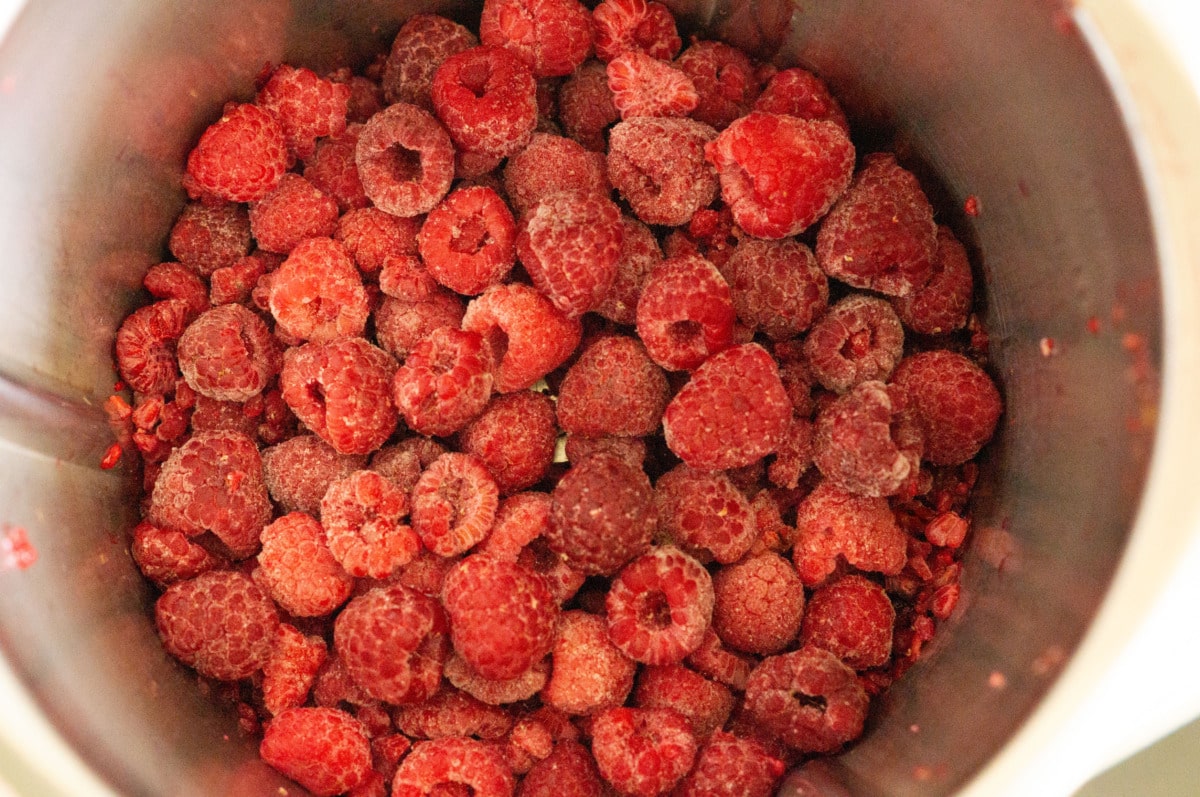
Place the frozen raspberries, jam sugar and lemon juice into the mixing bowl and cook for 20 minutes / 100°C / speed 2. With fresh raspberries, 15 minutes cooking time is sufficient.
-
2
Sterilise the jars.
Meanwhile, sterilise the jars and lids with boiling water. Blend the jam by increasing gradually up to speed 8.
-
3
Fill the jars.
Fill the jam into the prepared jars, seal and leave to cool.
Tip: For an extra twist, add a splash of Amaretto to the mixing bowl before blending.
Video
Nutrition per serving
Frozen raspberries work just as well
We use frozen raspberries from the supermarket about 70 per cent of the time. They are harvested at peak ripeness in summer, blast-frozen and often have more flavour than fresh March raspberries from Morocco. The only difference when cooking: 5 minutes longer, so 20 minutes instead of 15. No other adjustment needed.
Add frozen raspberries directly from the freezer into the mixing bowl without thawing. The Thermomix® melts them during the heating phase and the flavour is fully preserved. Thawed raspberries lose juice and with it flavour.
Why 2:1 jam sugar is the right choice over 1:1
Raspberries contain 0.4 to 0.7 per cent pectin (German Nutrition Society, 2024). That is a medium level. With 1:1 jam sugar (equal parts sugar and fruit) the jam would be almost a pure sugar solution with berry colour. With 2:1 (half the sugar) the berry character stays dominant and the jam sets firmer.
If you try 3:1: possible, but risky. The pectin content in 3:1 jam sugar is often not enough for a firm set, and the jam runs off the breakfast toast. We stick with 2:1 and stay on the safe side.
30 g lemon juice is not a flavouring but a pectin activator
Pectin needs acid to gel. Raspberries are low in acid (pH 3.5 to 3.8), and lemon juice (pH 2.4) provides the acid needed for pectin cross-linking. The 30 g does not come through in the finished jam but is essential for the set.
Leave it out and you get a runny jam no matter how long you cook it. Substitutes for lemon juice: 1 tsp citric acid powder or 30 g lime juice. Both work technically the same way.
Raspberry jam without seeds: sieve or muslin in the Varoma
If you prefer no seeds, press the finished jam through a fine sieve after cooking before filling the jars. This takes about 8 extra minutes but roughly halves the yield (because the seeds and pulp make up around 40 per cent of the volume). From 750 g raspberries you end up with only about 6 jars of 200 ml.
Professional approach: before cooking, chop the berries for 10 seconds at speed 6 and press them through a muslin cloth (or fine sieve) into the Varoma insert. Then continue cooking without seeds. This gives a silkier jam without the extra sieving afterwards, but also halves the yield here too.
A more elegant alternative: instead of blending smooth, just crush roughly (speed 3 instead of speed 8). This keeps half-berries intact and gives the jam a chunky texture that many people miss in shop-bought jars.
Variations: with vanilla, white chocolate or raspberry eau-de-vie
If you want to lift the basic recipe: stir in 1 tsp vanilla extract after cooking for a warm vanilla depth. Adding 50 g white chocolate in pieces in the last minute of cooking makes the jam richer and softens the acidity. 20 g raspberry eau-de-vie at the end gives an adult version with a subtle hint of alcohol.
If you enjoy a mixed berry jam: 500 g raspberries plus 250 g strawberries with the same sugar and lemon ratio. The strawberries add sweetness, the raspberries add acidity, keeping the balance right.
Sterilise the jars during the cooking time
Sterilise the jars and lids in parallel while the jam is cooking. We use the oven method: 100°C, 10 minutes, empty jars upside down on the rack. Lids separately in boiling water for 3 minutes. This is more hygienic than the classic washing-up liquid rinse.
If the Thermomix® is already running anyway, you can use the Varoma: Sterilising in the Thermomix® explains the method using Varoma steam for sterilising jars and lids at the same time. 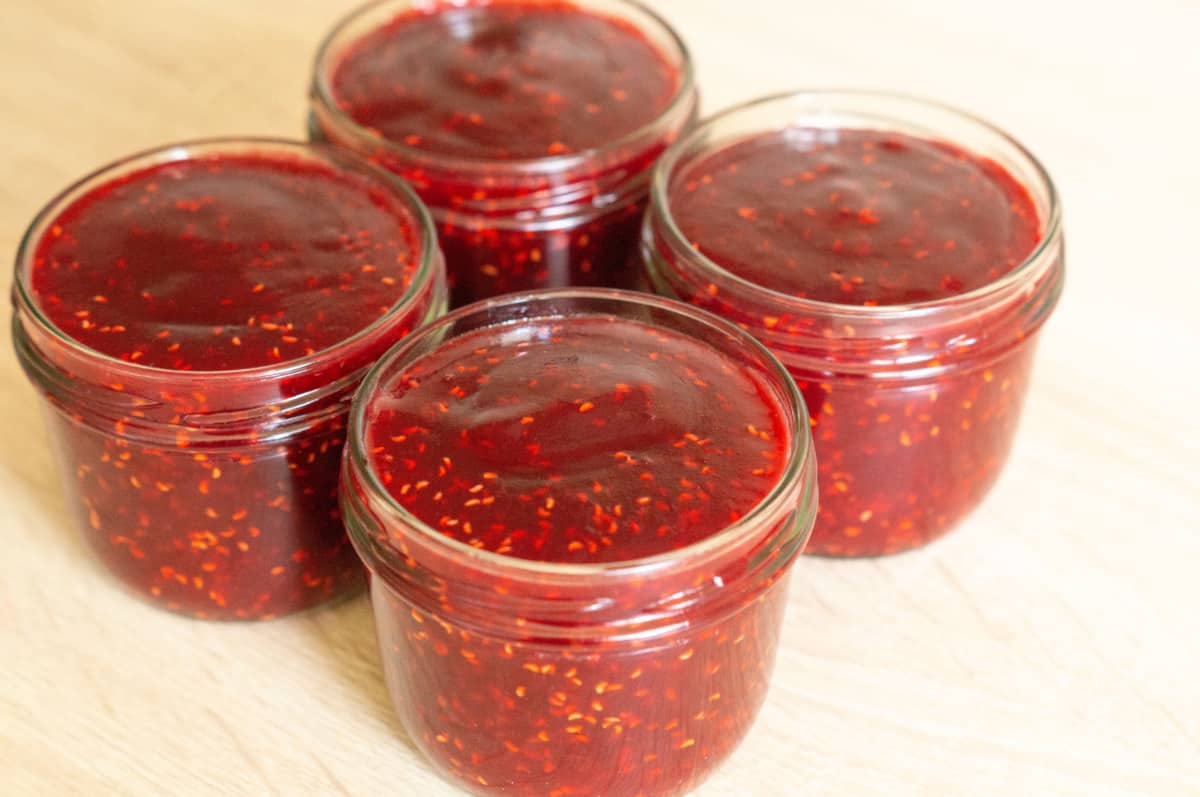
More jam recipes
If you want to preserve a different berry: our basic preserve recipe with the Thermomix® explains the pectin guide for all fruits. For a chocolate and fruit combination: Mon Cheri Jam. If you want to skip refined sugar entirely: Jam without Jam Sugar. A classic with Cointreau: Strawberry Jam with Cointreau. Spring seasonal favourite: Rhubarb Jam.
Raspberry jam keeps for a year unopened
Filled hot, sealed immediately and stored in a cool, dark place, the jam keeps for at least 12 months. Once opened, store in the fridge and use within 4 weeks. Turn the jars upside down for 5 minutes immediately after sealing so the vacuum forms.
If you cannot use 7 jars at once, you can also freeze a portion after preserving. In the freezer it keeps for 6 months without any loss of flavour. Thaw in the fridge overnight.