Shortcrust pastry is tricky. Too little mixing and it crumbles, too much and it turns tough, too warm and it sticks to everything. What it does tolerate is time. Thirty minutes in the fridge is the minimum, one hour is better. Everything else we solve in the Thermomix® with one rule: mix briefly, then stop immediately.
Shortcrust Pastry Basic Recipe with the Thermomix®
Ingredients 0 / 5 ✓
- 290 g sugar
- 500 g flour
- 1 pinch salt
- 250 g butter softened
- 2 eggs
Instructions 0 / 4
-
1
Mill the icing sugar.
Add the sugar to the mixing bowl and pulverise for 10 seconds / speed 10.
-
2
Mix the dough.
Add the flour, salt, butter in pieces and the eggs, then mix for 40 seconds / speed 5.
-
3
Rest the dough.
Wrap the dough in cling film or foil and leave to rest in the fridge for one hour.
-
4
Shape the dough.
Shape the dough as desired.
For example, roll out to 3 to 4 mm and cut into shapes, or press into tart tins.
If the dough is too warm, it will be harder to work with than when well chilled. You can put it back in the fridge and let it cool through again.
Please do not knead the dough additionally by hand. Otherwise your biscuits or tart will be harder after baking.
Video
Nutrition per serving
Why the butter comes straight from the fridge
Conventional cookbook wisdom says: bring butter to room temperature, then beat until creamy. For shortcrust pastry, that is wrong. Cold butter stays in small pieces within the flour, forming fat layers that melt during baking and leave small gaps behind. Those gaps are exactly what makes the pastry short. Warm butter blends too evenly with the flour. You end up with a dense, hard mass rather than a tender base.
That is why we add the butter in cubes, straight from the fridge, into the mixing bowl. On hot days, the egg goes in briefly chilled as well. Excessive? Not really, the difference shows up in the bite. Anyone who wants to leave out the egg can add 30 g more butter per egg, or 2 tbsp of ice-cold water. For a vegan version, MyEy works well as an egg replacement.
The Thermomix® is faster than your hands
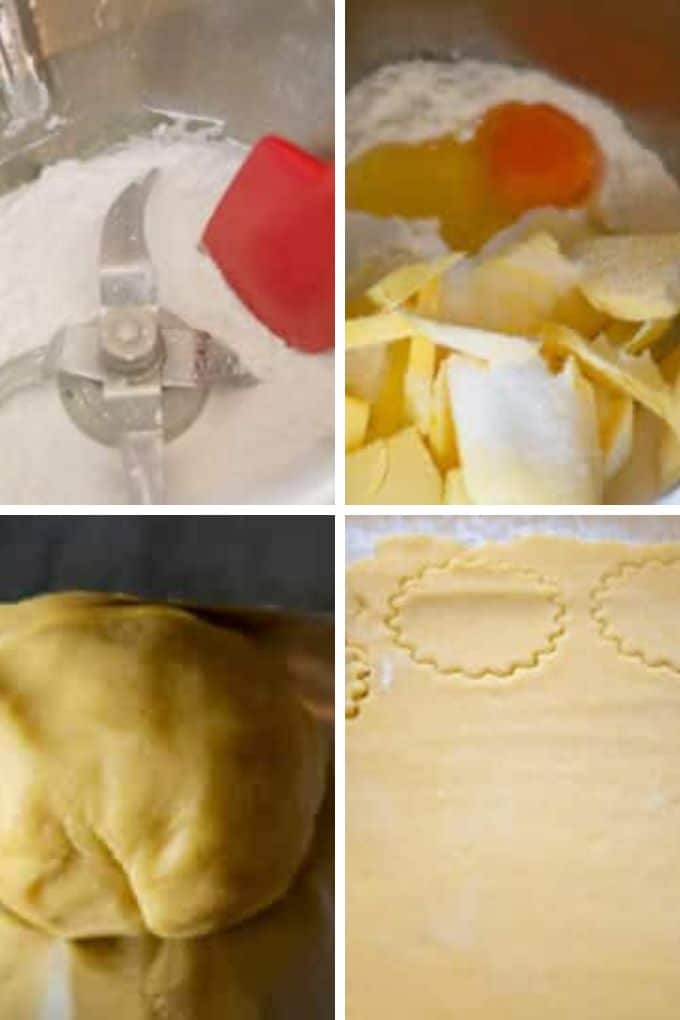
That is its advantage and its risk. Where you would knead by hand for two minutes, it needs twenty seconds. Where a stand mixer slowly builds up gluten, it is already done. We therefore split the mixing into three short steps: first turn the sugar into icing sugar, then combine butter with flour and salt into sandy crumbs, and finally work in the egg briefly. The seconds and speeds are in the recipe card. They work identically on the TM31, TM5, TM6 and TM7.
The dough may look crumbly at this point. It does not need to be smooth. Anyone who kneads it further on the work surface with their hands undoes exactly the mistake the Thermomix® just avoided. Instead, press it flat into a disc, wrap it in cling film and put it in the fridge. Done.
When the dough sticks or crumbles
If it sticks, it is too warm. Do not knead in extra flour, that makes the base dry later on. Put it back in the fridge for 15 minutes and roll it out between two sheets of baking paper. If it crumbles, it is too cold or was not pressed together long enough. Five minutes at room temperature, then roll out between baking paper. If it still does not hold together, a teaspoon of ice-cold water will help.
Make dough in advance
Wrapped in cling film, the raw dough keeps for 3 days in the fridge and up to 3 months in the freezer. To use it again, thaw overnight in the fridge, then leave at room temperature for 10 minutes. We often make double the quantity and divide it into portion-sized discs before freezing. That way you have pastry ready whenever you need it, without any rush.
Blind baking for liquid fillings
For a quiche or an apple tart with a liquid filling, the base needs to go into the oven on its own first. Otherwise it will go soggy from the inside. Line the tin with the dough, prick it several times with a fork, lay baking paper on top and weigh it down with dried pulses. Bake for 15 minutes at 180 °C top and bottom heat with the weights, then 5 minutes without. Leave the pulses to cool and you can reuse them as many times as you like.
For a nuttier base, replace half the flour with wholemeal flour. For a slightly caramelised note, replace part of the white sugar with brown sugar. For a chocolate or nut pastry, replace 40 to 50 g of flour with cocoa powder or ground hazelnuts, perfect as a base for a Nutella tart. The same basic recipe also gives us our butter biscuits. The technique stays the same: work cold, mix briefly, leave to rest.
Our Tip: make your own yeast with the Thermomix®.