When we know first thing in the morning that we will not feel like lengthy chopping by evening, this raw vegetable salad from the Thermomix® is on the table in 25 minutes. Carrots, white cabbage, apple, red cabbage, cucumber and pepper are roughly chopped, then a handful of walnuts and sunflower seeds are added for crunch. A dressing of yoghurt, honey, mustard and lemon brings everything together in a bowl full of colour.
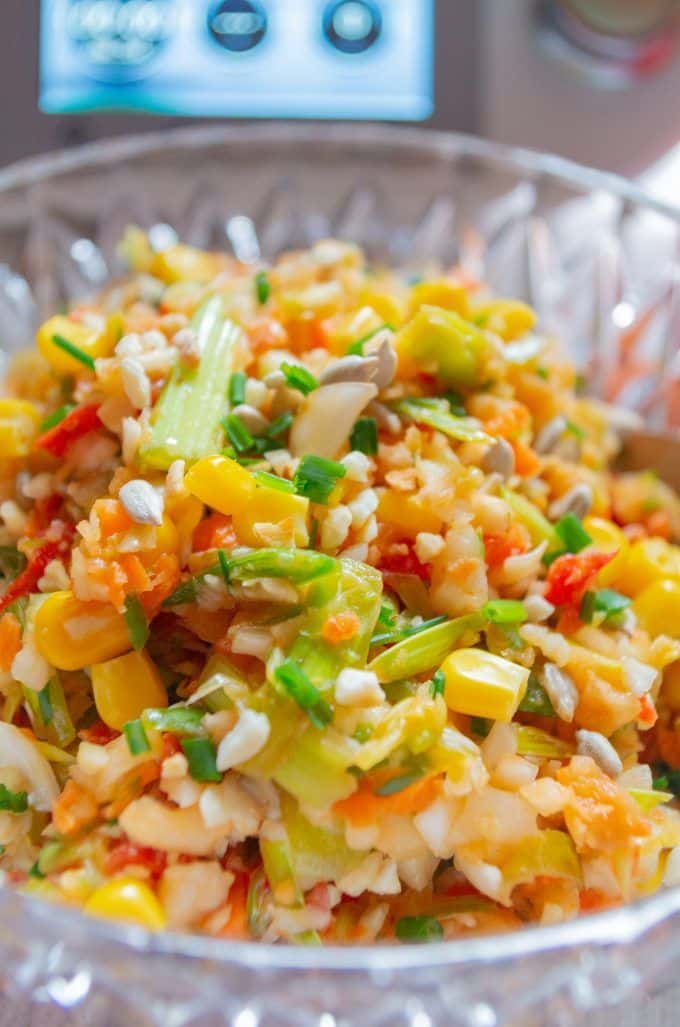
We eat the salad as a main meal (with grilled chicken or feta) or as a side at a barbecue. For work, we fill it into screw-top jars and keep the dressing separately in a small jar. It stays crisp for up to 3 days.
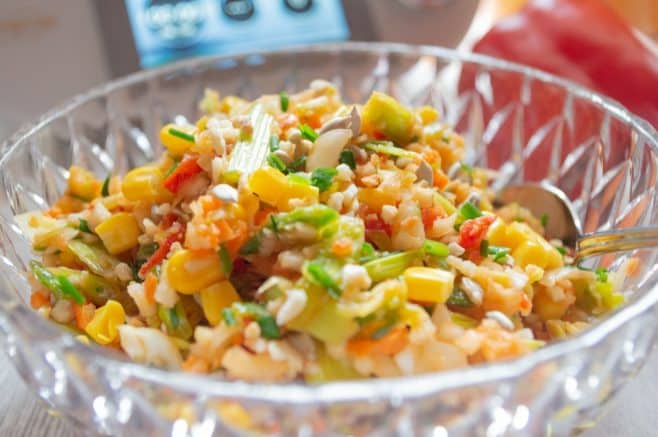
Colourful Raw Vegetable Salad with the Thermomix®

Ingredients 0 / 16 ✓
- 30 g walnut halves
- 30 g sunflower seeds
- 1 bunch chives
- 100 g white cabbage
- 50 g celery
- 100 g carrot
- 1 kohlrabi
- 1 stalk leek
- 1 red pepper
- 1 apple
- 80 g tinned sweetcorn (drained weight)
- 20 g vinegar
- 30 g walnut oil or olive oil
- 1 tbsp hot mustard
- 1 1/2 tsp salt
- 1 tsp black pepper
Instructions 0 / 4
-
1
Chop the nuts.
Place the walnut halves and sunflower seeds in the mixing bowl and chop for 3 sec / speed 5, then set aside.
-
2
Chop the chives.
Wash the chives, shake dry and pat dry. Place in the mixing bowl and chop for 7 sec / speed 5, then set aside.
-
3
Chop the vegetables.
Wash, trim and cut the white cabbage, celery, carrots, kohlrabi and leek into pieces and place in the mixing bowl. Wash the pepper and apple, quarter them and remove the cores, then add to the mixing bowl and chop using the spatula for 8 sec / speed 5.
-
4
Mix and serve.
Add the sweetcorn, vinegar, oil, mustard, salt, pepper and walnut halves and mix for 6 sec / reverse direction / speed 4. Serve sprinkled with the chives.
Tip: Also great as a side dish for a barbecue!
Video
Nutrition per serving
Which vegetables belong in and which just release water
The base is three crisp varieties: white cabbage (volume, vitamin C), carrot (sweetness, beta-carotene) and red cabbage (colour, anthocyanins). Add pepper (juicy), cucumber (fresh) and a tart apple (Boskoop or Granny Smith) for balance. We leave out tomatoes as they completely waterlog the salad after 2 hours. Also add cucumber only after removing the seeds, otherwise the bowl turns into soup when you take it with you.
Many recipe sites feature very purist raw vegetable versions with only 2 or 3 components. Our recipe uses 6 components, creating the variety that makes raw vegetable salads genuinely filling. The German Nutrition Society recommends 3 portions of vegetables per day, and a large bowl of this covers roughly half of that daily requirement.
Why the order in the mixing bowl matters
We chop the firmer vegetables (white cabbage, carrot, red cabbage) first at speed 5 for 4 seconds, then the softer ones (pepper, cucumber, apple) at speed 4 for just 2 seconds. Blending everything together produces a puree rather than a salad. We want fine strips and chunks, not a mousse. The walnuts and sunflower seeds are stirred in by hand at the end, otherwise they turn to powder.
The dressing makes all the difference
200 g Greek yoghurt (10% fat), 1 tbsp runny honey, 2 tsp medium mustard, juice of half a lemon, salt, pepper. 20 seconds at speed 4 in the mixing bowl. This mixture emulsifies without oil because the yoghurt brings enough fat of its own. For a vegan version: soya yoghurt plus 1 tbsp tahini in place of half the yoghurt. Season with salt just before serving, otherwise the salt draws water out of the vegetables.
Six raw vegetable variations for every season
Summer variation (strawberries, mint, lime), Autumn variation (pear, walnuts, cranberries), Winter variation (beetroot, apple, horseradish), Mediterranean (feta, olives, cherry tomatoes, olive oil), Asian (soy sauce, sesame oil, peanuts, ginger), Middle Eastern (pomegranate, chickpeas, tahini, cumin).
What goes well with the raw vegetable salad
As a filling main meal, we pair the salad with our chicken breast recipe or with oven-baked feta. At a barbecue it belongs alongside grilled halloumi and potato salad. In summer the salad works perfectly with our lighter summer salads.
Reverse direction and lemon: two tricks for bite and colour
Using reverse direction when chopping (speed 4 for 3 seconds instead of the normal forward rotation) produces noticeably larger pieces rather than a mash. The blunt side of the blades presses the vegetables rather than cutting through them, which is exactly what we want for carrot, red cabbage and apple so the salad keeps its bite. For the softer vegetables (pepper, cucumber) we stick to normal forward direction, otherwise they do not break down small enough.
The second trick against quick browning: stir 1 tsp of lemon juice directly into the apple and the pale raw vegetables immediately after chopping, then add the other components. The acid stops oxidation for several hours, so the salad still looks fresh after 3 hours in the office rather than grey around the apple. If you use Boskoop apples, you need less lemon juice as that variety already has plenty of natural acidity.
Goes well with: Bread rolls.