Meringues with the Thermomix® gives you around 30 crisp white meringue kisses from just 2 egg whites, 100 g sugar, and 1 pinch of salt. We whip the egg whites for 2 minutes at speed 3.5 until soft peaks form, then trickle in the sugar slowly and whip for a further 5 minutes until stiff and glossy. Baking is really drying: 3 hours at 100 °C in the oven produces white, crisp meringues that the French confectionery world calls meringue.
We make meringues as a biscuit accompaniment at Christmas, as a topping for celebration cakes, as decoration for desserts (ice cream, chocolate mousse), or to use up leftover egg whites after making eggnog or mayonnaise. At just 14 kcal per piece, they are lighter than any biscuit.
Meringues with the Thermomix®
Ingredients 0 / 3 ✓
- 2 egg whites
- 100 g sugar
- 1 pinch salt
Instructions 0 / 4
-
1
Preheat the oven.
Preheat the oven to 100 °C fan. Line a baking tray with baking paper.
-
2
Whip the egg whites.
Insert the butterfly whisk. Add the egg whites to the mixing bowl and whip for 4 minutes / speed 3.5 until stiff, trickling in the sugar and salt very slowly as you go.
-
3
Pipe meringues onto the tray.
Fill the meringue mixture into a piping bag and pipe small kisses of about 2 cm onto the baking tray, leaving enough space between them.
-
4
Bake the meringues.
Bake in the lower third of the oven for approximately 1 hour. Switch the oven off and leave the meringues to dry in the oven for a further 2 hours.
Tip: You can tint the egg white mixture with food colouring before baking, or sprinkle the meringue kisses with sugar pearls.
Note: For your meringues to work, the mixing bowl must be completely grease-free and the eggs well separated so that only the egg whites go into the mixing bowl.
Video
Nutrition per serving
Why only three ingredients matter
Classic meringue needs exactly three ingredients: egg whites, sugar, salt. Everything else is a variation. The ratio of 1 egg white to 50 g sugar (1:2) is the standard French patisserie formula, described in Pierre Herme’s reference work “Patisserie!” and in the German confectioners’ guild handbook. Change the ratio and you get either meringues that are too sweet (more sugar) or too unstable (less sugar, which collapses).
On many recipe sites and in Cookidoo, lemon juice or vanilla is often used. Neither is wrong, but both are variations rather than the classic. We keep it purist.
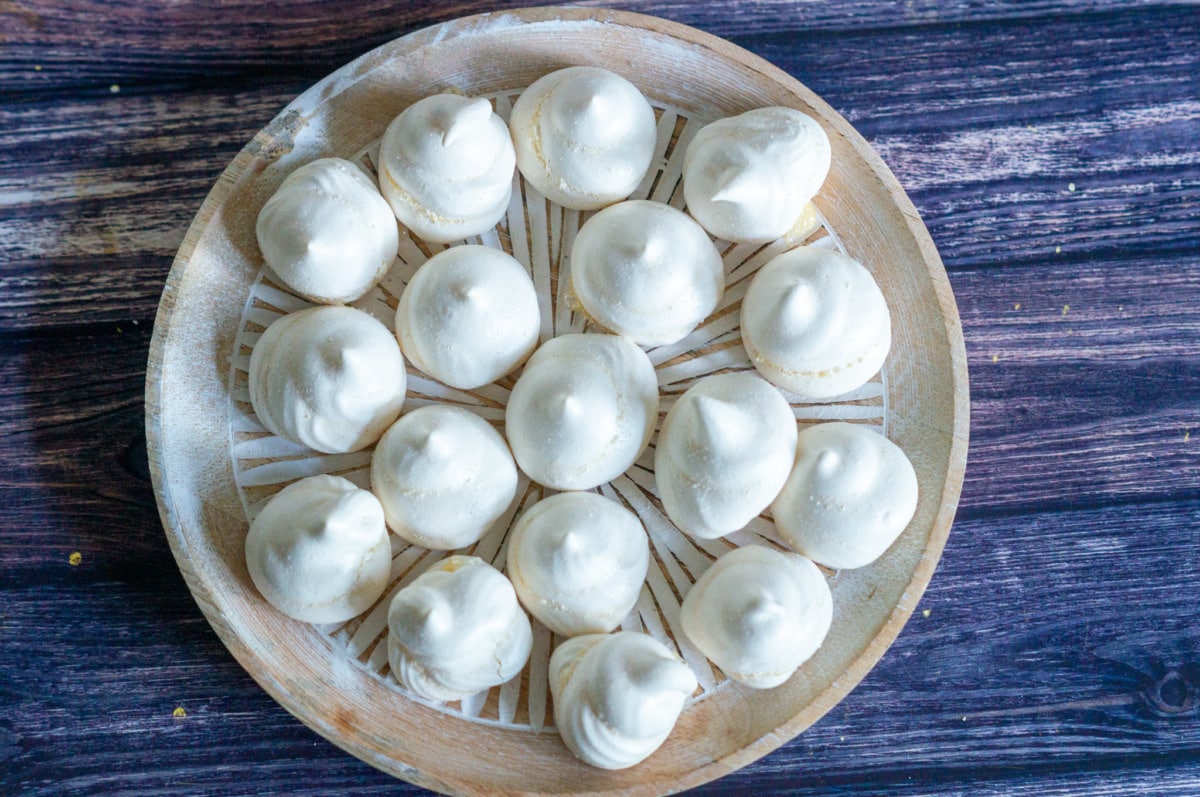
The timing of the sugar makes all the difference
Add the sugar after 2 minutes, once the foam shows soft peaks. Adding sugar too early (from the start) means it does not dissolve fully and leaves a grainy texture in the meringue. Adding it too late (after 4 minutes) reduces the volume because the foam is already too stiff to incorporate the crystals. Sweet spot: trickle in 1 tbsp of sugar every 30 seconds while continuing to whip at speed 3.5.
Also very important: the mixing bowl and butterfly whisk or whipping attachment must be completely grease-free. Even 0.5% fat in the bowl will prevent the egg whites from becoming stiff. Rinse with vinegar water (1 tbsp vinegar essence in 500 ml water) before whipping. More details on egg white technique in our comprehensive egg white guide.
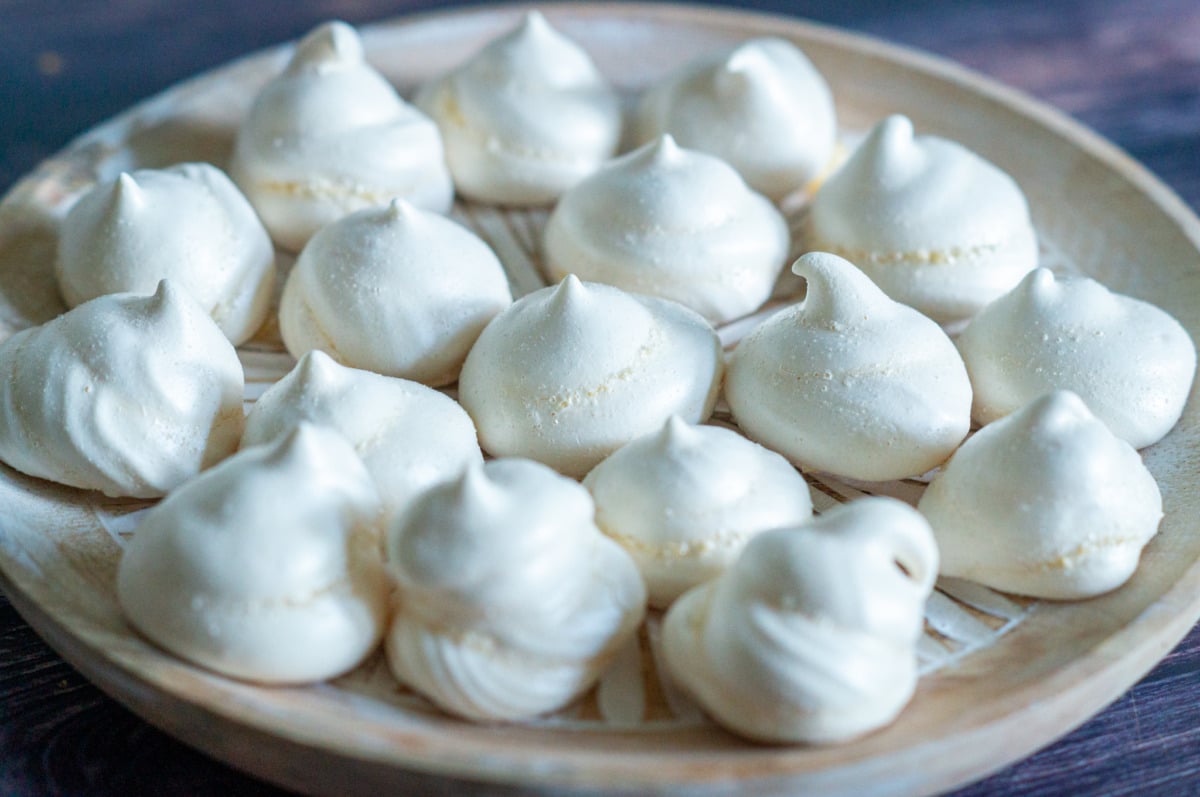
Drying, not baking: 3 hours at 100 °C
Goes well with: whipped cream.
At 100 °C, the water in the egg whites evaporates slowly without the protein browning or cracking. At a higher temperature (160 °C), you get meringues with brown tips, which taste different (a caramel note) but are not the classic white meringue. Professionals even use 80 °C over 5 hours for an even more perfect finish.
What to serve with meringues
As a topping for our chocolate mousse, as decoration alongside our blueberry ice cream, or in an Eton mess with cream and berries. More sweet classics in our desserts collection.