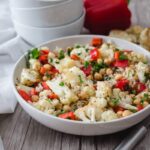
Cauliflower Salad with the Thermomix® takes 8 minutes and makes 4 servings (about 160 kcal per serving). 400 g raw cauliflower florets, 1 red pepper, 150 g chickpeas, parsley and a vinegar and oil dressing. The trick: the cauliflower is used raw, not cooked. In the mixing bowl it is chopped into small couscous-like pieces, giving a crisp and fresh salad texture.
We make this salad as a side dish for barbecues, as a light lunch or to take to work in a bento box. It is especially popular in summer, when heavy main courses feel too much. And it is low carb, vegan and gluten-free. One serving covers 80 per cent of the recommended daily intake of vitamin C.
Cauliflower Salad with the Thermomix®
Ingredients 0 / 8 ✓
- 400 g cauliflower florets
- 1 red pepper
- 150 g chickpeas from a tin
- 1/2 bunch flat-leaf parsley
- 30 g apple cider vinegar
- 30 g olive oil
- 1 tsp salt
- 1 tsp pepper
Instructions 0 / 3
-
1
Prepare the ingredients.
Cauliflower florets wash. Pepper wash and quarter (remove the core). Chickpeas drain. Parsley wash, shake dry and pick the leaves.
-
2
Chop the ingredients in the Thermomix®.
Add all the ingredients, except the chickpeas, to the mixing bowl and chop for 4 sec / speed 5 with the help of the spatula.
-
3
Mix and serve.
Add the chickpeas and mix for 7 sec / reverse direction / speed 3.
Video
Nutrition per serving
Why raw cauliflower: low carb instead of rice salad
Raw cauliflower, finely chopped, looks and feels similar to couscous or cooked rice. This gained popularity in the 2010s as “Cauliflower Rice”: a low-carb alternative to rice (5 g carbohydrates per 100 g instead of 30 g) with a similar mouthfeel.
Plus: the nutrients in raw cauliflower (vitamin C, glucosinolates, folate) are sensitive to heat. Cooking destroys 40 to 60 per cent of the vitamins. Using it raw keeps everything in.
The idea that raw cauliflower tastes strange is nonsense: cut into small pieces and dressed, it has a nutty, fresh flavour with no hint of cabbage. The dressing does most of the talking.
4 seconds at speed 5: no longer
The trick: chop the cauliflower, pepper and parsley together for 4 seconds at speed 5. Any longer and the salad turns into a puree. Any higher speed and the vegetables get pulverised rather than chopped.
Use the spatula to stir after the 4 seconds and check that everything is evenly sized. For any larger pieces: 2 more seconds. The result should be grain-sized pieces (3 to 5 mm). Too fine equals mush, too coarse equals chunky salad.
The chickpeas go in LAST, mixed for 7 seconds on reverse direction at speed 3. Reverse direction keeps the chickpeas whole.
Chickpeas: protein and staying power
150 g tinned chickpeas add 12 g of plant protein per serving (more than one egg). That is why this salad actually fills you up, rather than just being a nibble. Plus: fibre for good digestion.
Tinned chickpeas are convenient and just as good as home-cooked. Organic chickpeas tend to have a slightly softer texture. If you prefer to cook your own: soak 75 g dried chickpeas overnight, boil for 1 hour, and you get 150 g.
Alternatives: white beans, lentils or black beans work just as well. With edamame (Japanese soy beans) the salad takes on an Asian character.
Vinegar and oil dressing: 30 g plus 30 g
30 g apple cider vinegar plus 30 g olive oil gives a classic 1:1 dressing ratio. Apple cider vinegar is milder than wine vinegar and suits vegetables well. Extra virgin olive oil brings a Mediterranean note.
Alternatives: 30 g balsamic (sweet and savoury), 30 g lemon juice (fresher), 30 g rice vinegar (Asian style). For the oil: walnut oil (nutty), linseed oil (omega-3), pumpkin seed oil (intense). Avoid refined sunflower oil (too neutral, no flavour).
1 tsp salt plus 1 tsp pepper are the minimum seasoning. Add 1 tsp mustard for an emulsifying effect (the dressing stays together longer) or 1 tsp honey for a slightly sweet note.
Variations: Mediterranean, Asian, Indian, Summer
Mediterranean: add 50 g diced feta and 50 g olives. Plus oregano and thyme. Greek village salad style.
Asian: edamame instead of chickpeas, sesame oil instead of olive oil, 1 tsp soy sauce. Garnish with sesame seeds and spring onions.
Indian: 1 tsp curry powder plus 1 tsp garam masala plus 50 g grated carrots. Serve with a yoghurt dressing (yoghurt, lemon juice and salt).
Mexican: black beans instead of chickpeas, plus 50 g sweetcorn, 1/2 tsp cumin, 1 tsp lime juice. Garnish with diced avocado.
Summer version: 100 g halved cherry tomatoes, 50 g diced cucumber, 30 g pine nuts. Fresh and Mediterranean.
Tabbouleh style: 1 bunch of mint instead of parsley, plus 1 bunch of fresh coriander, plus 1 tsp sumac. Fresh and Levantine.
What to serve with cauliflower salad
As a side dish at a barbecue (steak, sausages, grilled vegetables). As a light lunch or supper. As a packed lunch in a bento box. As a healthy buffet dish at parties (vegan, gluten-free, suits everyone).
Also works as a couscous substitute under chicken curry, as a rice substitute under a mince sauce, or mixed with pesto as a pasta alternative. A satisfying low-carb main course.
Cauliflower salad keeps for 2 days in the fridge, do not freeze
Kept in a covered container in the fridge, it stays fresh for 2 days. On day two the flavours have melded together and it often tastes even better. If the dressing has settled at the bottom, give it a good stir before serving.
Freezing does NOT work: raw cauliflower turns watery and limp when thawed, and so does the pepper. The salad texture is ruined. Better to make it fresh (8 minutes is all it takes).
Pro tip for the bento box: make the salad in the morning but store the chickpeas separately (otherwise they go soggy), then combine just before serving. This keeps the salad crisp for up to 6 hours.
Goes well with: flatbread, feta and hummus.