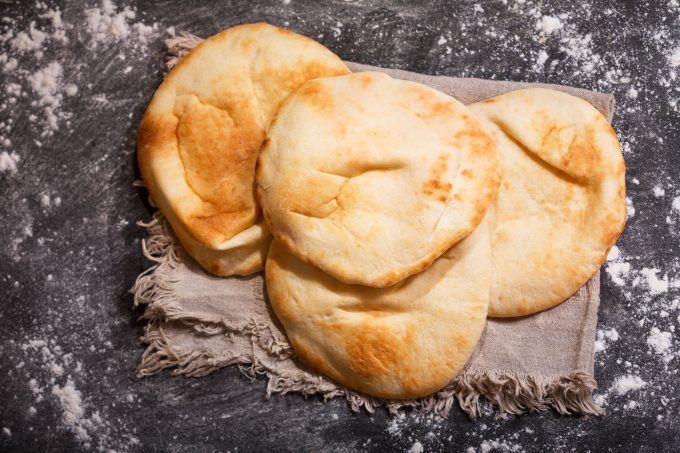
Pitta bread is not ordinary bread but a controlled heat experiment. The pocket does not come from a secret recipe but from water vapour that bursts between the layers of dough the moment real heat at 250°C hits from below. If the tray goes into the oven cold, the bread stays flat. If the base is hot enough, the rounds puff up within 60 seconds like small balloons.
We have been baking pitta regularly for years, mostly to go with Tzatziki, occasionally with minced lamb, or simply with olive oil and salt as a snack. The first attempts were disappointing: dense flatbreads with no pocket, because we underestimated the oven and slid the trays into the heat too late. We now know what really matters, and it has less to do with the dough than with what happens underneath it.
Pitta Bread with the Thermomix®
Ingredients 0 / 6 ✓
- 200 g water lukewarm
- 100 g milk
- 1/2 cube fresh yeast
- 420 g plain flour (Type 405) + extra flour for dusting
- 2 tsp salt
- 20 g olive oil + a little extra for the baking trays
Instructions 0 / 5
-
1
Mix water, milk and yeast.
Add water, milk and yeast to the mixing bowl, mix for 2 minutes / kneading mode and leave to rest in the mixing bowl for 15 minutes.
-
2
Knead the yeast dough.
Add the remaining ingredients to the mixing bowl and knead for 10 minutes / kneading mode. Transfer the dough to a large bowl, cover with a tea towel and leave to prove for 40 minutes.
-
3
Shape the dough.
Divide the dough into 8 pieces on a floured work surface and shape into balls. Cover the balls with a tea towel and leave to rest for 15 minutes.
-
4
Preheat the oven.
Meanwhile, preheat the oven to 250°C (top and bottom heat). Brush the baking trays evenly with olive oil.
-
5
Bake.
Oil your fingers with olive oil and flatten the balls into rounds. Place on the baking trays and bake on the middle shelf for 6 to 8 minutes. Best served while still warm.
Tip: You can sprinkle the pitta breads with black sesame seeds before baking.
Nutrition per serving
Why pitta puffs up at all
Inside each flattened round sits residual water from the 200 g of lukewarm water and 100 g of milk. The moment the round hits a very hot surface, that water evaporates instantly. The steam has no way out because the outer layer is sealed by the heat straight away. So it pushes the centre apart and drives the top and bottom away from each other. That is the pocket we later fill with Tzatziki or falafel.
For that to work, three conditions have to come together: the dough must be elastic enough not to tear; the oven must genuinely reach 250°C, not 220 or 230; and the heat must shoot into the dough from below, not creep through a cold tray first. If any of these three conditions is missing, you get a flat flatbread. Still tastes good, but there is no pocket.
The yeast dough in the Thermomix®
We start with the 200 g water, 100 g milk and half a cube of yeast in the mixing bowl. Mix for 2 minutes / kneading mode, then leave to rest in the mixing bowl for 15 minutes. This pause is not overkill but a pre-ferment: the yeast draws in oxygen in the lukewarm liquid and produces the first gases. If you tip the flour straight in, the yeast has not yet activated, and the dough will be tougher.
After the pre-ferment, add 420 g plain flour, 2 tsp salt and 20 g olive oil. Knead for 10 minutes / kneading mode. That is longer than for a standard bread dough, and it is intentional. Pitta bread needs a strong gluten network, because that network is what traps the water vapour later. If the dough is kneaded for too short a time, it tears in the oven, the steam escapes, and the pocket does not form.
We tip the dough into a large bowl, cover it with a damp tea towel and leave it to prove for 40 minutes. The towel must be damp, not dry, otherwise the dough forms a skin on top that tears when you shape it. In a warm kitchen the dough nearly doubles in 40 minutes. If there is a draught or it is cooler, leave it for 60 minutes instead.
From dough ball to flatbread
Turn the proved dough onto a floured work surface and divide it into 8 equal pieces. We weigh the pieces because uneven balls puff up unevenly in the oven: the smaller ones go hard first, the larger ones stay doughy inside. With roughly 740 g of dough that works out at about 92 g per piece.
Round each piece by rolling it under a cupped hand on the work surface until a smooth top forms. That smooth top matters because it becomes the upper layer of the pocket later. Cracks or folds tear open in the oven, and every crack lets steam escape. Cover the 8 balls with a tea towel and leave to rest for 15 minutes. This intermediate prove relaxes the gluten, otherwise the dough springs back when you press it flat.
The oven is the real star of the show
While the dough rests during its 15-minute intermediate prove, we preheat the oven to 250°C top and bottom heat. Fan-assisted works less well here because it dries the surface before the steam from below can do its job. If your oven only goes up to 230°C, switch the grill on for the last minute; that helps.
The crucial step: instead of loading a cold tray with the rounds, we slide the tray into the hot oven empty and preheat it for at least 15 minutes. If you have a pizza stone, use that; otherwise an upturned baking tray works just as well. The idea is always the same: a genuinely hot base that kicks the dough from the very first second. On a cold tray the dough loses too much energy for too long, the water inside evaporates too slowly, and the bread stays flat.
If you do not have a second tray, a heavy cast-iron frying pan placed upside down on the rack works too. The point is to have a preheated, hard, smooth surface that drives heat into the dough the moment you place the bread on it. Brush a thin layer of olive oil onto the hot surface to prevent sticking and add a little colour.
Bake, watch, take out
Press each ball flat with your fingers one at a time, not with a rolling pin. A rolling pin pushes the air out of the dough, and without air bubbles there is no steam pressure. We oil our fingers with olive oil and press each ball to about 12 cm in diameter and half a centimetre thick. Thicker is possible, but then the pittas turn out stodgy rather than light.
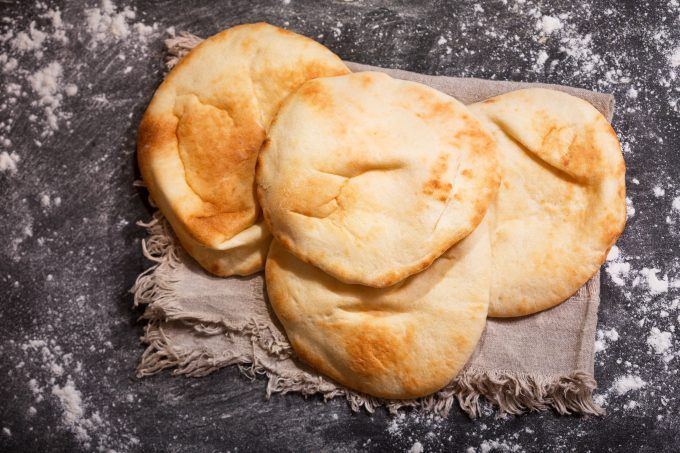
Place the rounds quickly on the preheated tray and close the oven door straight away. Every second with the door open costs 5°C. Bake on the middle shelf for 6 to 8 minutes. After about 90 seconds you can see through the glass how the first rounds start to puff up. That is the sign that everything is going to plan. As soon as the pittas are lightly browned all over, take them out. Longer in the oven means drier, and dry pitta tears when you cut it open instead of unfolding.
What can go wrong
No pocket forms. In nine out of ten cases the tray was not hot enough. We now check with a cheap infrared thermometer: below 220°C base temperature, nothing puffs up. The fix is to preheat the tray longer, at least 15 minutes. If the oven is weak, place the tray directly on the oven floor.
The pittas tear open at the sides. The dough was not elastic enough, usually because it was kneaded for too short a time or not proved for long enough. Next time, run the full 10 minutes of kneading mode and give the main prove a full 60 minutes.
The pitta stays doughy in the middle. Pressed out too thick. Use your fingers to flatten it properly. Half a centimetre is the upper limit. With thicker rounds the steam cannot split the layers and the pitta turns chewy.
The pitta comes out hard and board-like. Either too long in the oven or left to sit in residual heat after baking. Pitta should go straight from the oven under a tea towel in a basket. The trapped moisture works back into the crumb within 5 minutes and makes the breads pliable.
Variations that actually work
With sesame or nigella seeds on top. Brush the rounds with a little water before baking and scatter the seeds over. The sesame toasts in the oven alongside the bread and the aroma carries through the whole pitta.
With a wholemeal element. Replace up to 100 g of the plain flour with wholemeal flour. More than that makes the dough less elastic and the pocket less reliable. We settled on 80 g wholemeal to 340 g plain flour. That is the point where flavour and pocket still work together.
With olives or sun-dried tomatoes. Mix them in as small pieces just before the main prove. Important: not too many, or the pieces disrupt the gluten network and the pocket collapses. 50 g into the dough is the limit.
Sweet, as a naan-style variant. We mix 1 tbsp of honey into the pre-ferment and bake for only 5 minutes instead of 8. The pitta comes out softer and works well with yoghurt dips or fruit.
2 days in the fridge, warmed back up in a pan
Pitta tastes best warm from the oven and there is no way around that. Whatever is left over should go straight into a bread bag or an airtight container, otherwise the rounds dry out within half an hour. Stored like that, they keep for two days at room temperature. The fridge makes them tough, so it is better to keep them at room temperature or freeze them straight away.
To freeze, we place the pittas individually between sheets of baking paper and pack the stack into a freezer bag. They keep for three months that way. Reheat in a toaster or in a dry frying pan over medium heat for 60 seconds. They are almost as good as fresh. The microwave does not work. It makes the pitta rubbery.
Our pitta goes best with a creamy Tzatziki, a coriander spread, or classic hummus with olive oil. Anyone looking for more bread and roll recipes will also find hazelnut rolls and Mediterranean rolls on our site. And if you want to read more about baking with the Thermomix®, that is where our collection of tried-and-tested baking recipes lives.
Plain flour or strong flour? Our answer
Goes well with: Hummus, Tzatziki and gyros.
You might also like: Braided bread with the Thermomix®.
Most pitta bread recipes online use strong bread flour because it contains more gluten protein and forms a more stable network. We stick with plain flour (Type 405) all the same. The reason is the kneading time: 10 minutes on kneading mode in the Thermomix® is enough to develop an elastic network from plain flour that holds the steam reliably. Strong flour tends to turn tough at that point and needs a longer main prove to become pliable again. If you do want to use strong flour, extend the 40-minute prove to 60 minutes and shape the rounds half a centimetre thicker, otherwise they tear at the sides as they puff up.