Fresh herbs last three days in the fridge, lose their colour in the freezer, and taste like hay when dried. We turn them into a paste with 100 g of salt and a splash of olive oil, and suddenly that summer flavour keeps for six months.
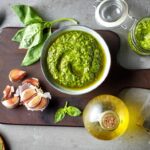
We have been making this paste every year at the end of July, when the garden produces parsley, basil, oregano, thyme, and rosemary all at once. Three 250 g jars keep us going through the whole winter. One tablespoon replaces a whole bunch of fresh herbs in tomato sauce, lentil soup, Risotto, or as a seasoning for sauteed potatoes.
Long-Life Herb Seasoning Paste with the Thermomix®
Ingredients 0 / 11 ✓
- 1 bunch parsley
- 4 sprigs oregano
- 1/2 bunch basil
- 2 sprigs thyme
- 2 sprigs rosemary
- 5 dried tomatoes
- 300 g parsley root
- 100 g celeriac
- 1 spring onion
- 2 garlic cloves
- 100 g salt
Instructions 0 / 4
-
1
Prepare the herbs.
Wash the herbs, shake off the water, pat dry, and strip the leaves and needles from the stalks.
-
2
Prepare the vegetables.
Wash and peel the parsley root and celeriac, then cut into pieces. Wash the spring onion and cut into pieces. Peel the garlic.
-
3
Chop everything.
Place all ingredients in the mixing bowl and blend for 10 seconds / speed 10. Push down with the spatula and repeat twice.
-
4
Fill into jars.
Spoon the seasoning paste into sterilised jars and store in the fridge.
Notes: Make sure your herbs are completely dry before placing them in the mixing bowl. If you have worked cleanly, your herb seasoning paste will keep for several weeks when stored in the fridge.
Tip: You can also blend your herb seasoning paste with olive oil. It will keep just as well.
Video
Nutrition per serving
Why salt and oil actually preserve the herbs
Preservation here works through two mechanisms that work together and that we use deliberately.
Salt draws out water. With 100 g of salt to around 600 g of plant matter, we end up with a salt content of roughly 14 per cent in the finished paste. Above about 10 per cent, most bacteria and mould spores stop working because the salt robs them of their cell water. This is the same principle as cured meat or salt-pickled gherkins, except that here the parsley root and celeriac provide the starch and sweetness that make the salt taste less aggressive.
Olive oil forms a protective layer. When you add a tablespoon of olive oil on top of the paste after filling the jars, the oil seals the surface airtight. Oxygen is the second cause of spoilage after water, because it triggers oxidation and turns the fresh green colour into a dull brown. The oil layer stops this process, as long as we use a clean spoon and cover the surface with oil again after each use.
The Thermomix® chops at cell level. At 10 seconds / speed 10, repeated three times with a scrape-down in between, the plant cells break open so thoroughly that the salt really reaches everywhere. Herbs chopped by hand retain too many intact cells, in which water later collects and mould takes hold. That is why this paste lasts longer in the mixing bowl than any hand-chopped herb butter.
What really determines whether the paste keeps for six months
Herbs must be bone dry
Residual moisture is the most common reason the paste develops mould spots on top after three weeks. After washing, strip the leaves and needles individually, lay them in a clean tea towel, place a second towel on top, and press down firmly with the flat of your hand several times. If you want to be thorough, spread the herbs out on a tray afterwards and leave them for 30 minutes. We now use a salad spinner with a herb insert, which saves the towel step.
Jars must be sterilised
We boil the screw-top jars along with their lids in vigorously boiling water for ten minutes, then stand them upside down on a clean tea towel. We only fill the paste in once the jars are completely dry. Skipping the drying step introduces water and the salt has less effect in the top centimetre. Alternatively, the oven method works too: 120 °C for 15 minutes leaves the inside of the jars genuinely germ-free.
Do not reduce the salt
We get questions every year asking whether 100 g of salt is too much. The answer is no, because the salt is what does the preserving. If you reduce the salt, the shelf life drops to a few weeks. If you want to cook with less salt, simply use the paste more sparingly in the finished dish. One teaspoon is enough for a sauce for four people, which adds around 1.5 g of salt, less than a small pinch.
Do not leave out the root vegetables
The 300 g of parsley root and 100 g of celeriac make up roughly half the paste by weight. The root vegetable base is not a filler, it is the flavour framework. A paste made from herbs alone tastes sharp and harsh, because the essential oils become too dominant without a carrier sugar. The root vegetables bring natural sweetness and starch, to which the aromas can bind. If you cannot find parsley root, use parsnip in the same quantity. Carrot does not work here, it is too sweet and overpowers the herbs.
How we vary the paste throughout the year
Mediterranean version: More rosemary, more thyme, less parsley. Plus 5 more dried tomatoes and a tablespoon of tomato puree. Goes well with pasta, Bruschetta, and roasted vegetables.
Frankfurt green sauce: Parsley, chives, chervil, salad burnet, sorrel, borage, and cress in equal parts, instead of the Mediterranean mix. In summer we also freeze portions in ice-cube trays, so we have green sauce in February too. For the classic sauce, our green sauce from the Thermomix® without preservation works better.
Asian twist: Instead of rosemary and oregano, use fresh coriander, a thumb-sized piece of ginger, and a small chilli. We use this to season rice dishes, stir-fried vegetables, or a quick peanut sauce.
Oil-based version: If you want the paste mainly for pasta, replace 50 g of salt with 100 g of olive oil. The shelf life then drops to around eight weeks, but it tastes milder and can be spooned straight into hot pasta.
What we actually use the paste for
One tablespoon replaces a bunch of fresh herbs plus the salt needed for a main course. We add the paste at the end of cooking so it keeps its fresh notes. In our kitchen, specifically:
- In every stew, stirred in just before serving
- In tomato sauce, one heaped teaspoon per 500 g of sauce
- Spread on buttered farmhouse bread with thin tomato slices
- Stirred into quark, served with jacket potatoes
- As a marinade for chicken fillets, loosened with olive oil
- In salad dressing, so no extra salt is needed
If you like the idea but prefer to use herbs fresh rather than preserving them, take a look at our wild herb butter, our classic herb butter, or our herb pull-apart bread. Those three recipes are the fresh-use version of the same summer idea, just without the long shelf life.
Storage and how to take it out correctly
In the fridge at 4 to 6 °C our jars keep for six months, sometimes longer. After each use we smooth the surface with the spoon and pour a tablespoon of olive oil over it, so the paste disappears again under a thin film of oil. The spoon must be clean and dry, so do not dip it back into the jar from a hot sauce. In an opened jar, always check for discolouration. A light, yellow-green layer on top is normal and comes from the oil. Dark spots or a whitish fuzz mean mould and the jar goes in the bin.
Also worth a look: Low Carb Crumble with the Thermomix®.
If you want to portion the paste, freeze it in ice-cube trays, where it will keep for twelve months. Once thawed, the texture changes slightly but the flavour stays the same. Drop the frozen cubes directly into hot pots and they dissolve as you stir.