If you stir 400 g of double cream at speed 4 for 7 minutes, you will not get whipped cream. You get real butter, and real buttermilk as a bonus.
The principle is simple: double cream is made up of fat and water. Speed 4 stirs fast enough that the two separate. The fat globules clump together and become butter, the water drains off and becomes buttermilk. We make this whenever we need buttermilk for pancakes or waffles anyway. Two products, one run, 15 minutes.
Homemade Butter in the Thermomix®

Ingredients 0 / 2 ✓
- 400 g double cream
- 200 g water ice cold
Instructions 0 / 5
-
1
Whip the cream.
Add the double cream to the mixing bowl and stir for 7 minutes / speed 4. This produces butter and buttermilk.
-
2
Drain the buttermilk.
Place the steaming basket into the mixing bowl, hold it firmly and pour the buttermilk into a container.
-
3
Rinse with water.
Add 200 g water to the mixing bowl and stir for 40 seconds / speed 4.
-
4
Wash the butter.
Drain the butter through the steaming basket and knead it continuously (by hand) under cold running water until the water runs clear.
-
5
Chill the butter.
Either shape the butter into a roll and wrap it in greaseproof paper, or place it in a sealable container and store in the fridge.
Tip: If you prefer salted butter, add about 5 g of salt in step 1.
The butter can be used as a base for herb butter, garlic butter or any number of other variations.
Video
Nutrition per serving
What happens during churning and why the Thermomix® does it better
By hand, homemade butter requires a jar that you shake for several minutes until your arm aches. The Thermomix® takes care of it in 7 minutes without you having to stand over it. Speed 4 is key here: speed 3 is too slow (the cream does not separate completely), and speed 5 breaks the butter up too finely so it separates less well.
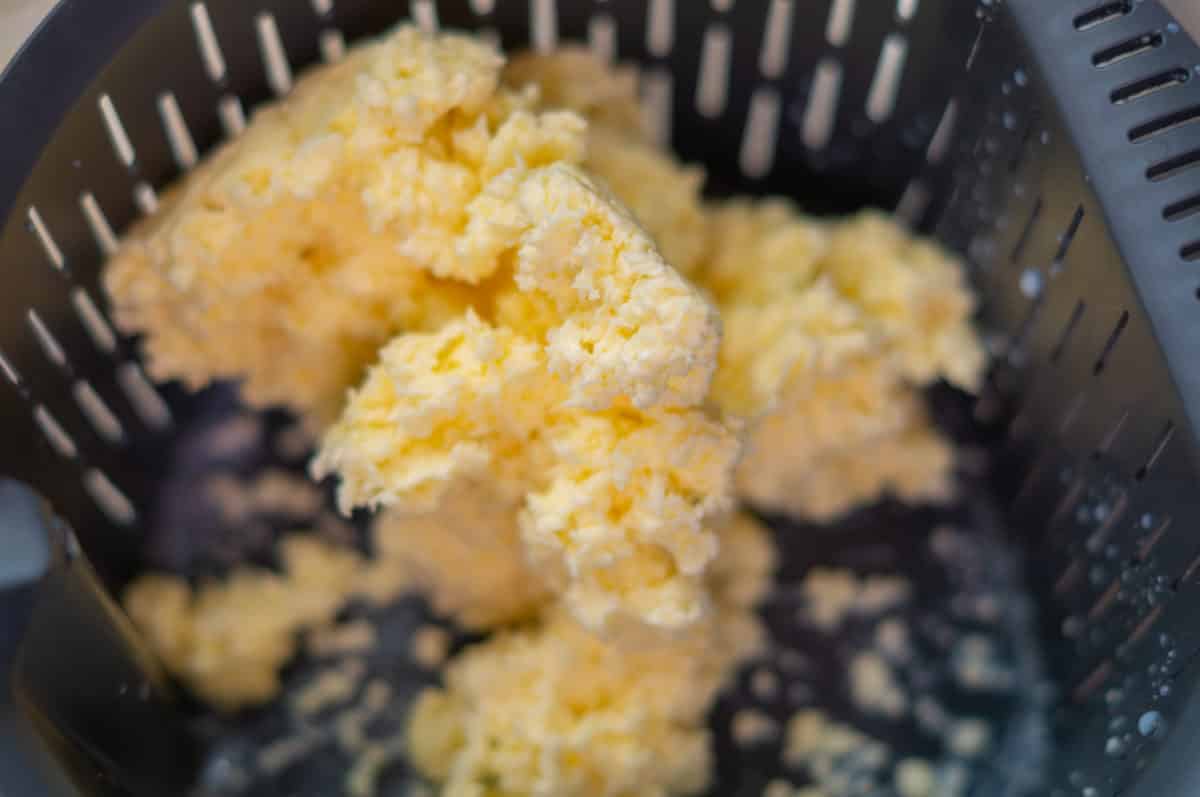
The 400 g of double cream passes through four visible stages:
- Foamy (minutes 1 to 2): The cream takes in air and thickens. It looks like the beginning of whipped cream.
- Firm (minutes 3 to 4): The mixture becomes so thick that the mixing bowl gets noticeably louder.
- Crumbly (minutes 5 to 6): The mixture starts to fall apart. This looks wrong but is exactly right.
- Separation (minute 7): The fatty lumps are butter, the liquid beneath is buttermilk.
The key points when washing the butter
The washing step is often underestimated, but it is what determines how long the butter keeps. After churning, buttermilk is still trapped in the butter. It spoils quickly and reduces shelf life to just a few days. Washing the butter thoroughly gives you 2 weeks of fridge life.
Here is how to do it properly: place the steaming basket into the mixing bowl and pour off the buttermilk. Then add 200 g of ice-cold water and run for 40 seconds at speed 4. Drain the butter again. Now comes the hands-on part: knead the butter under cold running water until the water running off is clear. This takes 2 to 3 minutes. If you get impatient and stop while the water is still slightly milky, the shelf life will be shorter.
Pressing a clean tea towel over the butter absorbs the last traces of moisture and makes the butter firmer. This is especially useful if you want to shape it into a roll wrapped in greaseproof paper.
Cream quality and what it means for the result
We always use double cream with at least 30% fat for homemade butter, 32 to 36% is even better. The higher the fat content, the more butter you get. From 400 g of standard double cream (30%) you get around 150 g of butter. Creme double would give more, but the price-to-yield ratio does not make it worthwhile.
Fresh cream from the chilled aisle gives a different result from long-life cream. We have tried both: long-life cream works, but the flavour is milder. Once you have made butter with fresh farm cream, you notice the difference the moment you slice into the finished butter.
What you can do with the buttermilk
From 400 g of double cream you get roughly 250 ml of real buttermilk. Not the watered-down product from the supermarket, but full-flavoured buttermilk. We collect it in a screw-top jar and use it the same day. In Thermomix® pancakes, buttermilk makes the batter lighter than plain milk. Make butter in the morning and you will have fluffier pancakes by lunchtime.
The buttermilk is also the base for a sourdough starter, a marinade or a buttermilk dressing. It keeps in the fridge for 2 to 3 days.
Salting, flavouring and using the butter further
If you want salted butter, add 5 g of salt directly to the cream in step 1. The salt distributes evenly during churning. Sea salt flakes are added after washing if you want the typical visible salt crystals on the butter.
Homemade butter is the best base for variations because it has no added flavour. We regularly make:
- Thermomix® herb butter with parsley, chives and garlic
- Thermomix® garlic butter for the barbecue
- Wild herb butter in spring
- Tomato butter for pasta
- Flower butter for special occasions
How long homemade butter keeps
In the fridge: well-washed butter wrapped in greaseproof paper keeps for 2 weeks. In a covered butter dish it keeps even a little longer, as it absorbs fewer outside flavours.
In the freezer: butter freezes without any trouble. Wrap it in greaseproof paper, place it in a freezer bag and it keeps for up to 3 months. Defrost overnight in the fridge, not at room temperature (the water will separate at room temperature).
As a butter roll: after washing, place the warm butter on greaseproof paper, shape into a roll, wrap it tightly and chill for 2 hours. This makes it easy to slice cleanly.
If the separation does not work
Goes well with: radishes and honey.
The most common reason why butter and buttermilk have not separated cleanly after 7 minutes is that the cream was too warm. We always take it straight from the fridge and do not leave it on the worktop beforehand. Above 15°C the cream stays foamy and does not tip into the crumbly stage. If nothing has separated after 7 minutes, simply run it for another 2 to 3 minutes rather than giving up. Fat content also matters: below 30% it works poorly, whipping cream with 32 to 36% is ideal and gives a better yield, roughly 150 g of butter from 400 g of cream.
Homemade butter is the base for many further recipes. Once you start making it, you will rarely buy it again.