Pull-apart bread differs from a herb butter pizza by just one step: the strips are stood upright in the loaf tin rather than laid flat. We have been making bread this way for years, and that single step is what determines whether you get properly tearable layers or just a flat, buttery flatbread out of the oven.
We bring this bread to barbecue parties regularly because it solves two things at once: it replaces the usual supermarket baguette and doubles as a little show-stopper. Nobody slices a piece off. Everyone tears out a layer. That is exactly why the layering matters. In the Thermomix®, preparation takes 15 minutes plus proving time, and the mixing bowl only needs a quick rinse before the herb butter comes together in it.
Herb Pull-Apart Bread with the Thermomix®
Ingredients 0 / 12 ✓
- 200 g water
- 40 g olive oil
- 1 1/2 tsp salt
- 1/2 cube fresh yeast
- 500 g flour, type 405 (plain flour)
- 1 garlic clove
- 1/2 bunch parsley
- 1/2 bunch chives
- 1/2 tsp dried tarragon
- 1/2 tsp salt
- 1 tsp medium-hot mustard
- 150 g butter
Instructions 0 / 8
-
1
Dissolve the yeast.
Add water, olive oil, salt and yeast to the mixing bowl and heat for 3 min / 37°C / speed 1.
-
2
Knead the dough.
Add the flour and knead for 2 min / kneading mode until a dough forms.
-
3
Prove.
Transfer the dough to a bowl, cover and leave to rise in a warm place for 1 hour. Rinse the mixing bowl.
-
4
Garlic.
Peel the garlic, add to the mixing bowl and chop for 3 sec / speed 8.
-
5
Herbs.
Wash the parsley and chives, shake dry, remove any tough stalks, then add to the bowl together with the tarragon, salt and mustard and chop for 5 sec / speed 6.
-
6
Mix in the butter.
Add the butter in pieces and mix for 30 sec / speed 4.
-
7
Shape the dough.
Roll the dough out on a floured surface to slightly larger than a baking tray, spread with the herb butter, cut into 5 strips, fold them accordion-style, layer them upright in a greased loaf tin and leave to prove for a further 15 minutes.
-
8
Bake.
Preheat the oven to 220°C top and bottom heat and bake the bread on the middle shelf for 25 minutes. Best served warm.
Tip: You can vary the bread by tucking rashers of bacon and/or cheese between the layers.
Video
Nutrition per serving
Why the strips must stand upright
When we roll out the yeasted dough, spread it with herb butter and cut it into five equal strips, we end up with five butter-coated layers. If we stack those layers flat in a loaf tin, the butter melts out of the gaps during baking, the layers sink together and fuse into one solid mass. The result is a bread that is barely distinguishable from a plaited loaf.
If we stand the five strips upright in the tin instead, the buttered surfaces face sideways. The heat drives the dough upward, the butter seeps into the side joints and forms the small, flaky gaps that let you pull the layers apart. The tin only sets the direction: the geometry of the bread comes from the vertical layering, not from the tin itself.
That is also why we do not recommend a shallow roasting dish or a round springform tin. A loaf or bread tin of about 25 cm length forces the five strips into a row. In a wide dish they topple and the layering is lost. If you do not have a loaf tin, you can fold two strips of baking paper into a supporting wall inside a regular dish.
How the dough and herb butter come together in the mixing bowl
The yeasted dough needs 200 g water, 40 g olive oil, one and a half teaspoons of salt, half a cube of fresh yeast and 500 g plain flour (type 405). We add the water, oil, salt and yeast to the mixing bowl and set it to 3 min / 37°C / speed 1. The 37°C is not arbitrary. At this temperature the yeast dissolves evenly without the yeast cells being damaged. The flour goes in next and the Thermomix® kneads for 2 min / kneading mode. The dough does not need longer. Plain flour develops its gluten during the resting time.
We tip the dough into a floured bowl, cover it and place it somewhere warm. One hour is usually enough. On cooler days it is worth putting the bowl on a radiator or in the oven preheated to 30°C. While the dough proves, we rinse the mixing bowl once. Traces of yeasted dough will not spoil the herb butter, but anyone who makes the butter in a smeared bowl will end up with greenish dough scraps on the work surface.
For the herb butter, we peel the garlic clove and drop it into the running mixing bowl for 3 sec / speed 8. Then in go half a bunch of parsley, half a bunch of chives, half a teaspoon of dried tarragon, half a teaspoon of salt and one teaspoon of medium-hot mustard. Everything is chopped for 5 sec / speed 6. Speed 6 is important here: higher and the parsley turns to a mushy paste; lower and stalks remain that will get stuck in your teeth. Finally 150 g of room-temperature butter in pieces goes in and mixes for 30 sec / speed 4. If you use cold butter straight from the fridge it will stick to the walls of the mixing bowl. Taking it out half an hour beforehand is enough.
The mustard is not there for flavour. It acts as an emulsifier. It binds the butter with the moisture from the herbs and stops the butter beading off the dough in droplets. Without mustard, half the herb butter runs off during layering and pools at the bottom of the tin.
The five strips, the accordion fold and the loaf tin
After an hour of proving the dough will have visibly doubled in size. We tip it onto a floured surface and roll it out into a rectangle roughly the size of a baking tray, about 30 by 40 cm. If you roll it too thin you get crisp but fragile layers. If you leave it too thick you will only fit three rather than five clean folds into the tin. Just under half a centimetre thick is the mark that has worked most reliably for us over hundreds of attempts.
We spread the herb butter generously over the entire surface with a spatula. It is fine to use a good amount. The dough absorbs more butter than you might expect. We then cut the rectangle lengthways into five equal strips. A pizza wheel helps, but a sharp knife works just as well. Straight cut edges are important. Diagonal strips will not stand upright properly in the tin. They topple and fill the loaf tin unevenly.
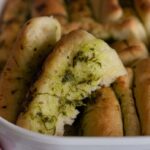
Now comes the accordion step. We take the first strip, lay the second one buttered-side down on top, then the third, fourth and fifth, building a tall stack of five layers. We then cut this stack crossways into pieces roughly the height of the loaf tin. We place the pieces upright in the greased tin, one beside the other, with the cut edges facing upward. It looks like a row of books standing on a shelf with green spines. That is exactly the picture we want, because those layers are what grow into the pull-apart folds during baking.
Fifteen minutes of final proving in the tin at room temperature is enough, then the bread goes into the oven at 220°C top and bottom heat for 25 minutes on the middle shelf. Top and bottom heat rather than fan is important here: fan dries the surface too quickly and seals the gaps before the dough can rise. After 20 minutes it is worth checking. If the surface is already darkening, we loosely lay a piece of baking paper over the top.
When the bread stays raw in the middle
The most common problem with pull-apart bread is not the crust but the centre. The outside looks perfectly browned while the dough in the lower layers is still sticky. We regularly come across three causes. First: the strips were stacked too thick, so the heat cannot reach the centre of the layers. The fix for next time is to cut six narrower strips instead of five. Second: the tin was too small and the dough pushed upward rather than baking through. A loaf tin 25 to 30 cm long is the right size for the quantities in this recipe. Third: the oven was not preheated. Pull-apart bread needs the heat shock from the start. Without it the yeast keeps working instead of stopping inside the dough.
If we notice the centre is still raw, we cover the bread with foil and bake it for a further 5 to 8 minutes. The foil stops the top crust burning while the centre finishes cooking. For the skewer test: a wooden skewer must come out clean. Greasy residue on the skewer is just butter, not a sign of raw dough.
A second common problem is butter running out of the tin onto the oven floor. This happens when too much butter was spread on or when the tin is too small and the strips protrude above the rim. Placing a baking tray on the shelf below the loaf tin catches any drips and prevents smoke in the kitchen.
Wild garlic, tomato, cheese: what we layer instead of parsley
Wild garlic pull-apart bread in spring. In April and May we replace the parsley and chives with a whole bunch of wild garlic and leave out the tarragon and mustard. The garlic clove is no longer needed either, as the wild garlic provides the sharp note. The wild garlic pesto method from our pesto recipe works here exactly as written, just with butter instead of oil as the base.
Tomato butter with sun-dried tomatoes. For a Mediterranean flavour, replace the fresh herbs with 50 g sun-dried tomatoes in oil and one tablespoon of dried Italian herbs. We make this version often when fresh herbs are in short supply. Our tomato butter recipe gives the right proportions.
Cheese between the layers. 100 g grated mountain cheese or Cheddar spread across the five strips melts into the gaps during baking and stretches into long strings when you pull the bread apart. Watch the salt: we reduce the salt in the butter to a quarter teaspoon because the cheese is already well seasoned.
Bacon instead of salt. Three strips of cooked breakfast bacon, finely diced, give the bread a hearty, rustic direction. This works especially well alongside soups such as our cabbage soup.
Sweet with cinnamon and sugar. If you want a sweet version, replace the herb butter with a mixture of 100 g soft butter, 60 g sugar and a heaped teaspoon of cinnamon. The bread is then served at breakfast and tastes like cinnamon rolls in loaf form.
What we serve with pull-apart bread
Pull-apart bread is a side, not the main event, and needs something to dip or spread. At barbecue parties we put it on the table alongside our wild garlic pesto, tomato pesto and basil pesto. The pestos complement the herbs in the butter and give the bread two layers of flavour. Anyone who wants to boost the garlic note can reach for extra herb butter from the Thermomix® as a dip.
With soups, pull-apart bread works particularly well because the layers can be dunked without the whole piece falling apart. Broccoli salad or Obatzda are our standard accompaniments when we want something less meat-heavy. For a Bavarian combination we serve it with white sausage and sweet mustard.
If you want to make more yeasted bread at the same time, our pizza dough uses the same yeasted base and the bread hub has all the other yeasted breads we make in the Thermomix®. Our plaited loaf also uses a similar kneading logic, just with milk instead of water and a long overnight prove. Herb salt on the crust before baking is the quickest way to add extra flavour to the bread.
Reheating, freezing, the next day
Pull-apart bread is best warm from the oven, but it keeps perfectly well for 24 hours in a bread box or under a clean tea towel. In a plastic bag it loses its crust within a few hours, which is the worst way to store it. By the second day it dries out, but it can be revived in the oven at 160°C for 5 minutes. A small dish of water alongside creates steam and brings the crust back to life.
Freezing works well if we wrap the whole bread or individual portions directly in foil as soon as it has cooled and put it in the freezer. It keeps for up to three months. To defrost, leave it in the fridge overnight, then bake it in the oven at 180°C for 8 to 10 minutes. Avoid the microwave: it makes the bread rubbery because the butter softens rather than melting properly.
Also goes well with: soup and cheese.
Also worth trying: Panini with the Thermomix®.
We like to use any leftovers from the day before to make garlic croutons. Tear the layers into cubes, bake in the oven at 180°C for 8 minutes until crisp, then scatter over soups or salads. The herb butter inside provides the flavour straight away.
More breads from the Thermomix® can be found in the bread hub, with pizza dough as a quick alternative, the plaited loaf for a sweeter direction and herb butter as a dipping option.