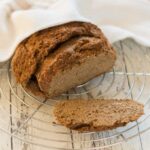
A bread without a single gram of flour that still tastes like bread and does not crumble: this works because ground linseeds bind liquid like a sponge. That very property is what turns low-fat quark, eggs and linseeds into a kneadable dough. We have been baking this linseed quark bread regularly for years, especially when we do not want to skip a bread-based meal in the evening but want to keep the carbs low.
The finished loaf weighs around 700 g, delivers roughly 12 g of protein per slice at only 2 g of carbohydrates, and keeps you full noticeably longer than any wheat bread. One slice keeps us going comfortably from breakfast through to lunch. If you are starting out with low carb eating or simply want more protein at breakfast, this is a basic recipe that works every time and can be varied however you like.
Low Carb Linseed Quark Bread, Thermomix®
Ingredients 0 / 9 ✓
- 90 g linseeds
- 60 g pumpkin seeds
- 1 sachet cream of tartar baking powder
- 1 tsp salt
- 300 g low-fat quark (10% fat in dry matter)
- 80 g pea protein (82% protein content)
- 30 g wheat bran
- 40 g spelt bran
- 4 eggs
Instructions 0 / 5
-
1
Grind the linseeds.
Add the linseeds to the mixing bowl and grind for 20 sec / speed 10.
-
2
Chop the pumpkin seeds.
Add the pumpkin seeds and chop for 10 sec / speed 9.
-
3
Knead the dough and leave to swell.
Add the remaining ingredients and process into a dough for 5 min / kneading mode. Leave the dough to swell in the mixing bowl for 15 minutes.
-
4
Preheat the oven.
Meanwhile, preheat the oven to 180°C (fan 160°C, gas mark 2-3) and line the baking tray with baking paper.
-
5
Shape and bake the bread.
Shape the dough into a loaf, place on the baking tray and bake on the middle shelf of the oven for 45 to 50 minutes.
Tip: You can also bake other grains and seeds into the bread. Simply add them in step 3.
Video
Nutrition per serving
Why the bread works without flour
Three components hold the dough together, and each one has a specific job:
- 90 g of ground linseeds absorb up to four times their own weight in liquid. As soon as we grind the linseeds for 20 seconds at speed 10 in the Thermomix®, their surface area increases enormously. Only then can they absorb the water from the quark and provide the necessary stability.
- 300 g of low-fat quark plus 4 eggs supply the moisture and form the protein base at the same time. Without the quark the dough turns crumbly; without the eggs there is no binding protein to set during baking and hold the loaf together.
- 80 g of pea protein and 70 g of bran replace flour as the dry component. The pea protein gives the bread a light, open crumb rather than a dense, doughy texture, and the bran provides the fibrous structure that our palate expects from bread.
The Thermomix® is not just convenient here, it is essential. The linseeds must be ground really finely so that they bind properly. By hand or in a jug blender we rarely achieve an even result, because the small seeds tend to jump around rather than being chopped. Speed 10 for a full 20 seconds is the simplest solution, and the pumpkin seeds go straight in afterwards without changing the mixing bowl.
The resting time is not negotiable
The most important step in the whole recipe is the waiting time. After kneading we leave the dough to rest for 15 minutes in the mixing bowl, with no stirring function, simply with the lid closed. During that quarter of an hour the ground linseeds absorb the liquid from the quark and eggs and turn into a gel-like mass. Before the rest the dough feels wet and sticky; afterwards it is pliable like soft bread dough.
We use those 15 minutes to preheat the oven to 180°C top and bottom heat (fan 160°C) and to line the baking tray with baking paper. The timing fits perfectly: the oven is hot by the time the dough has finished swelling. Anyone who shapes the dough immediately will end up with a flat, soggy loaf. Those 15 minutes are not patience for its own sake but part of the recipe mechanics.
What matters when shaping
After the resting time the dough is soft but not liquid. We tip it onto the baking paper and shape a loaf with damp hands. A round loaf gives a thicker crumb and needs a longer baking time. An oblong loaf (shaped roughly like a baguette but thicker) bakes more evenly all the way through. Before baking we score the surface in a crosshatch pattern with a sharp knife so the bread does not crack as it rises.
At 180°C the bread needs 45 to 50 minutes on the middle shelf. We check whether it is done by tapping the base: if it sounds hollow, it is ready. For a thick, round loaf it is better to bake 5 minutes longer, otherwise the centre stays soggy. Leave it to cool completely before slicing, otherwise the crumb sticks to the knife.
Where the bread turns dry or crumbles
1. Bread is soggy in the middle
The cause is almost always too short a resting time or too short a baking time. The linseeds only bind the liquid after 10 to 15 minutes of waiting. Baking earlier means too much free water remains in the dough and cannot evaporate. Our solution: Leave it to swell for at least 15 minutes, and when baking add 5 minutes rather than taking it out too soon. Insert a wooden skewer into the thickest part: nothing should stick to it.
2. Bread crumbles when sliced
This happens when the bread is cut while still warm or when the linseeds were not ground finely enough. While the bread is hot the protein structure has not yet set. Our solution: Leave it to cool on a wire rack for at least 30 minutes, ideally an hour. Using a sharp serrated bread knife also makes it easier to cut clean, thin slices.
3. Dough feels too dry
Low-fat quark varies in water content depending on the brand. If the dough is crumbly rather than smooth after 15 minutes, it needs more liquid. Our solution: Add lukewarm water one tablespoon at a time and mix briefly on kneading mode until a pliable dough forms. A maximum of 30 to 40 g of water, otherwise the balance tips and the bread turns soggy again.
Variations we make often
- With sunflower seeds and sesame: Instead of 60 g of pumpkin seeds we use 30 g of sunflower seeds plus 30 g of sesame. Fold the sesame into the dough rather than grinding it. This gives a nuttier flavour.
- With walnuts for a slightly sweet version: Fold 50 g of roughly chopped walnuts plus 1 tsp of cinnamon into the finished dough. This loaf tastes great with a cream cheese spread or a thin layer of almond butter at breakfast.
- With a cheese crust: Scatter 50 g of grated mountain cheese over the surface before baking. This turns it into a savoury snack loaf that is filling even without any topping.
- Rolls instead of a loaf: We shape the dough into 8 small rolls, which bake in only 25 to 30 minutes. Handy for freezing in individual portions.
Spreads, cheese and cold cuts on the bread
The linseed quark bread is a neutral base that works with almost any topping. We classically serve our coriander spread with it, because the fresh herbs complement the nutty flavour of the linseeds well. Anyone who prefers something more hearty will find over two dozen ideas in our collection of bread spreads made in the Thermomix®, from lentil hummus to tomato cream cheese.
At breakfast we often serve the bread with avocado and a poached egg, which keeps us going until lunch. Anyone who wants to stay on the low carb track will also find a filling kohlrabi and broccoli soup with avocado or courgette spaghetti with nut pesto for lunch. More recipes from the same theme are available under our low calorie section.
Fresh for 5 days, frozen for 3 months
Freshly baked, the bread keeps in a bread bin or a linen bag for about 4 days. In the fridge it becomes firmer and slightly drier more quickly, but it keeps for 5 to 6 days. We prefer to store it at room temperature so the crumb stays moister.
To freeze, we slice the cooled loaf and place baking paper between the slices. That way we can take out individual slices from the freezer later without having to defrost the whole block. In the toaster the frozen slices turn crisp in 3 minutes and taste almost freshly baked. Frozen, the bread keeps easily for 3 months.
One final note in the interest of honesty: in terms of flavour the linseed quark bread is not a substitute for a good sourdough. It tastes nutty, slightly unusual and takes a try or two before the flavour becomes familiar. But as a high-protein bread that genuinely fills you up and keeps you going for hours, we know no better recipe made in the Thermomix®.
How other recipes differ
Goes well with: Butter, cream cheese and smoked salmon.
Also worth trying: Thermomix® panini.
Other recipes vary on the ratios: some use 500 g of quark and only 3 eggs; we stick with 300 g and 4 eggs for better stability. Instead of our pea protein and bran base, you will often see almonds plus oat bran. Baking powder is standard; bicarbonate of soda is rare and would need an acidic counterpart. For toppings, sunflower seeds, pumpkin seeds and almonds are most common, while a chia version with 2 tbsp of soaked seeds gives a moister crumb. Baking temperature is universally 180°C, though baking times are often 60 to 80 minutes rather than our 45 to 50 because those loaves are heavier. Stored in the fridge wrapped in foil the bread keeps for up to a week, which aligns well with our 5 to 6 days.