Russian pinch cake made in the Thermomix® deliberately splits the dough in two: two thirds are rolled out and pressed into the tin, one third is torn into pieces and scattered over the quark filling. This split is not a decorative idea but a baking logic. The rolled base needs 70 minutes of steady heat from below, while the pinched pieces on top are meant to stay loose and crack during baking. If we rolled out all the dough or pinched it all, we would end up with either a base that is too thick or a rim that will not hold.
We have been baking pinch cake for years for birthdays and family visits. The Thermomix® brings exactly one simplification here: both portions of dough are mixed smooth in under 30 seconds each, without any hand kneading or dragging out a stand mixer. The actual work stays hands-on: rolling the dough, pressing up the rim, tearing and scattering the pieces.
Russian Pinch Cake with the Thermomix® - Grandma's Classic
Ingredients 0 / 12 ✓
- 230 g butter plus a little extra for greasing the tin
- 380 g flour
- 160 g sugar
- 1 egg
- 30 g unsweetened cocoa powder (baking cocoa)
- 1 sachet vanilla sugar
- 1 sachet baking powder
- 220 g sugar
- 200 g butter
- 500 g low-fat quark (10% fat in dry matter)
- 1 sachet vanilla pudding powder
- 5 eggs
Instructions 0 / 5
-
1
Preheat the oven.
Preheat the oven to 180°C top/bottom heat and grease a springform tin with a little butter.
-
2
Mix the dough.
Cut the butter into pieces, add to the mixing bowl along with the remaining dough ingredients and mix for 25 sec / speed 6.
-
3
Fill the tin.
Turn the dough out onto a floured work surface and knead briefly by hand. Set aside 1/3 of the dough, roll out the rest and press it into the springform tin, pulling the edges up to form a rim of about 3 cm.
-
4
Mix the filling.
Cut the butter into pieces, add to the mixing bowl along with the remaining filling ingredients, mix for 35 sec / speed 5 and spread over the base. Tear the reserved dough into pieces and scatter them over the filling.
-
5
Bake the cake.
Bake the cake on the middle shelf of the oven for approx. 35 minutes, then cover with foil and bake for a further 30 to 40 minutes.
Tip: If you like, you can roll out the remaining third of the dough, cut out shapes and scatter them over the cake filling. They look lovely once baked.
Nutrition per serving
Why low-fat quark and not full-fat quark
The recipe calls for 500 g of low-fat quark with 10% fat in dry matter. Full-fat quark with 20% or 40% fat makes the filling too soft. It spreads during baking, the base becomes soggy and the pinched pieces sink. Low-fat quark holds its shape because less fat means a higher melting point. The butter in the filling already contributes 200 g of fat, which is enough.
If you only have full-fat quark at home, reduce the butter to 150 g and expect a longer baking time because the filling sets more slowly. Alternatively, mix 250 g low-fat quark with 250 g 20% quark. That gives a middle ground that still works.
The 3 cm rim rule when rolling
The dough base must have a rim of at least 3 cm. This is not negotiable. The quark filling is liquid when it goes into the tin. A rim that is too low lets it run over the dough. A rim that is too high stays raw at the top while the base is already browning. 3 cm is the balance between sealing the filling in and ensuring even baking throughout.
We roll the dough on a floured work surface with a rolling pin to about 0.5 cm thick. We then lift it with both hands into the greased springform tin and press it gently up the sides. If the dough tears while rolling, simply press the cracks back together with your fingers. The dough is rich enough in butter that it will bond again.
Foil from minute 35 to prevent burnt pinched pieces
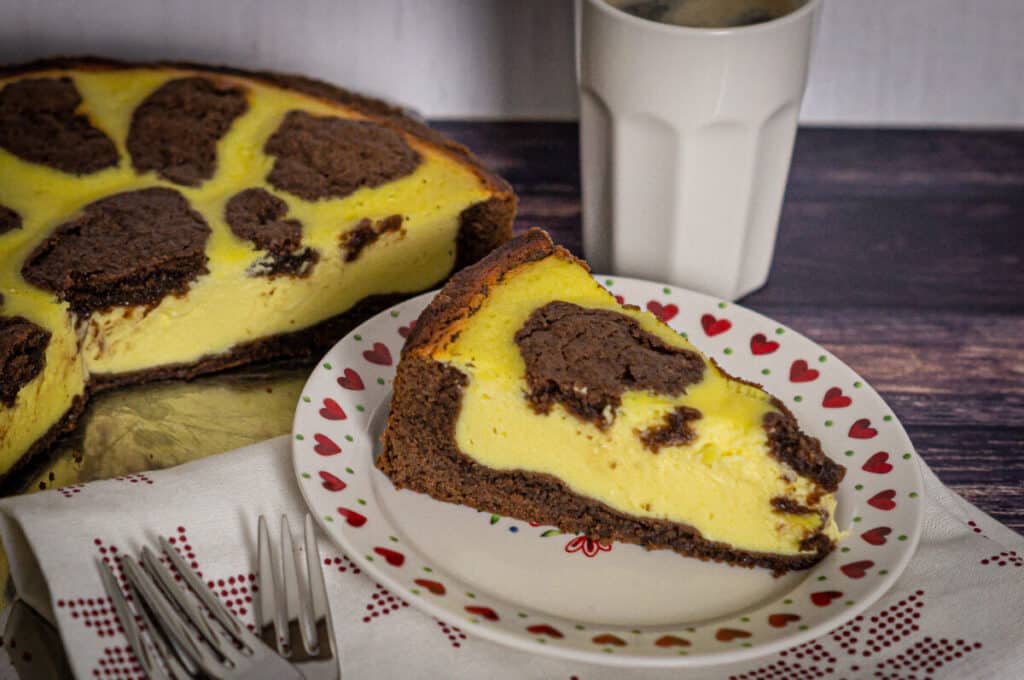
The cake bakes in two phases: 35 minutes uncovered, then 30 to 40 minutes covered with foil. Without the cover, the pinched pieces on top burn before the quark filling in the centre is done. The foil reflects the top heat while allowing the bottom heat to continue working. This way the base turns crisp, the filling sets firm and the pinched pieces come out golden brown rather than black.
We lay the foil loosely over the top without pressing it down. It should only block direct radiant heat, not trap steam inside the oven. After 65 minutes of total baking time we do the skewer test: insert a wooden skewer into the centre, pull it out and check that no dough or quark sticks to it. If the skewer comes out clean, the cake is done. If batter still clings to it, bake for a further 5 minutes with the foil in place.
Why 30 g baking cocoa and not chocolate
The dough is mixed with 30 g of unsweetened baking cocoa, not with chocolate or drinking cocoa powder. Baking cocoa is defatted cocoa powder without added sugar. Chocolate introduces too much fat into the dough and makes it greasy. Drinking cocoa powder contains sugar, which makes the dough too sweet and causes it to burn more quickly. Unsweetened baking cocoa gives only colour and a lightly bitter flavour without changing the texture of the dough.
The 30 g of cocoa go directly into the Thermomix® along with the flour, butter and the other dough ingredients. 25 sec / speed 6 is enough to distribute the cocoa evenly. Mixing for longer serves no purpose and would only warm the dough.
Leave the cake to cool completely or it will crack
The cake must cool in the tin for at least 2 hours after baking before you open the springform. The quark filling is still soft immediately after baking. If you open the tin too early, the cake will split in the centre. The filling needs time to firm up. We usually leave the cake overnight. The next day it slices cleanly and the layers hold together.
To serve, lift the cake onto a cake plate and cut into 16 pieces. Each piece should contain base, filling and pinched pieces. Rinse a sharp knife under hot water, dry it and draw it through the cake. This gives clean cuts without the filling sticking to the blade.
Store in the fridge, not at room temperature
Russian pinch cake belongs in the fridge as soon as it has cooled down. The quark filling is dairy-based and spoils at room temperature within a day. Stored covered in the fridge, the cake keeps for 4 to 5 days. The pinched pieces soften slightly after the first day, but the base stays crisp.
Freezing works without any problems. Cut the cake into pieces, wrap each piece individually in cling film and place them in a freezer bag. Keeps for 3 months. To thaw, place a piece in the fridge overnight. Do not defrost in the microwave as the filling will turn mushy.
Other Thermomix® recipes we bake regularly: Quick Apple Cake from the Tray, Thermomix® Pancakes and Thermomix® Advocaat.
What other recipes do differently
Goes well with: Vanilla sauce, icing sugar and vanilla ice cream.
Also worth a look: Oreo Roll Thermomix®.
Many Thermomix® recipes for pinch cake use 4 tablespoons of baking cocoa or even 50 g, vanilla pudding powder in the quark filling and baking times of between 50 and 70 minutes at 175 or 180°C top/bottom heat. Some versions replace part of the low-fat quark with cream cheese for extra creaminess, or add chocolate chips to the dough for an extra cocoa boost. To prevent cracks, many sources recommend leaving the cake to cool in the switched-off oven with the door slightly ajar. We stick with our 30 g of baking cocoa, 200 g of butter in the filling and the 2-hour cooling phase in the tin, because these quantities have given us stable, clean-cutting slices for years. If you want more chocolate depth, increase the cocoa to 40 g without losing the texture of the dough.