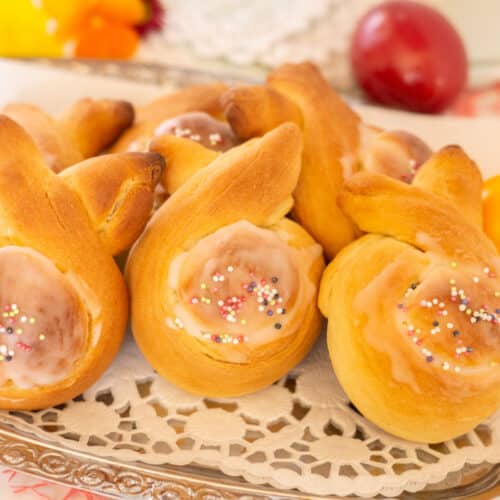
Anyone who presses raisins into the yeast dough as bunny eyes before baking will pull out dark, bitter crumbs from the oven 20 minutes later. At 180°C the little dried fruits burn reliably because they sit exposed on the surface with no dough to protect them. The solution lies in the order of steps: We bake the Easter yeast bunnies plain and fix the eyes, mouth and tummy decoration afterwards with icing. That way the bunnies stay light, glossy and can be decorated individually for each child.
We have been baking these yeast bunnies every Easter Saturday with our children for years. In the beginning we made all the classic beginner mistakes: dough that was too cold and would not rise, burnt raisin eyes, sticky icing that melted away under the sugar pearls. We now know exactly where the key adjustments are. With 250 g of flour, half a cube of fresh yeast and 80 g of Crème fraîche we get eight soft, lightly sweet bunnies that look just as good on the Easter table as they do as a small gift in a basket.
Easter Yeast Bunnies with the Thermomix®

Ingredients 0 / 11 ✓
- 1/2 cube fresh yeast
- 60 g milk
- 50 g sugar
- 1 sachet vanilla sugar
- 250 g flour
- 1 pinch salt
- 80 g Crème fraîche
- 30 g butter
- 30 g icing sugar home-made
- 1 tbsp lemon juice
- 20 g sugar pearls
Instructions 0 / 5
-
1
Knead the dough.
Place the yeast, milk, sugar and vanilla sugar in the mixing bowl and warm for 3 min / 37°C / speed 1. Add the flour, salt, Crème fraîche and butter and knead for 3 min / kneading mode.
-
2
Prove the dough.
Transfer the dough to a bowl, cover and leave to prove in a warm place for approximately one hour until roughly doubled in volume.
-
3
Shape the Easter yeast bunnies.
Line a baking tray with baking paper. Divide the dough into eight equal pieces. Take a third from each piece and roll it into a ball. Roll the remaining dough into a log, wrap it around the ball and pinch the two ends upwards to form ears. Repeat with all eight pieces and place on the baking tray.
-
4
Bake the Thermomix® Easter yeast bunnies.
Cover and leave to prove in a warm place for a further 15 minutes.
Preheat the oven to 180°C top and bottom heat and bake the bunnies on the middle shelf for approximately 20 minutes. Leave to cool.
-
5
Decorate the Easter bunnies.
Mix the icing sugar with the lemon juice, brush the tummies of the bunnies and scatter sugar pearls over the top.
Tip: If you would like to make more bunnies, simply double the quantity of dough.
Video
Nutrition per serving
Why Crème fraîche in the yeast dough makes the difference
Classic sweet yeast dough uses milk and butter. We also add 80 g of Crème fraîche to the 250 g of flour because the milk fat in the Crème fraîche makes the crumb more tender and the slight acidity stabilises the yeast at the same time. The result: the bunnies stay soft even on the second day and do not dry out as quickly as plain milk-and-yeast bunnies. The dough is also a little more pliable to shape, which helps when forming the ears.
In the mixing bowl this happens in two clear steps. First the half cube of yeast, 60 g milk, 50 g sugar and 1 sachet of vanilla sugar go into the bowl and warm for 3 min / 37°C / speed 1. This temperature is the comfort zone of the yeast. Anyone working at 50°C will kill part of the yeast cultures and end up with a flat dough. Then 250 g flour, 1 pinch of salt, 80 g Crème fraîche and 30 g butter are added and the mixing bowl kneads for 3 min / kneading mode. No more time is needed. Kneading longer overheats the dough through friction and the yeast will perform worse afterwards.
The right proving time is one hour, not 30 minutes
The biggest frustration when baking with yeast comes from proving times that are too short. The 60 minutes in a warm place is not a suggestion but a minimum. The dough must have roughly doubled in volume, otherwise the bunnies will be dense and crack at the ears during baking. We use the mixing bowl lid as a cover and place the bowl on the switched-off oven with the oven light on. That reliably gives 28 to 30°C without killing the yeast.
In winter, when the kitchen is below 20°C, we extend the proving time to 75 to 90 minutes. Better ten minutes too long than too short. Over-proving is hardly possible with this quantity of dough because 250 g of flour and half a cube of yeast create a moderate ratio. The dough does not collapse as quickly as a plaited bread dough.
A knot and scissors instead of a ball with snake ears
There are two methods for shaping a yeast bunny. The simple one: take a third of the piece of dough, shape it into a small ball and roll the rest into a longer log, wrap the log as a U around the ball and bend the two ends upward to form two ears. That is our standard technique and the one used to shape the bunnies pictured here.
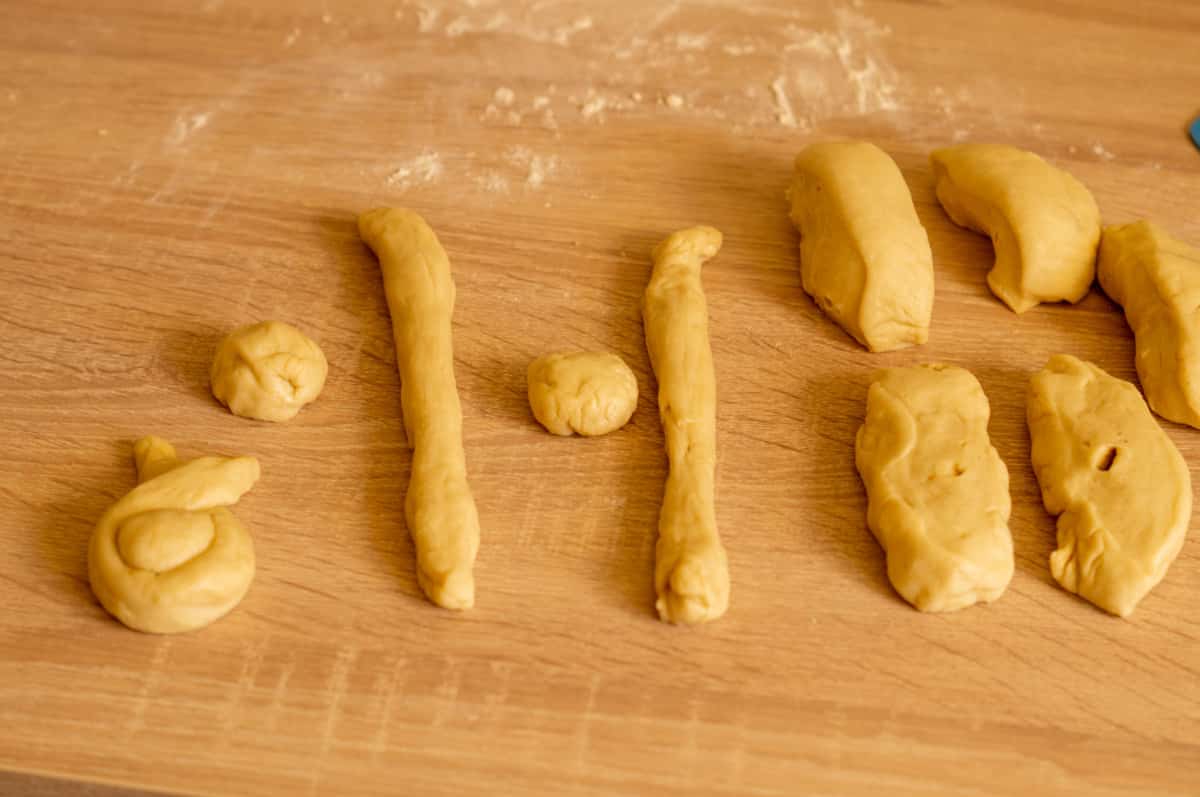
The second method is the knot-and-scissors variation for children who want to do the shaping themselves. Roll the whole piece of dough into a log, tie a loose knot, snip the top end lengthways with kitchen scissors and pull the two halves apart to form the ears. It looks characterful and can be done with three or four-year-olds in five minutes. Important with both methods: leave at least three finger-widths between the bunnies on the baking tray, otherwise they grow together during the second prove.
Before baking we leave the shaped bunnies on the tray to prove for a further 15 minutes, covered. This is the second prove and it ensures the bunnies do not crack in the oven and that the ears keep their shape.
Egg yolk and milk for a golden shine
The typical bakery gloss on sweet yeast pastries does not come from the oven but from a pastry brush. Before baking we brush the bunnies with a mixture of 1 egg yolk and 1 tbsp of milk. The egg yolk gives the golden-brown colour and the milk thins it out just enough so it does not clump. Using pure egg yolk gives patchy results. Using only milk gives pale bunnies with no shine.
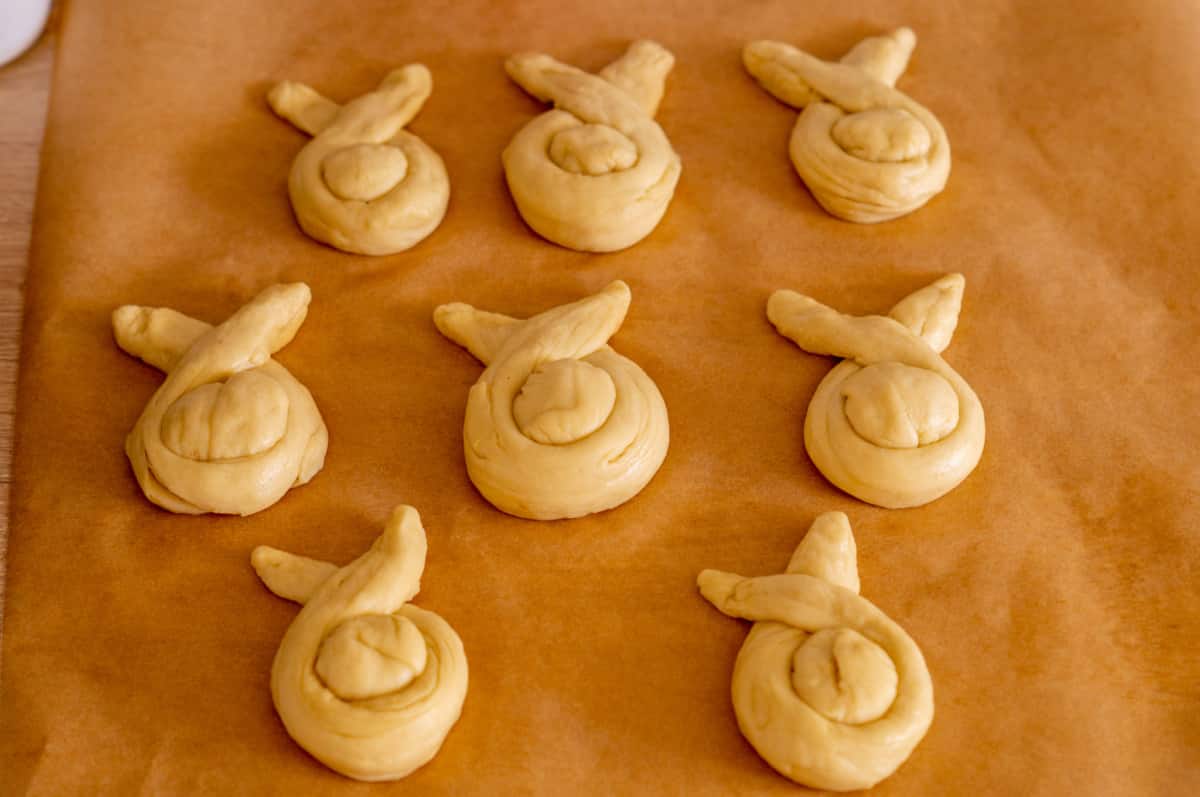
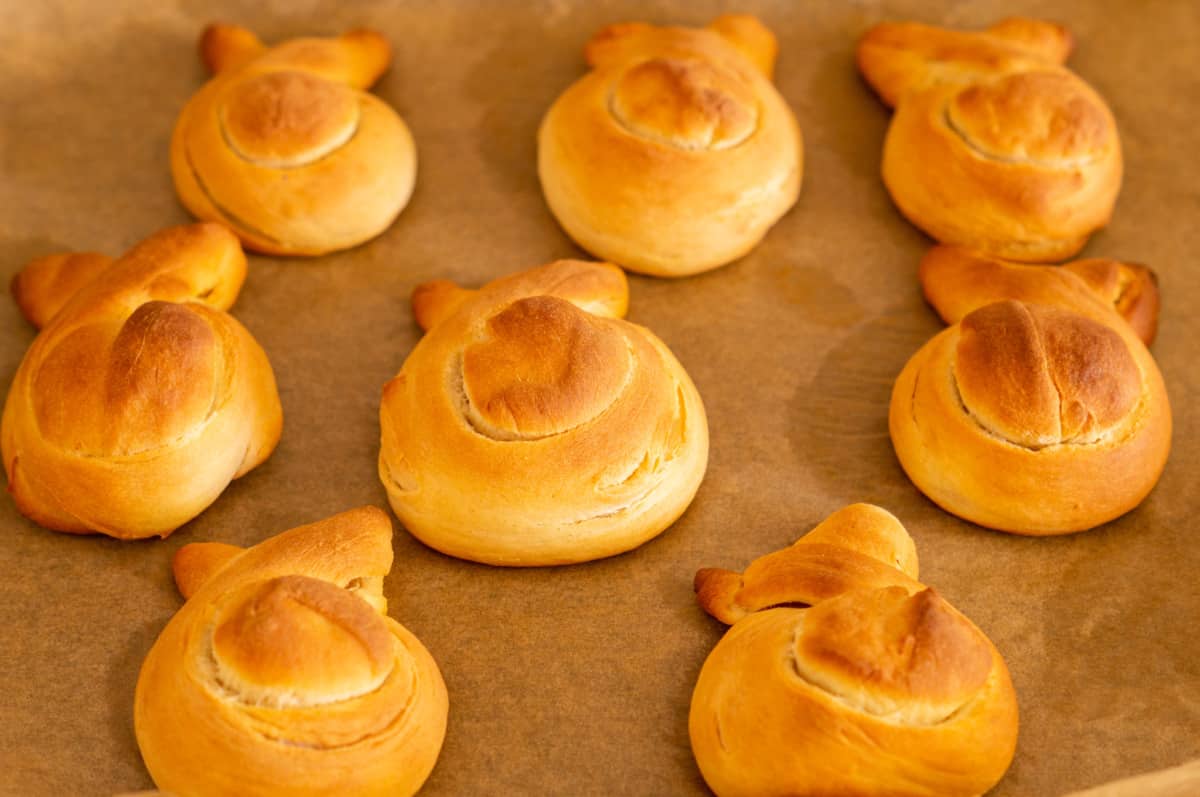
At 180°C top and bottom heat the bunnies need 20 minutes on the middle shelf. After 15 minutes it is worth a glance through the oven window. If the ear tips are already dark brown, cover them briefly with foil. Otherwise the thin tips turn black while the tummy is still pale.
Fix the eyes after baking with icing
Here is the most important trick in the whole recipe. We do NOT attach the eyes before baking. Not raisins, not chocolate drops, not the little sugar pearls. At 180°C raisins burn, chocolate drops melt and streak into the dough, and sugar pearls turn hard and dull. Instead we leave the bunnies to cool completely after baking, which takes 30 to 40 minutes.
Then we mix 30 g of icing sugar with 1 tbsp of lemon juice to make a thick icing. Using a small brush we paint a tummy patch on each bunny and immediately press 20 g of sugar pearls into the still-moist icing. For the eyes, place a tiny dot of icing in the right spot and fix a raisin or sugar pearl there. The icing sets in 10 minutes into a firm adhesive. The eyes stay soft and edible, the tummy patch shines white and the bunnies keep their light, golden-brown yeast dough colour.
What can go wrong with the dough
If the dough has not risen after 60 minutes, the milk was too hot when warmed. 37°C is the limit. At 50°C or higher the yeast dies. Solution: start fresh, there is no reviving it. If the bunnies crack during baking, the second proving time was too short or the flour was too dry. In summer 15 minutes for the second prove is enough, in winter allow 20. If the bunnies are dark on the bottom and pale on top, the shelf was too low. Middle shelf means middle shelf, not second from the bottom.
A common frustration: the icing is too runny and drips down the tummies. Solution: start with less lemon juice, half a tablespoon is often enough. The icing must drip slowly from the brush, not run freely.
Prepare and freeze instead of rushing on Easter morning
We often prepare the bunnies as early as Good Friday. Work up to the point of “shaped on the baking tray”, then place the tray in the freezer for 30 minutes. Once the bunnies are firm, transfer them to a freezer bag and freeze. On Easter morning take them straight from the freezer onto a baking tray, leave to thaw and prove in a warm place for 45 minutes, then bake as described. They taste freshly made at the breakfast table and save all the rush before brunch.
Baked bunnies keep in a bread bin or under a clean tea towel for two days. After day three they dry out. The easiest fix: three seconds in a toaster or ten seconds at 800 W in the microwave and they are soft again. Unbaked dough shapes keep in the freezer for three months. Apply the icing and sugar pearls only after thawing and baking, otherwise they go soggy.
Anyone planning more Easter baking will find our basic recipe for sweet yeast dough as a base for your own variations, the quark-and-oil bunnies without yeast for a quick version, the classic Easter lamb with the Thermomix®, a plaited Easter bread as well as a roundup of 12 further Easter recipes for the Thermomix®.
What other recipes do differently
Many yeast bunny recipes online use plain milk and butter and leave out the Crème fraîche, so the bunnies go dry by the second day. Others press raisins in as eyes before baking, even though the little fruits reliably turn black and bitter at 180°C. Instead of a sweet yeast dough base, some use a neutral quark-and-oil dough that is quicker to make but lacks the typical bakery aroma. The classic shape made from a ball and a U-shaped log is standard, while the knot-and-scissors version for children is rarely seen. We deliberately use an egg yolk and milk mixture instead of pure egg yolk to avoid patchy colouring.
Goes well with: Butter, jam and coffee.