Tortellini with the Thermomix® is a three-ingredient recipe with a clear sequence: 3 minutes on kneading mode in the mixing bowl, 30 minutes resting time on the work surface. The dough must rest because the gluten needs time to relax. Without those 30 minutes, the dough tears when you roll it out and the tortellini split open during cooking.
We make tortellini regularly because homemade pasta has a different bite to shop-bought. The Thermomix® kneads the dough more evenly than by hand, and kneading mode ensures all three ingredients are fully combined. After kneading you get a crumbly mass, not a smooth ball. That is correct. You shape the ball after the resting period, once the gluten has relaxed.
Homemade Tortellini with the Thermomix®, Basic Recipe
Ingredients 0 / 3 ✓
- 400 g flour, type 405 + a little extra for dusting
- 4 eggs
- 1/2 tsp salt
Instructions 0 / 7
-
1
Add flour, eggs, and salt to the mixing bowl and knead for 3 minutes / kneading mode.
-
2
Meanwhile, dust the work surface with flour.
-
3
Remove the crumbly dough from the mixing bowl and knead it into a ball by hand. Wrap the dough ball in cling film and leave to rest for 30 minutes.
-
4
Knead the dough ball again, then roll it out in portions to thin sheets and cover.
-
5
Cut circles with a 6 cm diameter from the dough sheets.
-
6
Place 1/2 tsp of filling in the centre of each dough circle. Fold each circle in half, pressing the edges firmly together with your fingers. Gently stretch both ends outward, fold them back over your index finger, and press the tips together.
-
7
Bring a pot of salted water to the boil and cook the tortellini for 3 to 4 minutes.
Tip: Ricotta, finely chopped vegetables, or minced meat in sauce all work well as a filling.
Video
Nutrition per serving
Why 400 g flour to 4 eggs is the right base
The ratio of 100 g flour per egg is standard for pasta dough. More flour makes the dough dry and crumbly, less makes it sticky and difficult to handle. With 400 g type 405 flour and 4 medium eggs you get a dough that rolls out thinly without tearing. Type 405 is low in protein and has a neutral flavour. That is intentional for tortellini, because the filling carries the taste.
Salt belongs in the dough, not just in the cooking water. Half a teaspoon per 400 g flour is enough. More salt draws moisture from the dough and makes it crumbly. Less leaves the dough tasting bland, even with filling.
The 30-minute resting time is not optional
After kneading the dough must rest for 30 minutes in cling film. This is not a suggestion but a physical requirement. While the dough rests, the gluten network relaxes. If you roll out the dough straight after kneading it springs back. The sheets come out thick and uneven, and the tortellini split open during cooking because the dough is under tension.
Cling film prevents the surface from drying out. Without it a skin forms, which shows up as a hard patch when you roll the dough out. Those patches tear later when you shape the tortellini.
Rolling thin means under 1 mm
Tortellini need thin sheets of dough. Under 1 mm is the target. Thicker than 1.5 mm and the tortellini turn chewy during cooking because the dough sits three layers deep at the folded edges. A pasta machine rolls the dough more evenly than a rolling pin. We use an electric pasta machine because it is faster and keeps both hands free. Rolling by hand works too, but it takes longer and the result is less even.
The rolled dough sheets must be covered, otherwise they dry out. Use a slightly damp kitchen towel rather than cling film directly on the dough. Cling film sticks to the dough and tears it when you pull it off.
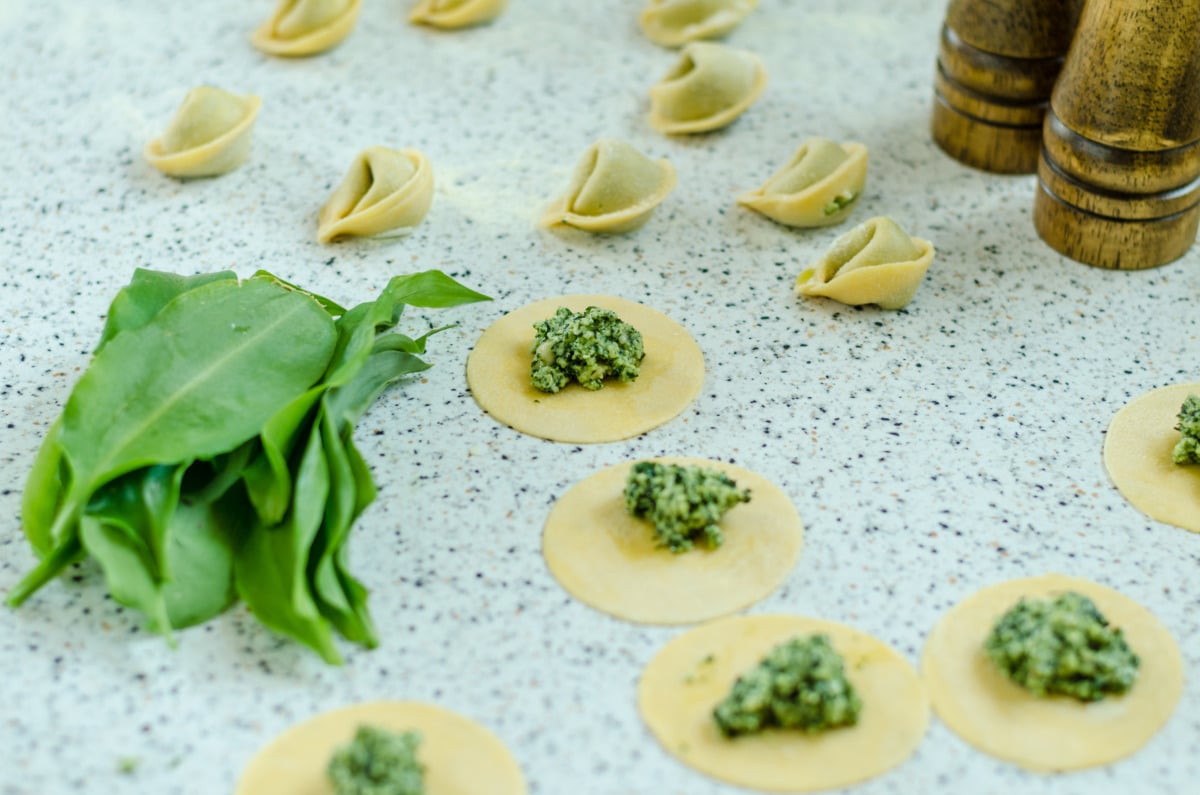
6 cm circles and no more than half a teaspoon of filling
The dough circles must be 6 cm in diameter. Larger and the tortellini become too bulky and cook unevenly. Smaller and there is not enough room for the filling. Cut the circles with a glass or a round cutter. The edges must be clean, not jagged. Jagged edges do not hold the filling in place.
Use only half a teaspoon of filling per circle. More filling squeezes out when you fold and the edges will not stick. Less filling makes the tortellini taste empty. The filling must be firm, not runny. Ricotta works well because it is dry enough. Chopped vegetables must be thoroughly drained first. Minced meat must be completely cold before use, otherwise the filling melts the dough from the inside.
How to fold tortellini correctly
Fold the dough circle in half to create a half-moon shape. Press the edges firmly together, otherwise the tortellini open up during cooking. Do not add water to the edges. The dough is moist enough to stick on its own. Water makes the dough slippery and the edges will not hold.
Then gently stretch both ends of the half-moon outward, fold them back over your index finger, and press the tips together. This shape is the defining feature of tortellini. Wrapping around the finger means the dough lies double at the join, which keeps the tortellini from falling apart during cooking.
3 to 4 minutes cooking time, no longer
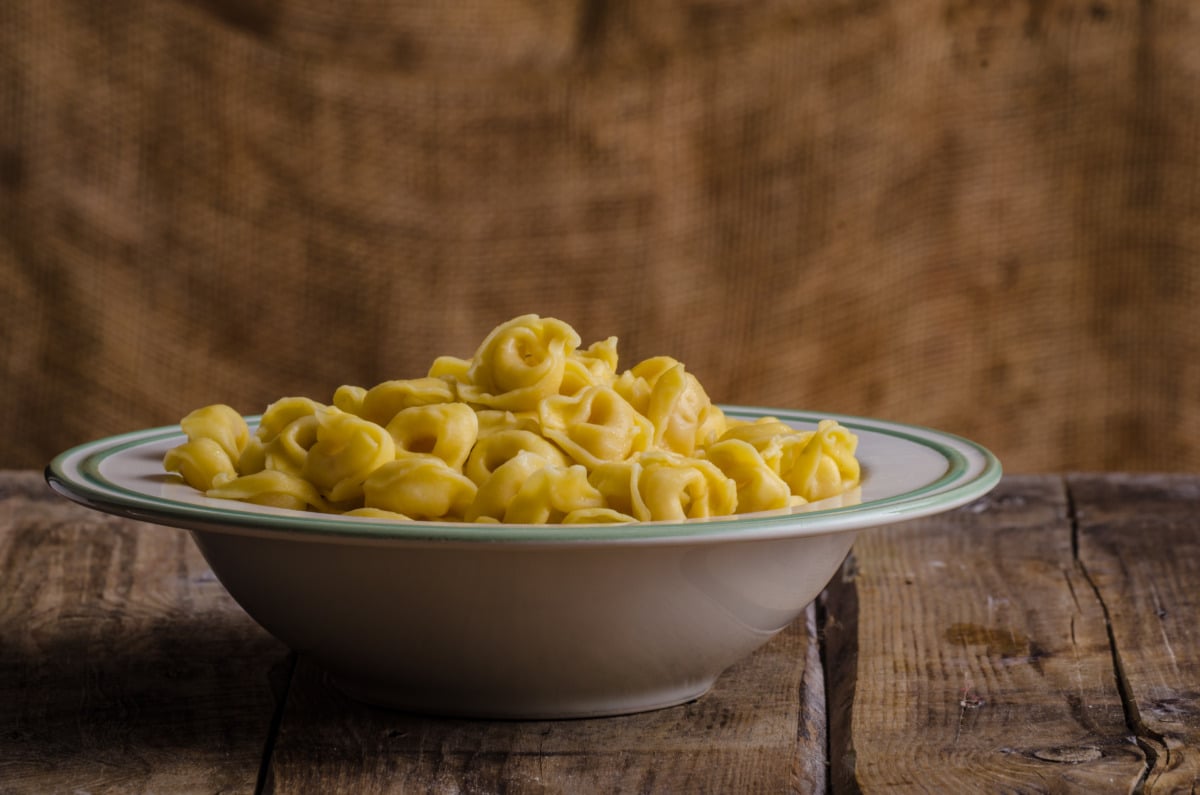
Cook tortellini in vigorously boiling salted water. 3 to 4 minutes is enough. No longer, otherwise the dough turns mushy and the filling breaks out. The tortellini are ready when they float to the surface. Lift them out immediately with a slotted spoon and do not leave them sitting in the cooking water. Every extra minute in the water softens the dough further.
Do not cook too many tortellini at once. A maximum of 15 to 20 pieces per batch, otherwise the water temperature drops too sharply and the tortellini stick together before the water returns to the boil.
Freeze raw, not cooked
Fresh tortellini keep in the fridge for one day at most. Any longer and the filling releases moisture into the dough, making it go soft. Better to freeze the raw tortellini. Spread them on a floured baking tray, freeze for 1 hour, then transfer to a freezer bag. This way they will not stick together. Cook frozen tortellini directly from frozen in boiling water, without thawing first. Cooking time increases by 1 minute, to 4 to 5 minutes.
Goes well with: tomato sauce, cheese sauce, and pesto.
Cooked tortellini do not store well. They go mushy and lose their texture. If you have leftovers, eat them on the same day.