Chocolate peanut cookies made in the Thermomix® used to fail us at exactly one point: when the chocolate pieces were mixed into the dough, they melted against the blade and disappeared into the batter. We wanted visible chunks that crack when you bite in. The solution comes down to the order of ingredients in the mixing bowl, and that is what this recipe is all about.
We have been baking these cookies for years as our go-to travel snack. For birthday celebrations at school, on long car journeys, for a film night at home. The combination of 160 g milk chocolate, 80 g salted peanuts and 70 g peanut butter is the Reese’s logic in cookie form: salt meets sweetness, and both hit you in the same bite. Without the salt from the peanuts the whole thing would taste unremarkable. With it, you get a distinct variety we bake even when we had not planned to make cookies at all.
Chocolate Peanut Cookies with the Thermomix®
Ingredients 0 / 8 ✓
- 160 g milk chocolate
- 80 g salted peanuts
- 180 g sugar
- 280 g butter
- 180 g sweetened condensed milk
- 70 g peanut butter
- 350 g flour
- 1/2 sachet baking powder
Instructions 0 / 6
-
1
Chop the chocolate.
Add the chocolate in pieces to the mixing bowl, chop for 4 sec / speed 5 and set aside.
-
2
Chop the peanuts.
Add the peanuts to the mixing bowl, chop for 4 sec / speed 5 and add to the chocolate.
-
3
Cream butter and sugar.
Add the sugar and butter to the mixing bowl and beat until fluffy for 2 min / speed 4.
-
4
Mix the dough.
Add the condensed milk, peanut butter, flour and baking powder and mix for 30 sec / speed 4.
-
5
Fold in the chocolate.
Add the chocolate mixture and fold in for 5 sec / reverse direction / speed 3.
-
6
Bake the cookies.
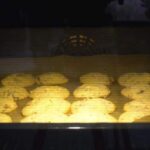
Preheat the oven to 180°C top and bottom heat and line a baking tray with baking paper. Use a teaspoon to place small mounds on the tray and bake on the middle shelf for approx. 12 minutes.
Video
Nutrition per serving
Salt, peanut crunch and chocolate sweetness together
The chocolate pieces go into the mixing bowl only after the dough is done. That is the key point. We chop the 160 g of milk chocolate first (4 sec / speed 5), remove it, make the complete dough, and fold the chocolate in right at the end with just 5 sec / reverse direction / speed 3. Anyone who mixes the chocolate straight in with the butter, sugar and flour ends up with a chocolate-brown dough rather than a dough dotted with chunks. The blades break every larger piece apart and the friction heat melts the rest away. With our method the pieces stay intact and distribute evenly.
The salted peanuts must not be chopped too finely. We put the 80 g of peanuts in the empty mixing bowl and run it for 4 sec / speed 5. That gives coarse pieces with a little peanut dust in between. That is exactly the mix we want: larger pieces for the crunch, fine dust for the flavour in the dough. Going to speed 8 or higher gives you peanut butter. The paste disappears flavour-wise into the peanut butter and the crunch is gone.
Keep the baking time short and let the cookies finish on the tray. 12 minutes at 180°C top and bottom heat sounds brief, but it is exactly right. The cookies come out of the oven with golden-brown edges and a still-soft centre. As they cool on the tray they carry on cooking and turn chewy. Anyone who bakes for 15 or 16 minutes because they do not look set will end up with hard biscuits. Better to take them out after 12 minutes and leave them on the tray for 5 minutes before moving them to a wire rack.
Where chocolate chunks disappear or cookies go flat
Chocolate chunks disappear into the dough
This happens when the chocolate is mixed in for too long. The mixing bowl warms up during the 30-second mixing stage, the blades break the pieces down, and in the end the dough is brown rather than studded with chunks.
Our solution: Remove the chopped chocolate from the mixing bowl and set it aside until the butter, sugar, condensed milk, peanut butter, flour and baking powder have been worked into a dough. Only then add the chopped chocolate and peanuts and fold in for just 5 sec / reverse direction / speed 3. The reverse direction is essential here: it pushes the pieces through the dough without cutting them.
Cookies go flat and run into each other
The 280 g of butter in the recipe is a lot. If the butter is too warm and the dough goes straight onto the tray, the cookies spread out wide in the oven and end up stuck together in a sheet.
Our solution: Chill the finished dough in the fridge for 30 minutes. This firms up the butter, the cookies hold their shape and the centre stays chewy. We leave plenty of space between the dough mounds, at least 4 cm, because they spread noticeably during baking. A standard baking tray fits about 12 to 14 cookies per batch.
Cookies turn hard and dry
The two culprits here are almost always: too long in the oven or left out in the open for too long. Cookies dry out quickly, especially with the high proportion of flour (350 g) and peanut butter.
Our solution: Treat the 12 minutes as a fixed rule, not a guide. If they still look wobbly, that is correct, they will set outside the oven. Once they are cold, transfer them to a tin with a tight-fitting lid. A small piece of apple inside the tin adds moisture and keeps the cookies chewy for days.
With caramel, oats or without peanut
With dark chocolate. We swap the 160 g of milk chocolate 1:1 for dark chocolate with 60 to 70% cocoa. The cookies are less sweet and the salt from the peanuts comes through more strongly. Usually the better option for adults, but children often find it too bitter.
With chocolate chips instead of a bar. When we do not feel like chopping, we use 160 g of ready-made chocolate chips. These go in without any prior chopping, added at the last step together with the peanuts, again 5 sec / reverse direction / speed 3. Quicker, but gives the same chunky effect.
With cashews or pecans instead of peanuts. Works flavour-wise, but loses the salty crunch character. If you want to keep the Reese’s vibe, stick with the salted peanuts and swap the chocolate instead. With cashews, add at least a small pinch of salt extra to the dough.
Half the quantity for 20 cookies. The full recipe makes 40 pieces, which is a lot for one household. We halve it regularly: 80 g milk chocolate, 40 g peanuts, 90 g sugar, 140 g butter, 90 g condensed milk, 35 g peanut butter, 175 g flour, 1/4 sachet baking powder. The speeds and times in the mixing bowl stay the same, only the baking time may be a minute shorter.
Coffee, milk or vanilla ice cream as a sandwich
If you enjoy cookies in general, we have several varieties to compare. Our Macadamia Cookies with the Thermomix® use white chocolate and are the lighter counterpart to these. When you need something even faster, the Cookie Cups with the Thermomix® are the mug version: a single warm cookie in five minutes, perfect for an evening without the full baking effort. And if you like the idea of dough prepared in advance, the shortcrust hub for the Thermomix® has ideas that work on the same principle: knead, chill, shape, bake.
5 days in a tin, frozen for 3 months
At room temperature. Stored in a tin with a tight-fitting lid, the cookies keep for a week. With a piece of apple or a slice of bread inside the tin they stay chewy. Without it they become noticeably drier after three to four days.
In the freezer. There are two ways to go here. Either freeze the fully baked cookies (airtight, keeps for up to three months, thaw at room temperature for 30 minutes on baking day). Or freeze the dough in portions before baking: place spoonfuls on a tray, freeze until solid, then transfer to a freezer bag. That way we can take a few cookies straight from the freezer onto the tray, add 2 to 3 extra minutes of baking time, and have warm cookies in under a quarter of an hour.
Also goes well with: vanilla ice cream, milk and coffee cream.
The dough in the fridge. Up to two days is fine, covered airtight with cling film. The condensed milk keeps the dough pliable even after 48 hours. Let it come to room temperature for a few minutes before shaping, otherwise the mounds are hard to scoop.
If you want to keep browsing our baking collection: our baking recipes for the Thermomix® gather everything from cookies to plaited loaves, and the shortcrust hub already has the next biscuit ideas waiting.