Chocolate pieces do not belong in the kneading blade. Anyone who tips them in with the flour and kneads them through ends up with a uniformly brown loaf and no visible chunks. We want the opposite: a light chocolate bread with dark pools of chocolate that flash through each slice when you cut it.
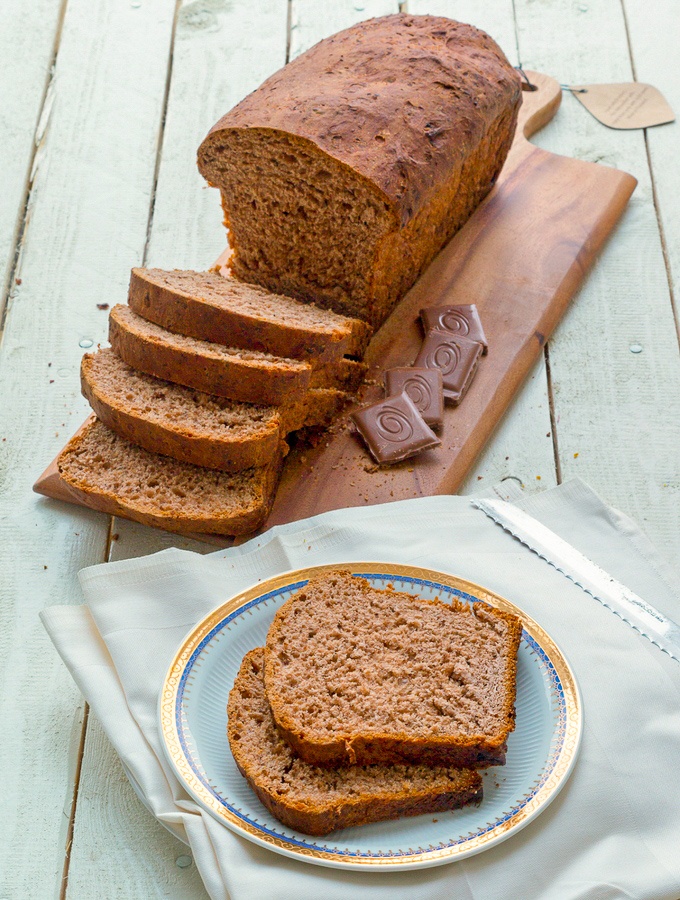
We bake this sweet yeast bread regularly at weekends. 480 g flour, one cube of fresh yeast, 250 g milk, 60 g sugar, one egg, 30 g butter and one tablespoon of cocoa powder form the base dough. The 130 g dark chocolate couverture goes in last, and that is precisely the moment that decides whether the bread looks chocolatey or simply tastes of it. More on this below. It is the one point where many home bakers accidentally turn the dough an even brown.
If you are looking for savoury breads, we also have an olive and walnut loaf, Mediterranean rolls and hazelnut rolls on the site. Today, though, it is all about the sweet version.
Chocolate Bread with the Thermomix®
Ingredients 0 / 12 ✓
- 130 g dark chocolate couverture
- 1 cube fresh yeast
- 480 g flour, Type 550 (plain/bread flour)
- 250 g milk
- 1 tsp salt
- 30 g butter
- 60 g sugar
- 1 egg
- 1 tbsp cocoa powder (unsweetened)
- 1 egg
- 50 g milk
- 1 pinch salt
Instructions 0 / 5
-
1
Chop the couverture.
Break the couverture into pieces, place in the mixing bowl and chop for 8 sec / speed 8.
-
2
Knead the yeast dough.
Crumble the yeast into the mixing bowl. Add the flour, milk, salt, butter, sugar, egg and cocoa powder and knead for 5 min / kneading mode until a smooth dough forms. Transfer to a bowl, cover with a damp tea towel and leave to prove for 8 hours at room temperature.
-
3
Shape the dough.
Gently knead the dough by hand, shape into an oblong loaf and place in the loaf tin. Cover with cling film and leave to prove for a further 3 to 4 hours.
-
4
Preheat the oven.
Preheat the oven to 50 °C, top and bottom heat. Remove the cling film from the tin.
-
5
Bake the bread.
Mix the egg, milk and salt together and brush over the bread. Place the bread in the oven and leave to rise for 25 minutes. Increase the temperature to 170 °C (fan 150 °C, gas mark 2) and bake the bread for 30 to 35 minutes.
Tip: For an even more chocolatey result, fold bake-stable chocolate chips into the dough in step three.
Video
Nutrition per serving
Why chocolate pieces must not go into the kneading blade
The kneading mode on the Thermomix® uses the normal blade in reverse direction. The blade has sharp edges, and in a warm yeast dough that develops additional frictional heat during kneading, chocolate pieces lose their shape within the first minute. They smear against the blade, dissolve into the dough and colour the flour an even cocoa brown. That is exactly what we do not want.
Our solution in practice: knead the yeast dough with just the 480 g flour, the yeast, the milk, the salt, the butter, the sugar, the egg and the cocoa powder. The cocoa powder gives the dough a darker base colour and the chocolate note. Only once the dough is fully kneaded and sitting in the bowl do the chopped chocolate pieces go in, folded in by hand. We turn the dough out onto a floured work surface, press it flat, distribute the chocolate pieces across it and fold the dough two to three times. This keeps the pieces intact, gives the dough its characteristic marbling, and after baking the bread shows visible dark pockets in the light brown crumb.
Kneading time: shorter than you think
Yeast dough in the Thermomix® does not need five minutes on kneading mode. In practice we knead for just 90 seconds on kneading mode. That is enough to bring the flour, milk and yeast together into a smooth dough. Kneading for longer drives more heat into the dough, which harms the yeast. Fresh yeast works best between 25 and 35 degrees. With longer kneading times the dough temperature climbs quickly above 30 degrees, which shortens the first proving phase and flattens the flavour.
The test: after 90 seconds on kneading mode the dough is slightly sticky but lifts cleanly out of the mixing bowl. If it still looks too wet, add 10 g of flour on the work surface rather than kneading again. If it is too firm, work in a splash of lukewarm milk by hand. Your hands judge the consistency better than any timing.
Long proving time as the flavour secret
The chocolate bread has two proving phases. The first lasts 8 hours at room temperature, covered with a damp tea towel. Anyone who starts the dough in the evening and continues in the morning has timed it perfectly. The second proving phase after shaping lasts 3 to 4 hours in the loaf tin.
Why so long? Long proving times give the yeast time to develop complex flavours. Quick yeast doughs proved in 60 minutes taste one-dimensional, mostly of yeast. Our dough, after 12 hours total proving time, tastes nutty and gently sweet with a noticeably better crumb structure. The chocolate pieces stay cold and firm throughout because the dough rests in the bowl without any further mechanical stress.
The most common problems and how we fix them
Chocolate pieces do not distribute evenly
If all the chocolate pieces clump together in one spot, the dough was too warm. Our solution: Chill the dough in the fridge for 10 minutes before folding in the chocolate. Cold dough holds the pieces in place. When folding, distribute the pieces visibly rather than just throwing them in.
Bread stays wet inside
Chocolate bread contains more fat than a plain yeast loaf, thanks to the 130 g couverture and the 30 g butter. That makes the crumb softer but can lead to a stodgy centre. Our solution: Cover the bread with foil for the last 10 minutes and extend the baking time from 35 minutes to 40 minutes. Use a skewer test: the skewer must come out clean.
Crust turns too hard
Baking the bread without an egg wash gives a hard, matt surface. The mixture of 1 egg, 50 g milk and 1 pinch of salt is essential. Our solution: Brush generously before loading into the oven, then brush again after 15 minutes of baking. This creates the glossy, soft finish that is the hallmark of a sweet loaf.
Variations we have tested
With bake-stable chocolate chips: If you do not want to chop couverture, replace the 130 g dark couverture with 130 g bake-stable chocolate chips. They hold their shape on their own and can be folded in directly by hand. The flavour is a touch less intense than good couverture, but much more convenient.
Double chocolate: Double the tablespoon of cocoa powder to 2 tbsp unsweetened cocoa and reduce the flour by 30 g. The bread turns darker and tastes more distinctly of chocolate.
With nut pieces: Work in 50 g of coarsely chopped hazelnuts together with the chocolate pieces. The nuts add bite and pair well with dark couverture. We love this variation particularly in autumn.
With orange zest: Add the zest of one unwaxed organic orange to the dough. Chocolate and orange are a classic combination, and the aroma while baking is remarkable.
Slicing, serving and storing
Fresh from the oven the chocolate bread is still warm inside and the chocolate pieces are partly molten. We wait at least 30 minutes before the first cut, otherwise the bread breaks when sliced. Use a sharp bread knife with a sawing motion rather than pressing down.
Storage: In a bread bin or a large airtight container the bread keeps for 3 to 4 days. After 2 days it dries out slightly, at which point the slices are excellent for toasting. In the toaster the chocolate pieces soften again and the bread tastes almost freshly baked.
Freezing: The bread freezes well. We slice it first, pack the slices individually in freezer bags and take out what we need. Thawing at room temperature takes 30 minutes, or 4 minutes straight from the freezer in the toaster. That way we always have chocolate bread ready for breakfast.
What goes well with chocolate bread
Plain, this chocolate bread is already a treat at breakfast or with afternoon coffee. Butter rounds it out nicely because the fat carries the chocolate flavours. Our favourite toppings: homemade chocolate hazelnut spread for the chocolate lovers, strawberry jam for a fruity contrast, or lemon curd for a sharp note. For adults, a thin layer of orange marmalade together with the dark couverture produces a surprisingly refined flavour.
Also good with: Butter.
Goes well alongside: 5-minute bread with the Thermomix®.