Cherry ice lollies with the Thermomix® are blended in 3 minutes and make 7 pieces. Here is how: pulverise 2 tsp vanilla sugar for 10 seconds / speed 10, then add 500 g water and 130 g cherry syrup and blend for 20 seconds / speed 10. Pour the mixture into moulds or lolly bags, seal well and freeze for at least 6 hours. Three ingredients, no artificial colours, no flavour enhancers.
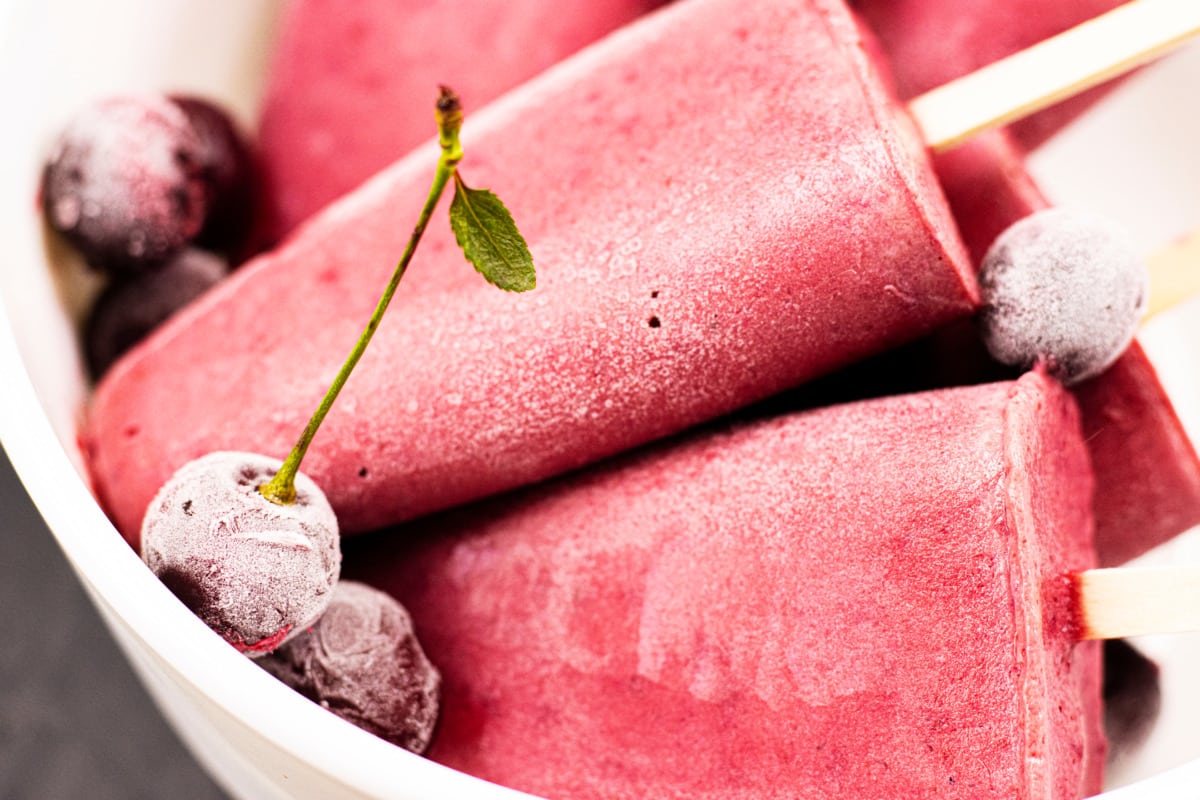
We use cherry syrup here rather than fresh cherries. That is not a compromise but a deliberate choice: the syrup dissolves evenly in 500 g of water, the colour stays consistent across all 7 pieces, and nobody bites down on a stone. Fresh cherries need to be pitted first, otherwise a single stone at speed 10 will damage the blade. With syrup, that problem simply does not arise.
Cherry Ice Lollies with the Thermomix®

Ingredients 0 / 3 ✓
- 2 tsp vanilla sugar
- 500 g water
- 130 g cherry syrup
Instructions 0 / 3
-
1
Pulverise the sugar.
Add the sugar to the mixing bowl and pulverise for 10 seconds / speed 10.
-
2
Blend the ingredients.
Add the water and syrup and blend for 20 seconds / speed 10.
-
3
Freeze.
Pour the mixture into ice lolly bags or ice lolly moulds, seal well and freeze.
Tip: Replace the water with apple juice for a delicious apple and cherry ice lolly.
Video
Nutrition per serving
Why cherry syrup is the right choice here
Fresh cherries have character, but they also come with challenges. If you use them for ice lollies, you need to remove every stone and then sieve the juice to keep fibres out of the finished lolly. Cherry syrup solves all of that: it brings concentrated fruit flavour, dissolves completely and keeps the colour true. If you would rather use real cherries, you will need a cherry stoner and you will have to press the blended mixture through a sieve.
A good cherry syrup makes all the difference. Cheap versions are often little more than sugar water with fruit flavouring, which barely registers once frozen. With a concentrated syrup, 130 g is enough for 7 pieces. The ratio is not accidental: 130 g of syrup in 500 g of water provides enough sugar to lower the freezing point. That is precisely what keeps the lollies pleasantly lickable rather than rock solid.
What the Thermomix® does better for ice lollies
Stirring the lolly mixture by hand works, but it has two weaknesses: the vanilla sugar does not dissolve fully, and small pockets of sweetness collect at the bottom of the jug. In the mixing bowl we first pulverise the sugar for 10 seconds at speed 10 to a fine powder. It then dissolves completely when blended with the liquid, and the sweetness is distributed evenly across all 7 pieces.
The second advantage is the blending itself. 20 seconds at speed 10 whips fine air bubbles into the liquid. That air produces smaller ice crystals, resulting in a softer lolly that is much easier to lick. Stirring by hand gives a denser, harder block. That difference between stirring and blending is exactly why it is worth using the Thermomix® here.
Which mould is worth it?
The result also depends on the container. Plastic moulds are affordable and practical for children, but the lollies can be harder to release. Stainless steel moulds conduct the cold more evenly, the lolly freezes through faster and slides out cleanly after a brief dip in warm water. Ice lolly bags are another option: tie them off after filling and place them straight in the freezer. The lolly comes out softer and you eat it straight from the bag. For children, that is often the more popular choice.
When filling the moulds, never fill them to the brim. Water expands as it freezes, so we leave about one centimetre of space at the top. Otherwise the mixture pushes over the edge and the lid no longer seals properly. With lolly bags, filling them two thirds of the way and tying them firmly is enough.
When the ice lolly turns out too hard or too bland
The lolly is rock solid and almost impossible to bite
Ice lollies without enough sugar freeze into a hard block. Our solution: Do not go below 120 g of cherry syrup for 500 g of water. The sugar lowers the freezing point and keeps the lolly lickable. If you want less sugar, take the lollies out of the freezer 5 minutes before eating so the surface can thaw slightly.
The flavour has disappeared after freezing
Cold mutes sweetness and aroma, so frozen lollies always taste milder than the liquid mixture. Our solution: Season the mixture deliberately a touch too sweet and too intense before freezing. What feels almost too strong in liquid form will be just right once frozen. Better to use 10 g more syrup than too little.
The lolly will not come out of the mould
Straight from the freezer, the lolly sticks to the mould, and pulling on the stick only pulls the stick out. Our solution: Dip the mould in warm water for 30 to 60 seconds, and the lolly will slide out cleanly. Alternatively, leave the mould at room temperature for one to two minutes until the edges begin to thaw.
How long the cherry ice lollies need in the freezer
In classic ice lolly moulds the lollies need 6 to 8 hours to freeze completely. We prefer to make them in the evening so they are ready the following lunchtime. In thin lolly bags it goes faster, usually 4 to 5 hours, because the mixture sits in a thinner layer.
There is a useful trick for softer lollies in bags: after roughly half the freezing time, the mixture will have started to set. Give the bag a quick tap on the worktop at that point to redistribute the ice crystals. The result is finer and easier to squeeze out. With solid moulds we skip that step as slow freezing is enough. Stored sealed in the freezer, the cherry ice lollies keep for up to one month.
Other ways to use the cherry ice lolly base
The tip in the recipe card is genuinely worth trying: swap the water for apple juice. The apple juice brings a subtle acidity that balances the cherry syrup and stops the lolly tasting one-dimensionally sweet. If you have a wider range of syrups, you can also mix in elderflower. That gives a cherry and elderflower ice lolly that stands out clearly from the other flavours in the collection.
For adults, this becomes a summery lolly with a kick: replace 50 g of the water with kirsch or amaretto. A word of caution: more alcohol than that will prevent the lolly from setting properly, as it lowers the freezing point too far. If you prefer something creamier rather than clear, replace 100 g of the water with cherry juice and add one tablespoon of double cream. The result then sits somewhere between a water ice and a fruit ice cream.
Other ice lolly flavours that work in the mixing bowl
The basic principle works with almost any syrup or juice. If you like something fruity and tart, our Lemon Ice Lollies are the right choice. For something different, our Watermelon Ice Lollies use real fruit instead of syrup. Also popular with children are our Strawberry Ice Lollies and the nostalgic Woodruff Ice Lollies.
Also try: Stracciatella Ice Cream, Thermomix®.