Granita is not sorbet. The difference lies in the fork: while sorbet is blended smooth and creamy, granita is raked with a fork every 45 to 60 minutes until coarse ice crystals form that melt instantly on the tongue. That texture is what makes it something in its own right. The Thermomix® handles the blending in 30 seconds; the freezer does the rest.
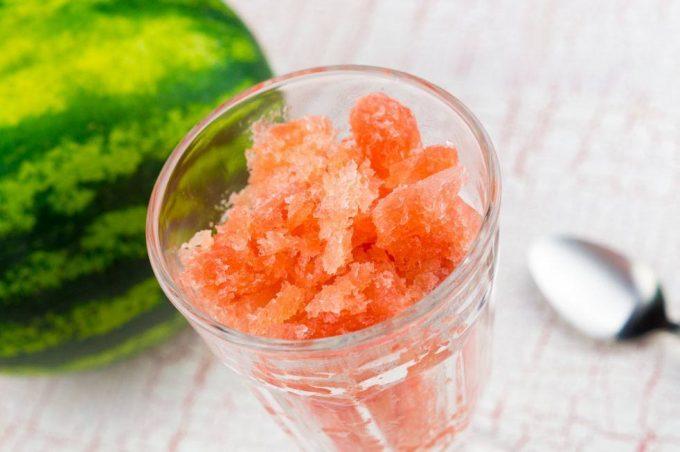
700 g watermelon flesh, 200 g water, 10 g sugar, 1 pinch of salt and 1 tsp rose water. That is it. Sugar and salt go in for 10 seconds at speed 10, then everything together for 20 seconds at gradually increasing speed 6 to 10. The mixture then goes into a flat container. At just under 4 € in ingredients for 6 servings, that works out to barely 40 calories per serving.
We have been making this granita for years, as soon as the first good watermelons arrive in June. It is the only frozen dessert we make that needs neither an ice cream maker nor egg yolks nor cream. And at 41 calories per serving, it is the lightest dessert we put on the table in summer.
Watermelon Granita with the Thermomix®
Ingredients 0 / 5 ✓
- 10 g sugar
- 1 pinch salt
- 700 g watermelon flesh
- 200 g water
- 1 tsp rose water
Instructions 0 / 3
-
1
Pulverise the sugar and salt.
Add sugar and salt to the mixing bowl and pulverise for 10 seconds / speed 10.
-
2
Blend the remaining ingredients.
Add the remaining ingredients and blend for 20 seconds / gradually increasing speed 6 to 8 to 10.
-
3
Freeze the granita mixture.
Freeze in an ice cream maker.
Alternatively, pour into a flat freezer container, seal and place in the freezer. After one hour, rake through with a fork. Freeze for at least 4 more hours, raking through with a fork every hour.
Tip: If you prefer a seed-free granita, pour the mixture through a sieve before freezing.
For the best result, use an ice cream maker if you have one.
Nutrition per serving
Why 10 g of sugar is enough instead of 150 g
Most watermelon recipes in the Thermomix® world use a sugar syrup made from 100 to 150 g of sugar, and some add egg white on top of that. We use 10 g. The reason: a ripe watermelon already contains around 8 g of fructose per 100 g. With 700 g of flesh, that is already around 56 g of natural sugar in the mixture. That is all you need if the melon is truly ripe.
We pulverise the 10 g of sugar together with the 1 pinch of salt for 10 seconds at speed 10. This is not a decorative step: fine icing sugar dissolves immediately in the cold fruit mixture, whereas coarse granulated sugar would sink to the bottom as grains during freezing. The salt lifts the sweetness of the melon without tasting salty itself. That small amount is the difference between bland and watery and genuinely tasting of melon.
For the actual blending, we run 20 seconds at gradually increasing speed from 6 to 8 to 10. The gradual ramp-up pulls the fruit pieces down towards the blade first, rather than flinging them against the wall. The result is a smooth, even mixture with no large chunks. Anyone who starts directly at speed 10 often finds fruit fibres stuck to the top of the mixing bowl.
Why the fork-scraping technique works
Fruit juices freeze unevenly. If you simply leave the mixture alone, you end up with a solid block of ice. The first scraping after one hour breaks up the outer layer of crystals and distributes them through the still-liquid centre. With the second, third and fourth passes (4 to 5 hours in total, every hour), the crystals continue to grow in a controlled way but stay loose. The result is that typical grainy, flaky granita texture that melts in the mouth straight away.
The container matters: flat and wide, not deep. We use a baking dish or a deep baking tray. The thinner the layer (2 to 3 cm), the faster the edges freeze and the more even the crystals will be. In a deep bowl, only the outside freezes; the inside stays liquid for hours.
If you have an ice cream maker, you can skip the scraping step entirely as the machine does the stirring. Without one it works just as well, it just requires more patience. A genuine tip: if you chill the watermelon for an hour beforehand, the freezing process starts faster and you need to scrape less often.
Common pitfalls with granita and how we fix them
It turns into a solid block instead of flaky
This happens whenever the scraping is forgotten or started too late. Once the mixture is fully frozen solid, it is very hard to loosen up again. Our fix: Set a timer for 60 minutes and scrape consistently while the centre is still slushy. If the block is already hard, leave it to thaw for 15 minutes, then break it up roughly with a fork. That rescues the texture reasonably well.
The granita tastes watery and bland
This is usually down to an unripe melon. Watermelon is over 90 per cent water, and a flavourless fruit becomes even flatter after freezing. Our fix: Taste a piece before blending. If the melon barely tastes sweet, add 5 g more sugar and 1 splash of lime juice. The acidity lifts the flavour noticeably without making it taste of lime.
Seeds crunch between your teeth
Watermelons have seeds, and the Thermomix® does not chop them completely. Our fix: Pour the blended mixture briefly through a sieve into the freezer container before it freezes. One step, 30 seconds, problem solved. With seedless varieties you can skip this entirely.
Rose water, lime and three more flavour variations
The rose water sounds like a lot, but 1 tsp in 900 g of total mixture gives only a gentle floral note. If you prefer it more neutral, simply leave it out. Here are our five favourite variations, all of which work with the same base mixture:
- Lime instead of rose water: Juice of half a lime (about 20 ml) in place of the rose water. Adds a fresh acidic note and works with any melon.
- Watermelon and mint: Add 5 fresh mint leaves during the last 10 seconds of blending. Tastes like summer and looks great with green flecks.
- Watermelon and basil: Use 3 basil leaves instead of mint. Surprisingly good, lightly peppery, a proper grown-up flavour.
- Aguas frescas style: 1 tbsp lime juice plus 1 pinch of chilli flakes. Sweet, sharp and sour, the Mexican classic as a frozen dessert.
- Granita with sparkling wine: After the first scraping, stir in 30 ml of Prosecco. The alcohol lowers the freezing point, keeping the granita looser and turning it into an aperitif.
Thermomix® ice cream recipes that go well alongside
The granita is a complete dessert on its own. Anyone who wants more choice on hot days can look at the Cherry Watermelon Slush with the Thermomix®, which goes in the same direction. For a proper ice cream without the scraping technique, Chocolate Ice Cream and Vanilla Ice Cream with the Thermomix® are the next places to look. A full collection of water ices, soft-serve and cream ices can be found in our Ice Cream with the Thermomix® section.
How long the granita keeps in the freezer
Freshly scraped, the granita tastes at its best. In a sealed container it keeps in the freezer for 2 to 3 weeks without any problem. However, after a few days it will freeze solid again as there is no cream or egg yolk to act as a binder. That is not a problem: leave it to thaw for 10 to 15 minutes before serving and rake it loose with a fork once more.
If you like to work ahead, you can also freeze the watermelon flesh in cubes. At minus 18 degrees the flesh keeps for 8 to 10 months. That way you can make fresh granita from frozen cubes in minutes during winter, when no good melons are to be found.
Frequently asked questions about watermelon granita
Goes well with: Prosecco.
Also worth a look: Vanilla Soft-Serve Thermomix® (5 minutes work, 8 servings).
If you make slush and granita often, you may be wondering about a dedicated machine. We have looked at whether the Ninja Slushi is worth it.