Over the past few years, we have tested five different types of juicer, from an 8-euro hand press to a 280-euro slow juicer. The key question is not “fast or slow” but how much cell juice ends up in the glass rather than oxidising in the air. Centrifugal juicers spin at 15,000 revolutions per minute, whipping in huge amounts of oxygen, while slow juicers running at 40 to 110 rpm deliver a fuller juice that keeps for up to 48 hours in the fridge. That is the core difference, not just the speed.
Five portions of fruit and vegetables a day sounds manageable, but in everyday life it is often a hurdle. Juice solves the problem in part, but only if the juicer suits your needs. If you want a daily glass of orange juice, you do not need a 200-watt machine with a pressing auger. If you want to process leafy greens and celery, a citrus press will not cut it. We show you which type of juicer works for which purpose and how to spot juice yield before you buy.
Juicing in the Thermomix®

Ingredients 0 / 2 ✓
- 700 g water
- 1 kg fruit e.g. elderberries, cherries, apples
Instructions 0 / 5
-
1
Prepare the Thermomix®.
Add water to the mixing bowl. Hang the simmering basket into the mixing bowl. Place a heat-resistant bowl (one that fits inside the simmering basket) into the simmering basket.
-
2
Juice the fruit.
Place the fruit (it does not need to be de-stalked or de-stoned) into the Varoma and juice for 60 min / Varoma / speed 1.
-
3
Transfer the juice.
Every 15 minutes, pause and pour the juice from the small bowl in the simmering basket into your container.
-
4
Sterilise the bottles.
In the meantime, sterilise the bottles.
-
5
Fill the bottles.
Fill the juice into the sterilised bottles.
Tips: The juicing time depends on the ripeness of the fruit. It may take longer or shorter accordingly. If juicing takes longer, you may need to top up the mixing bowl with more water.
Juice filled into sterilised bottles keeps in the fridge for about one to two weeks.
Nutrition per serving
Which juicer is right for you: three questions before you buy
Before you settle on a type of juicer, clarify three things: quantity, produce, and nutrient priority. The answers decide whether you need a 5-euro hand press or a 280-euro machine with an auger.
First question: single glass or batch? If you want a fresh glass of juice every day, an electric centrifugal juicer or a citrus press is enough. If you want to juice 5 kilograms of redcurrants from the garden over summer and store them for months, a steam juicer is the only sensible option. Everything in between is inefficient.
Second question: citrus only or leafy greens too? Citrus presses work only with oranges, lemons, and grapefruit. As soon as you want to process apples, carrots, or celery, you need a centrifugal juicer or slow juicer. For wheatgrass and leafy vegetables, only the slow juicer is suitable, because centrifugal juicers cannot press the fibres properly.
Third question: speed or nutrient retention? Centrifugal juicers deliver a litre of juice in 30 seconds, but they whip in a lot of air at 15,000 rpm (ExpertenTesten, November 2025). The juice oxidises quickly, tastes flatter, and must be drunk straight away. Slow juicers work at 40 to 110 rpm (Gruene Kueche, January 2025), introduce almost no oxygen, and deliver a fuller juice that keeps for 24 to 48 hours in the fridge. If you press juice in the morning for the whole family and still want a glass in the evening, that is an argument for the slow juicer.
Centrifugal juicers: fast, loud, great for hard fruit
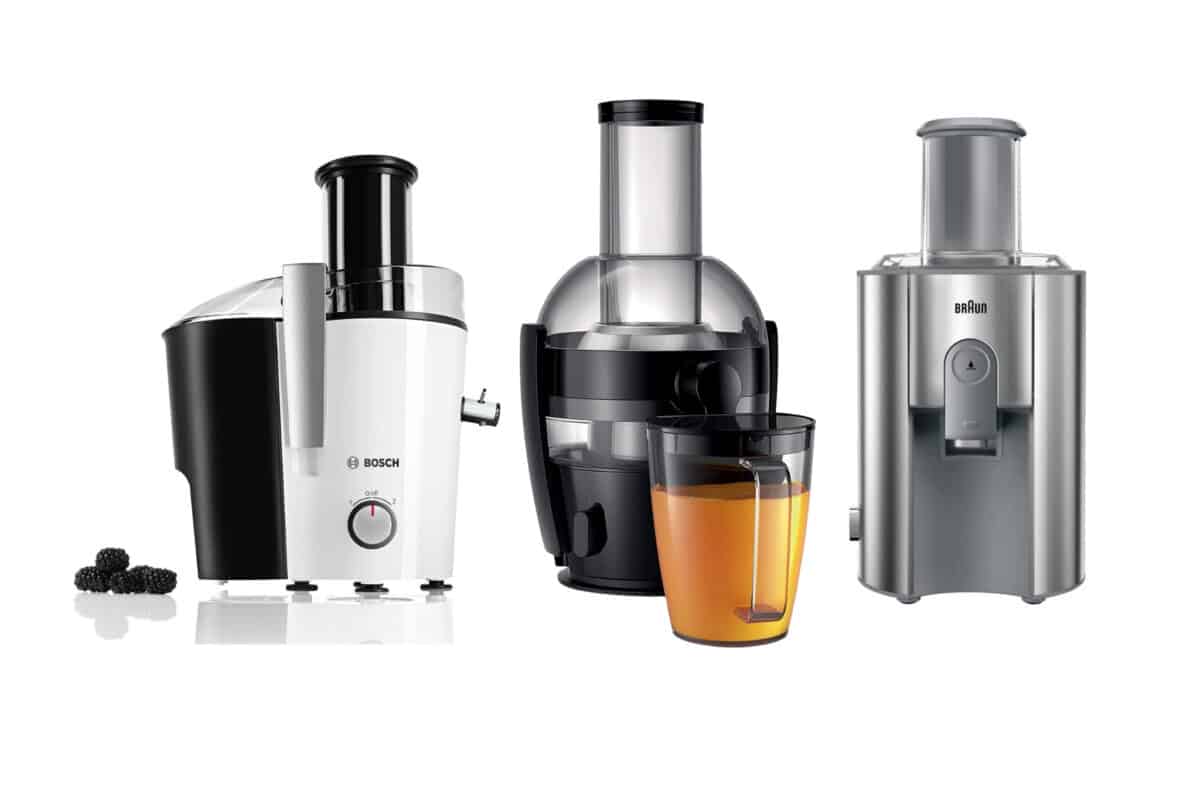
The centrifugal juicer is the most widespread type. The mechanism is simple: a grating disc shreds the fruit, then centrifugal force spins the juice through a sieve at 15,000 rpm. The solid parts stay behind and the juice runs off clear. The whole process takes 30 seconds for half a litre.
The strengths lie in speed and versatility. You can feed in whole apples, hard carrots, and beetroot, anything that holds its shape. Most models have a feed chute of 7 to 8 centimetres, which saves pre-cutting. Juice yield is good but not maximum. Centrifugal juicers run at 700 to 1,500 watts (ExpertenTesten, November 2025), and that is motor power you will notice on your electricity bill with daily use.
The weaknesses are noise, oxidation, and heat. At 15,000 rpm, friction heat builds up, not much, but measurable. The juice warms slightly and some nutrients are lost. More importantly, the air introduced makes the juice foam heavily, oxidise fast, and taste noticeably flatter after two hours in the fridge. For immediate consumption that is no problem, but it is not ideal for meal prep.
Cleaning is straightforward on most models, all parts are dishwasher-safe. When buying, check the position of the pulp container: an external one is more practical because you can empty it mid-session with large quantities without dismantling the machine. Price range: 60 to 250 euros (Testsieger.de, February 2026). The SEVERIN ES 3570 has been the price-to-performance winner in the mid-range segment for years.
A solid all-round centrifugal juicer with good value for money:
Slow juicers: maximum cell juice with minimal oxygen
The slow juicer presses rather than spins. One or two augers squeeze the produce slowly, much like a garlic press. Speeds range from 40 to 110 rpm, and some models reach only 38 (Gruene Kueche, January 2025). That is a hundred times slower than a centrifugal juicer, but that is exactly the advantage.
At low speeds, almost no air is whipped into the juice. The juice oxidises minimally, tastes fuller, and retains more nutrients. Slow juicers yield around 30 percent more juice from the same amount of produce than centrifugal juicers (Bosch, manufacturer data). The pulp should be almost dry, that is the quality benchmark. If you can still squeeze liquid out of the pulp, the machine is working inefficiently.
The second strength is versatility with soft produce. Slow juicers can handle leafy greens such as spinach, kale, and wheatgrass, as well as herbs and celery. Centrifugal juicers struggle with these because the fibres wrap around the grating disc. For juice fasts with vegetable juices, the slow juicer is therefore the first choice.
The weaknesses are speed, price, and preparation. Half a litre of juice takes 3 to 5 minutes, not 30 seconds. The feed chute is smaller, so you need to quarter apples and halve carrots. Stones must come out beforehand, otherwise the auger jams. Motor power is 150 to 400 watts (ExpertenTesten, November 2025), which saves electricity, but the machine itself costs 60 to 300 euros to buy.
Important when buying: make sure the machine can be fully dismantled and all parts are dishwasher-safe. Some models have external pulp containers, which makes emptying easier with large quantities. The auger should be robust, cheap plastic augers jam on ginger or nuts. Some manufacturers offer attachments for frozen yoghurt, nut milk, or noodles, which extends use beyond juicing.
The price-to-performance winner with a “Good” rating is the Severin ES 3571. For higher demands on juice yield and shelf life, Hurom and Kuvings models are well established in the upper price segment.
The best-value slow juicer:
Steam juicers: gentle heat for bulk processing
The steam juicer is the classic option for anyone with a fruit garden. The mechanism is simple: water in the lower pot is heated, the steam rises and bursts the cell walls of the fruit in the upper insert. The juice collects in the middle pot and runs through a tube directly into sterilised bottles. The whole process takes 30 to 60 minutes, depending on the type of fruit.
The strengths lie in throughput and shelf life. You can process 3 to 8 kilograms of fruit in one go, depending on the size of the fruit insert. The juice is sterilised by the steam heat and keeps for 6 to 12 months without any further treatment. No other juicer type can achieve that. Preparation is minimal: wash the fruit, quarter large fruit such as apples, and stones can stay in if you only want juice. The pulp becomes a puree that you can use for apple sauce or jam.
The weaknesses are heat and efficiency. At 75 degrees Celsius, 10 to 30 percent of vitamin C is lost (Dampfentsafter.eu, Federal Research Institute source). Fat-soluble vitamins such as vitamin A are fully retained, but the juice is less nutrient-rich than cold-pressed juice. That is the trade-off for the long shelf life. The steam juicer is only worthwhile from 3 kilograms of produce upwards; below that, the energy cost is not economical.
There are two variants: models for the hob and units with an integrated heating element. Hob models are cheaper and work on any hob, including induction. Units with their own heating element can be used in the garden as long as a socket is nearby. Price range: 40 to 150 euros (Testsieger.de, February 2026). Important when buying: the tube should be heat-resistant and have a valve so you can fill the bottles in a controlled way.
The juice produced is very concentrated. You can dilute it with water before drinking and it still tastes intense. For a winter store from summer fruit, the steam juicer is unrivalled.
A reliable steam juicer for large harvest quantities:
Citrus presses: specialist for oranges, lemons, and grapefruit
Citrus presses are the simplest option, but they work only with citrus fruit. The mechanism is always the same: a ribbed cone is pressed onto the halved fruit and the juice runs through a sieve into a container. The only difference is the power source.
The cheapest version is the hand press for under 5 euros. You twist the orange back and forth on the cone and you are done. For one glass of juice in the morning that is sufficient; for larger quantities you will get forearm ache. There are also lever presses, which work faster and require less twisting motion, but cost 20 to 50 euros.
Electric citrus presses use a motor so the cone turns automatically. You just hold the fruit and press lightly. That is less effort and faster. When buying, check the size of the collection container and the height of the juice spout. Some models have a spout that is too low and your favourite glass will not fit underneath. A stable base is also important, cheap models slide around during pressing.
The Philips HR2752/90 Essential was particularly praised in tests for its juice yield. Price range: 20 to 70 euros for electric models (Testsieger.de, February 2026). Cleaning is straightforward for all variants, and most parts are dishwasher-safe.
The limit is clear: as soon as you want to press other fruit or vegetables, you need a different type of juicer. For morning oranges, though, the citrus press is the most efficient solution.
A robust press for your daily orange juice:
Thermomix® as a juicer: a workaround without a dedicated attachment
The Thermomix® can juice, but it is not one of its strengths. The standard method is fiddly: steam the fruit in the Varoma, the juice drips into a bowl in the simmering basket, and you have to empty it every 15 minutes. It takes an hour for one litre of juice and delivers steam-processed juice with some vitamin loss, similar to a steam juicer but less efficient.
There is a juicing attachment for the Thermomix® that makes the process easier. With it, juicing works similarly to a slow juicer, but the juice yield remains lower than with a dedicated juicer. If your kitchen has no space for an additional appliance, the attachment is an option. If you want to make juice regularly, a proper juicer is the better investment.
For smoothies, the Thermomix® is far better suited than for clear juice. You blend fruit and vegetables with liquid and get a thick smoothie with pulp. This works particularly well with soft fruits such as mango, papaya, and banana, which do not process well in traditional juicers.
This juicing attachment makes juicing in the Thermomix® considerably easier, but it remains a compromise. For serious juicing, the other types are the better choice.
Buying decision: pulp dryness, feed chute, dishwasher compatibility
Once you have decided on a type of juicer, check three practical things before buying: pulp dryness, feed chute size, and cleaning effort.
Pulp dryness is the quality criterion. The pulp should be almost dry, and when you squeeze it no liquid should come out. That indicates maximum juice yield. With centrifugal juicers the pulp is often still moist; with good slow juicers it is as dry as sawdust. That is the difference between 70 and 90 percent yield.
The feed chute determines the preparation effort. Centrifugal juicers often have a diameter of 7 to 8 centimetres, so whole apples fit through. Slow juicers have smaller openings, so you need to quarter apples and halve carrots. If you make juice every day, that is a noticeable time difference.
Cleaning must be intuitive. Make sure the machine can be fully dismantled and all parts are dishwasher-safe. Some slow juicers have many small components that are fiddly to reassemble. If cleaning is too much effort, you will use the machine less. Test before buying whether the auger or grating disc comes out easily.
Additional criteria: motor power in slow juicers should be at least 150 watts, otherwise the auger jams on hard produce. With centrifugal juicers, an external pulp container is more practical because you can empty it mid-session with large quantities. And check whether the juice spout is high enough for your favourite glass.
The choice between juicer types comes down to three questions: how much juice you want to make, which produce you process, and how important nutrient retention is to you compared to speed. For a glass of orange juice in the morning, an electric citrus press for 30 euros is enough. For daily vegetable juices with maximum nutrient density, a slow juicer is the right choice. For bulk processing from the fruit garden, the steam juicer is unrivalled. The Thermomix® can serve as a workaround, but it is not really good at any of these tasks.
More on this topic: In the Thermomix® Accessories section you will find further guides. Or browse the complete guide overview.