2,703 ratings, average 4.99 stars. Boiling eggs in the Thermomix® is the most-tested basic recipe on will-mixen.de. 500 g water, eggs into the simmering basket, Varoma, speed 1. The cooking time is everything: 12 minutes for soft, 15 for hard. One minute makes the difference between a runny and a firm yolk.
We have been cooking eggs in the Thermomix® several times a week for years and have tested both methods hundreds of times: the simmering basket for up to 8 eggs, the Varoma for up to 20. Cooking time depends on the size, temperature and age of the eggs. Ignoring the difference between size M and L means ending up with yolks that are either too runny or too firm.
Boiling Eggs in the Varoma® (Thermomix®)

Ingredients 0 / 2 ✓
- 20 egg size M
- 500 g water
Instructions 0 / 3
-
1
Water.
Water into the mixing bowl.
-
2
Cook eggs.
Place eggs into the Varoma®, set the Varoma in position and cook 17 minutes / Varoma / speed 1.
-
3
Cool down.
Immediately cool the eggs under cold running water.
This recipe is for soft-boiled eggs. Increase the cooking time according to the table "Boiling Eggs in the Varoma®"
Video
Nutrition per serving
Cooking time table: how long do eggs need to cook in the Thermomix®?
Cooking time depends on the desired doneness and the egg size. Size M is 53 to 63 g per egg, size L is 63 to 73 g (EU Regulation 589/2008). The larger yolk in a size L egg needs roughly one minute more to reach the same doneness.
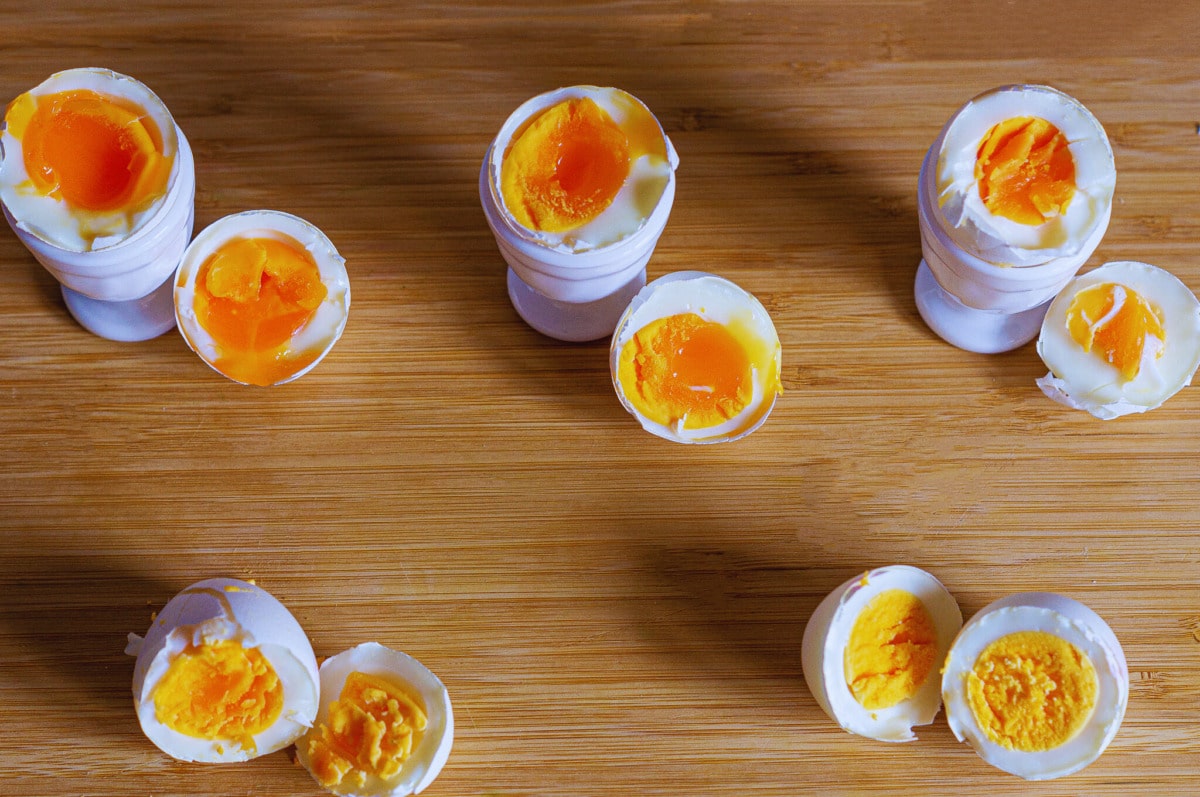
All times apply to eggs at room temperature. If the eggs come straight from the fridge, add half a minute. The table is based on our main method: 500 g water in the mixing bowl, eggs in the simmering basket, Varoma temperature, speed 1.
Simmering basket or Varoma: which method for how many eggs?
The simmering basket holds a maximum of 8 eggs. This method works on all Thermomix® models (TM7, TM6®, TM5®, TM31) and is ideal for everyday use. Add 500 g water to the mixing bowl, place eggs in the simmering basket, insert the basket, then cook for 12 to 16 minutes at Varoma and speed 1 depending on the desired doneness.
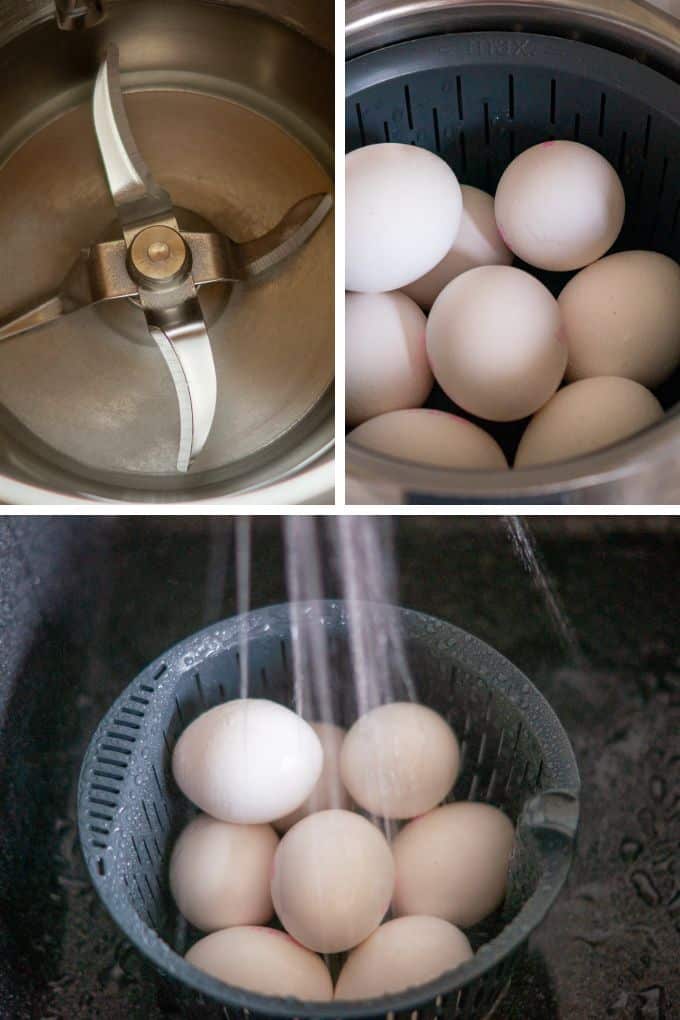
For larger quantities we use the Varoma. Up to 20 eggs fit in the Varoma container. The steam circulation is more even than stacking multiple baskets. Add 500 g water to the mixing bowl, place eggs in the Varoma container, set the Varoma in position, then cook for 17 minutes at Varoma and speed 1 for soft-boiled eggs. For hard-boiled eggs, increase the time to 23 minutes.
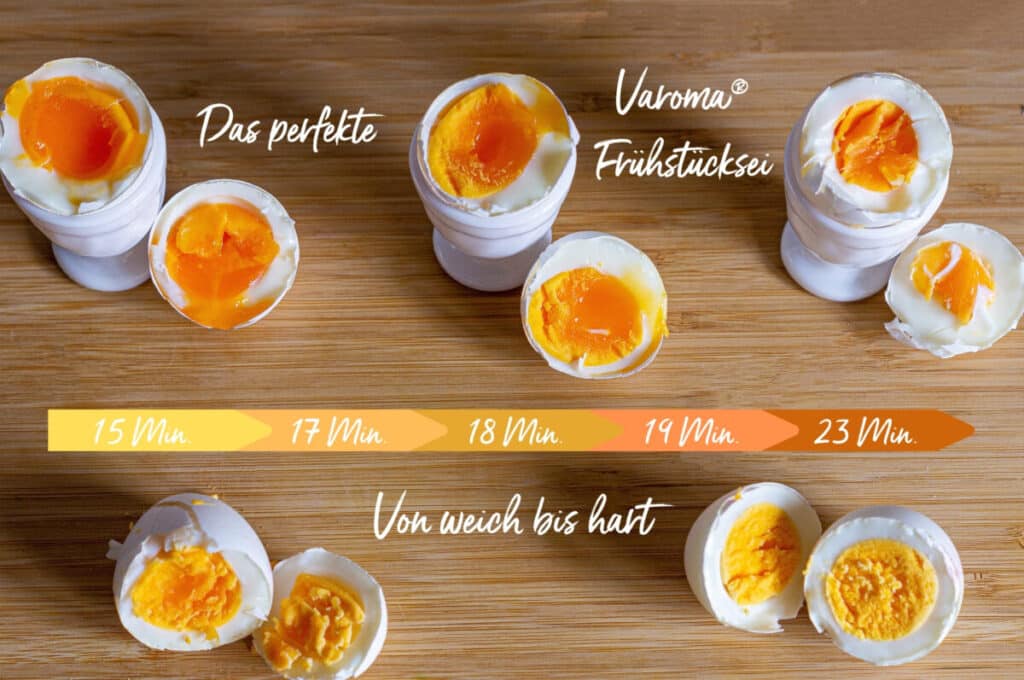
The Varoma reaches a steam temperature of around 120 °C. The longer cooking time is due to the indirect heat: the simmering basket sits directly above the water, and the Varoma sits above that. For Easter or meal prep the Varoma method is the better choice, because 20 eggs are ready all at once.
TM6®, TM7 and TM5®: differences between models
The simmering basket and Varoma methods work identically on all models. The TM6® and TM7 additionally offer an automatic egg mode using the egg holder accessory. This holder holds a maximum of 6 eggs. Set the desired doneness (soft, medium, hard) and the Thermomix® calculates the time automatically.
The advantage: no manual time setting. The disadvantage: fewer eggs than in the simmering basket, requires an extra accessory, and does not work on TM5® or TM31. For 8 or more eggs, or for older models, the manual simmering basket method is better. The speed setting remains the same across all methods: always speed 1.
Parallel cooking: eggs in the Varoma, potatoes in the mixing bowl
The biggest advantage of the Varoma method is being able to cook something else in the mixing bowl at the same time. Cook potatoes, rice or broccoli in the mixing bowl while the eggs steam in the Varoma above. The steam still gets through. The only condition is that the dish in the mixing bowl must also run at Varoma and speed 1. The cooking time follows whichever dish takes longer.
Example: cooking potatoes (20 minutes in the mixing bowl) and eggs in the Varoma (17 minutes for soft-boiled). Add the eggs to the Varoma 3 minutes later and both will be ready at the same time. Or let the eggs run the full 20 minutes and you get hard-boiled eggs.
Why are some eggs so hard to peel?
Fresh eggs (under 7 days old) are difficult to peel. The white sticks to the inner shell. The reason: the pH of a fresh egg is around 7.6. After 10 days it rises to around 9.2. A higher pH loosens the membrane between the white and the shell.
Our solution: store eggs for 10 to 14 days before boiling. Cooling under cold water helps with peeling, but cannot completely fix the stickiness of very fresh eggs. For Easter or meal prep, buy the eggs deliberately 2 weeks in advance.
Cooling in cold water: when it is necessary and when it is not
Cooling in cold water stops carry-over cooking only for soft and medium-soft eggs (12 to 14 minutes cooking time). At that point the yolk is still liquid or creamy. Without cooling, the egg continues to cook from residual heat and the yolk becomes firmer than intended.
For hard-boiled eggs (15 to 17 minutes) the yolk is already fully cooked through. Cooling then only helps with peeling, because the shell detaches more easily from the thermal shock. We cool all eggs in cold water because it makes peeling easier.
Pricking, vinegar, fridge: what actually works?
Pricking: Only useful for very fresh eggs (under 5 days old). The air pocket is still small, the pressure during cooking is higher and the shell is more likely to crack. For older eggs (10 days and more) pricking does nothing, the air pocket is large enough.
Vinegar in the water: Does not improve peeling. But if an egg cracks, the white coagulates faster thanks to the vinegar and does not run out. One tablespoon per 500 g water does no harm.
Straight from the fridge: Cold eggs need half to one minute longer and peel less easily, because the white sticks more firmly to the shell. Better to take the eggs out 30 minutes before cooking.
Directly in the mixing bowl without the simmering basket: not a good idea
Cooking eggs directly in the mixing bowl (without the simmering basket) does not work well. The eggs roll around on the base, knock against the blade and the shell cracks. The simmering basket is essential: it keeps the eggs in place and above the water.
Avoiding the green ring around the yolk
The grey-green ring around the yolk in hard-boiled eggs is caused by a reaction between iron in the yolk and sulphur in the white when cooking time is too long. It is harmless but looks unappetising. The solution: do not cook for longer than 16 minutes in the simmering basket (size M) and cool immediately after cooking. The ring starts to form at around 18 minutes of cooking time.
Easter eggs and meal prep: large batches all at once
For Easter or weekly meal prep the Varoma method is ideal: up to 20 eggs at once. Cook hard (23 minutes in the Varoma), cool in cold water, then store in the fridge. Hard-boiled eggs with an intact shell keep for 7 to 10 days. Store in a sealed container so they do not absorb other odours. Eat soft-boiled eggs within 2 to 3 days.
Always dye Easter eggs after cooking, not during. Dye does not penetrate the shell, it only settles on the outside. Cook the eggs as normal, cool in cold water, then place them in the dye bath.
What we do differently from other Thermomix® sites
We have looked at other major Thermomix® sites. Some give 16 minutes for hard-boiled eggs in the simmering basket, others as few as 14 minutes, and most without distinguishing between size M and L. In our experience, that is the main reason for inconsistent results. A size L egg weighs up to 73 g, a size M egg only 53 g. Using the same timer gives a still-runny centre in an L egg where an M egg is already fully cooked.
Goes well with: radishes and mustard eggs.
Our tip: grinding maize in the Thermomix®.
That is why we separate the cooking time by size: 15 minutes for hard at M, 16 minutes at L. For very hard: 16 and 17 minutes respectively. In the Varoma we recommend 23 minutes for hard, with an extra minute for L. The second difference: we cool consistently in proper ice water, not just under the tap. The faster temperature drop detaches the membrane more reliably and prevents the green ring.
More Thermomix® basic recipes
If you are boiling eggs, you may also need: egg salad with the Thermomix®, potatoes (cooked at the same time as the eggs in the Varoma), broccoli, breakfast rolls or porridge for a complete breakfast. All Thermomix® speed settings explained.