Bath salts with the Thermomix® are not a single recipe but a three-step system. We mix 500 g of Dead Sea salt dry with food colouring and a few drops of fragrance oil, 25 seconds at speed 4, then seal it airtight. No water, no oil in the salt. For a full bath, use 2 to 3 tablespoons (about 100 to 150 g) at around 37 °C water temperature. This way you have three finished jars ready in 20 minutes: unicorn, orange and rose petal.
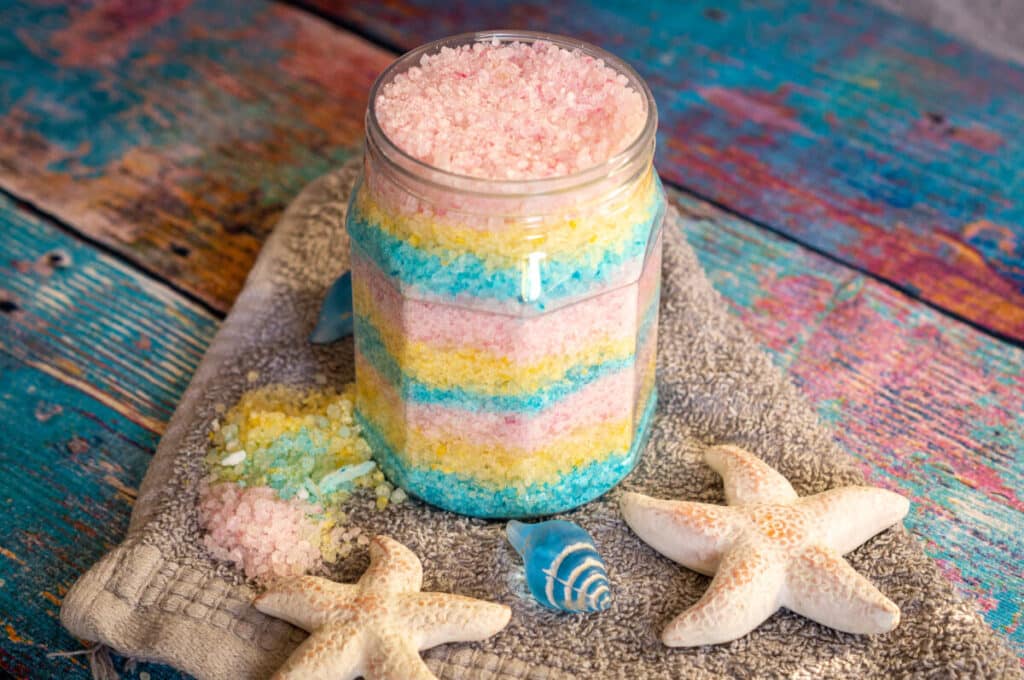
We have made all three variations hundreds of times. The unicorn bath salts in colourful layers, the orange bath salts with real zest and the rose petal bath salts with dried petals. Each one works on the same principle and each is ready in under ten minutes of active time. The reason we use the Thermomix® rather than stirring by hand is explained in the next section.
Rose Petal Bath Salts with the Thermomix®
Ingredients 0 / 5 ✓
- 500 g Dead Sea bath salt
- 2 tbsp dried rose petals
- 5-10 drops rose oil
- 1 food colouring pink
- nach Bedarf cosmetic glitter optional
Instructions 0 / 2
-
1
Salt.
Add the Dead Sea salt to the mixing bowl. Add the rose petals, rose oil, pink food colouring and glitter to your desired intensity, then mix for 25 seconds / speed 4. If the result is not evenly blended, add a few more seconds.
-
2
Seal.
Fill the rose petal bath salts into a container and seal airtight.
Why we mix the salt dry at speed 4
The Thermomix® distributes colour and fragrance evenly through the salt without you needing to stir with a spoon. 25 seconds at speed 4 is enough for 500 g. No longer than that, because the salt will become too fine and lose the coarse grain that crackles so nicely in the bathwater. If the mixture still looks streaky after 25 seconds, add more time in 5-second increments. Better to go twice briefly than once too long.
There is a second reason for mixing dry. As soon as the salt comes into contact with water it partly dissolves and forms lumps that you cannot smooth out again. That is why we wipe the mixing bowl between batches with a dry kitchen towel only and never rinse it with water. This is exactly where the Thermomix® makes the difference: by hand you will never distribute three colours as streak-free, and the zest will never be as finely worked into the salt as it is at speed 4.
Dead Sea salt, Epsom or sea salt: what belongs in the jar
We use 500 g of Dead Sea salt as the base, and that is a deliberate choice. Dead Sea salt is rich in magnesium, potassium and calcium and has been used for years on dry and itchy skin. It feels softer after bathing than ordinary table salt. The coarse grain also means the colour clings to it and the salt pours nicely when you fill the jars.
Epsom salt (magnesium sulphate) is the alternative if you want to absorb magnesium through the skin. It is finer and takes on colour less readily, so colours come out more subtle. Plain sea salt from the supermarket works too, but has fewer minerals. What does not belong in the jar is table salt with anti-caking agents: it clumps more quickly and feels scratchy on the skin. If you like, mix 400 g of Dead Sea salt with 100 g of bicarbonate of soda to soften the water.
Unicorn bath salts: layering instead of mixing
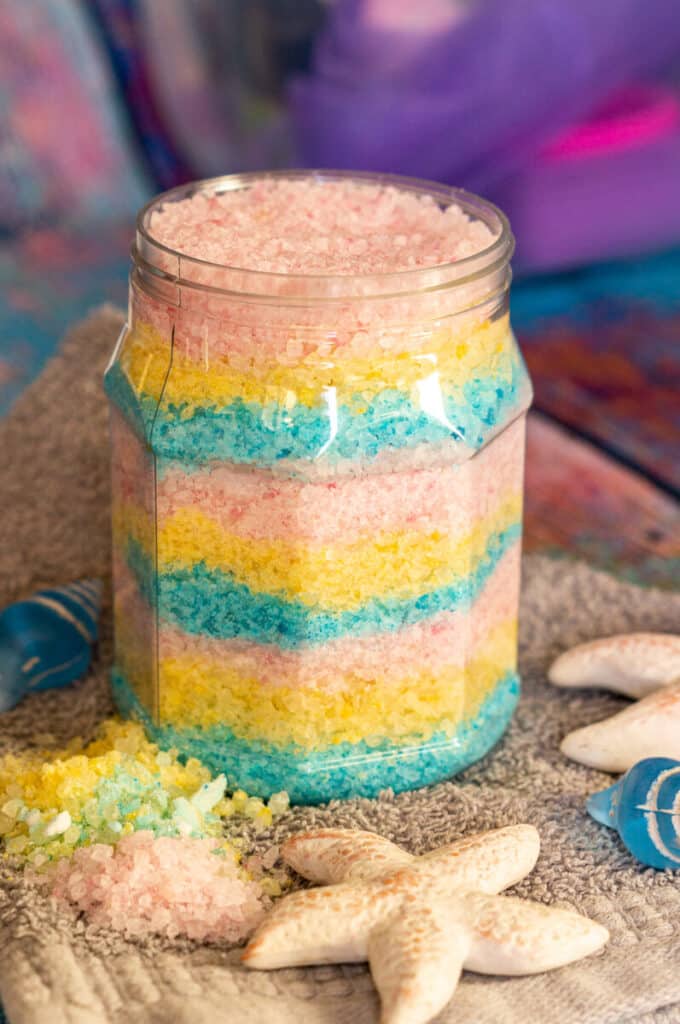
For the unicorn bath salts we colour the 500 g in three batches, so roughly 165 g per colour. Yellow with gold glitter, pink with any glitter colour, blue with silver glitter. Each third goes into the mixing bowl with a few drops of food colouring and some glitter for 25 seconds at speed 4, then into its own small bowl. Wipe the mixing bowl dry between each batch.
The filling only works if you layer the salt alternately. Yellow, pink, blue, yellow again. That is how you get the colourful stripes that make the unicorn bath salts so striking. If you pour everything in at once, the colours mix as they pour and turn a muddy brown-grey. A narrow, tall jar shows the layers better than a wide one.
Orange bath salts: zest delivers the aroma
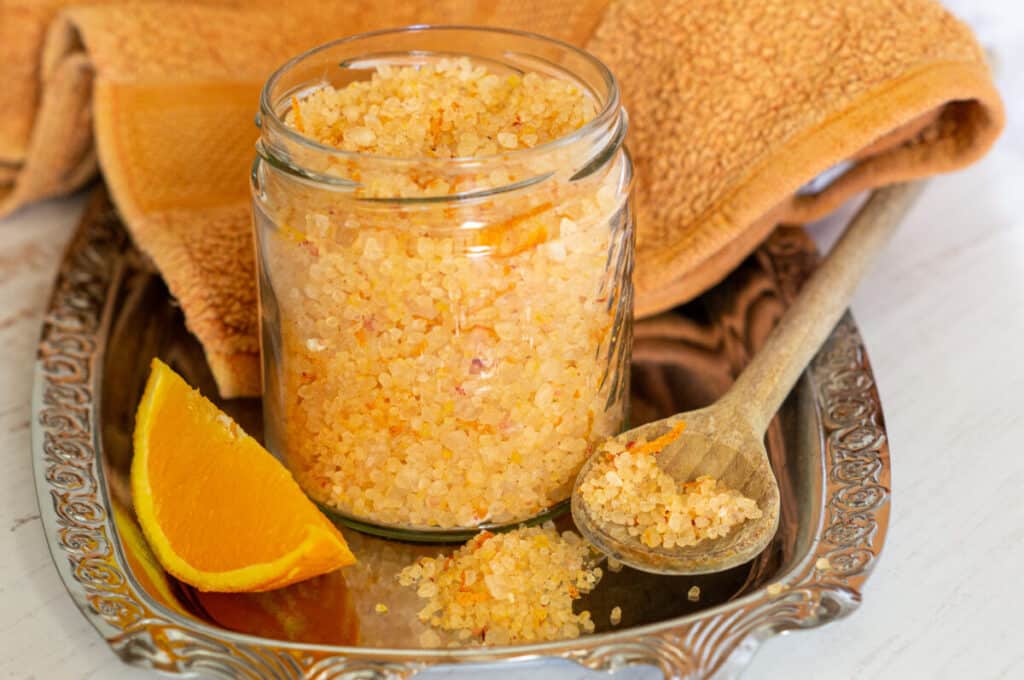
For the orange bath salts, combine 500 g of salt, the zest of 1 unwaxed orange, 5 to 10 drops of orange oil and orange food colouring in the mixing bowl, then 25 seconds at speed 4. The orange peel contains essential oils that are released when it is broken down. The Thermomix® grinds the zest and distributes it finely through the salt. The added orange oil strengthens the fragrance, because the zest alone fades as it dries in the salt.
It is important to use an unwaxed orange. Waxed peel cannot be distributed evenly and leaves ugly patches in the salt. Organic oranges are the safer choice here. Zest the orange thinly, keeping as little of the white pith as possible, otherwise it turns bitter.
Rose petal bath salts: dried petals keep the salt dry
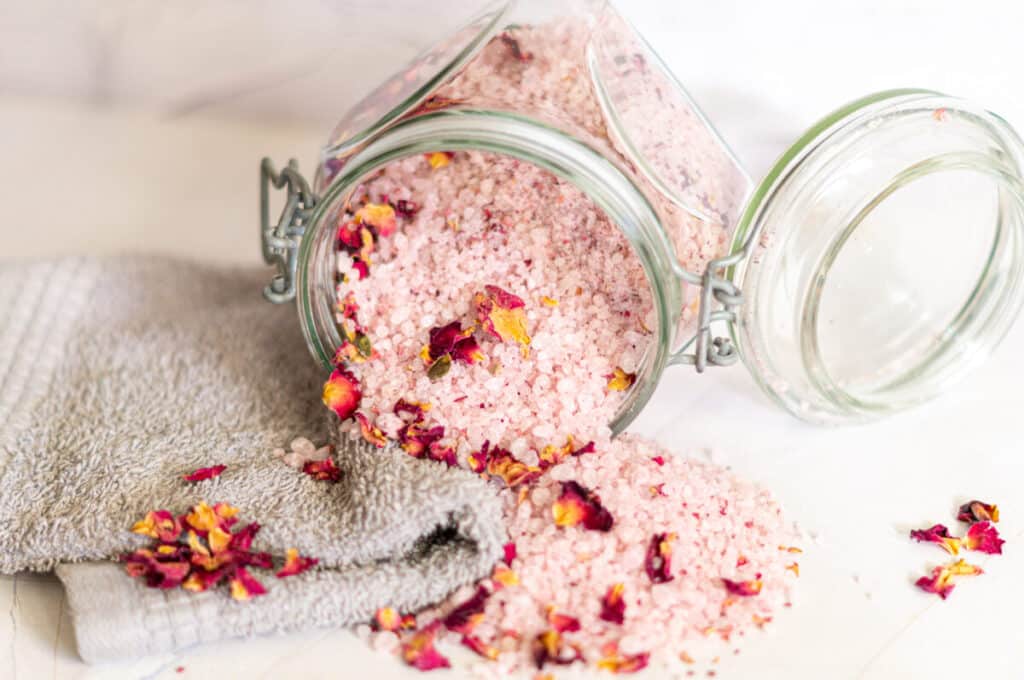
The rose petal bath salts need 500 g of salt, 2 tbsp of dried rose petals, 5 to 10 drops of rose oil and pink food colouring, all together for 25 seconds at speed 4. The rose petals must be dried, otherwise they introduce moisture into the salt, and that is the quickest route to clumping. Dried petals keep the salt free-flowing. The rose oil provides the fragrance and the petals provide the visual effect.
The pink colour completes the effect. Without colour the salt looks like grey road grit with brown crumbs. With pink food colouring it becomes a proper rose bath salt. If you want a stronger scent, combine the rose oil with a few drops of vanilla, which takes the sharp perfumed edge off the rose.
The three common pitfalls with homemade bath salts
The salt clumps after a few days
Bath salt draws moisture from the air and from any damp ingredient. The most common mistake: using fresh instead of dried petals, a wet mixing bowl or a jar that does not seal properly. Our solution: wipe the mixing bowl dry only, use exclusively dried petals and fill the finished salt into a jar with a clip-top lid. This keeps it free-flowing for months.
The unicorn colours turn brown-grey
This happens when you put all three colours into the mixing bowl at once or simply pour them all in together when filling the jar. As the salt pours in, the pigments blend into a muddy tone. Our solution: mix each colour separately, put each into its own small bowl and layer them alternately in the jar. Only then do the stripes stay cleanly separated.
The salt becomes too fine and dusty
If you mix the salt for too long or at too high a speed, you grind it to a powder. The coarse grain that crackles in the water disappears, and it creates dust when you open the jar. Our solution: stay at speed 4 and start with 25 seconds. Only mix further if the colour is still streaky, and then only in 5-second increments.
More fragrance and colour variations to try
The basic system always stays the same, only the colour and fragrance change. A few combinations that work well for us:
- Lavender for sleep: 500 g salt, 1 tbsp dried lavender, 8 drops lavender oil, purple colour. The classic choice for an evening bath.
- Eucalyptus for colds: 500 g salt, 8 to 10 drops eucalyptus oil, no colour. The steam rising from the warm water clears the nose.
- Lemon and mint to wake up: zest of 1 organic lemon, 5 drops peppermint oil, yellow colour. The fresh option for a morning bath.
- Add a nourishing oil at bath time: if you like, add 1 tbsp of almond or jojoba oil directly into the bath, not into the salt jar. This keeps the salt dry and your skin still gets the moisture.
Combining the bath salts into a wellness gift set
Bath salts work well as part of a homemade wellness gift set. We combine them with homemade foot balm and bath bombs made with the Thermomix®. For unicorn fans, a small bottle of unicorn liqueur makes a great addition. Anyone making the whole set will find more ideas in our Thermomix® Cosmetics collection.
Storing the bath salts so they stay free-flowing for months
Bath salt draws moisture from the air. In an open jar it clumps within a few days. Clip-top jars keep the salt free-flowing for months. It retains its colour and fragrance for about three to six months. Jam jars with screw-top lids also work, as long as the lid seals properly. With honey jars, check that the rubber seal in the lid is still intact.
Store the jars not in the bathroom but somewhere dry and dark, such as a bedroom cupboard. The humidity right next to the shower is the main reason bath salt clumps faster than expected.
Frequently asked questions about bath salts with the Thermomix®
More homemade Thermomix® Cosmetics recipes can be found in our recipe collection.