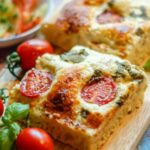
Focaccia in the Thermomix® takes time, but not attention. We mix the dough in 8 minutes, leave it to rise for 2.5 hours and bake it with Gorgonzola cream for 20 minutes until golden.
Focaccia is a Ligurian flatbread made from yeasted dough with olive oil. The Thermomix® kneads the dough on kneading mode until smooth and elastic. The yeast is activated beforehand at 37°C, exactly the temperature at which yeast works best without dying off.
Focaccia with Gorgonzola, Thermomix®
Ingredients 0 / 11 ✓
- 300 g water
- 40 g olive oil
- 2 tsp salt
- 30 g yeast
- 500 g flour
- 150 g cream cheese (full fat)
- 200 g herb crème fraîche
- 200 g Gorgonzola
- 250 g cherry tomatoes
- 2 sprigs basil
- 1 tsp pepper freshly ground
Instructions 0 / 6
-
1
Warm the yeast.
Add water, olive oil, salt and yeast to the mixing bowl and heat for 3 min / 37°C / speed 1.
-
2
Knead the dough.
Add flour and knead for 5 min / kneading mode until smooth. Transfer to a bowl, cover and leave to rise in a warm place for 2 hours.
-
3
Shape the dough.
Line a baking tray with baking paper, dust the dough with flour, roll it out on the tray and press dimples into the dough with your thumb. Leave to rise for another 30 minutes. Preheat the oven to 200°C top and bottom heat.
-
4
Mix the cream.
Add cream cheese, crème fraîche and Gorgonzola cut into pieces to the mixing bowl and mix for 6 sec / speed 6.
-
5
Top the focaccia.
Spread the cream evenly over the dough. Halve the cherry tomatoes and place on the dough. Wash the basil, shake dry, pull off the leaves, tear them and scatter over the focaccia. Sprinkle pepper on top.
-
6
Serve the focaccia.
Bake on the middle shelf of the oven for about 20 minutes until golden. Cut the bread into 12 pieces and enjoy.
Tip: Focaccia tastes best warm, served alongside a fresh salad. It is also great cold as a snack.
Nutrition per serving
Why the dimples in the dough are not just decoration
The characteristic finger dimples in focaccia dough are functional oil reservoirs. Olive oil collects in them, soaks into the dough during baking and creates the typical moist pockets between crisp zones. Without dimples the oil spreads evenly and the focaccia turns dry rather than moist and crisp.
We press the dimples deep into the dough with our thumb, just before the second rise. By then the dough has already risen but is still soft enough for the indentations. After baking, this creates the irregular air pockets that set focaccia apart from pizza.
Rising time determines the airiness
The dough must rise twice: 2 hours after kneading, then 30 minutes after shaping. The first rise builds the gluten structure and gives the dough its body. The second rise after rolling out lets the dimples fill with gas and produces the typical light texture.
Too short and the dough stays dense like pizza dough. Too long and it collapses in the oven because the yeast has consumed all the starch. 2 hours plus 30 minutes is the window in which focaccia stays moist and airy.
Gorgonzola cream instead of cheese strips
We blend Gorgonzola with cream cheese and herb crème fraîche at speed 6 into a spreadable cream. Plain Gorgonzola crumbles would burn in the oven and turn bitter. The cream cheese base protects the Gorgonzola and makes the cream mild enough for children.
The cream is spread onto the dough after the second rise, not before. Spread on earlier, it would sink into the dough and make the surface soggy. Applied just before baking it stays as a layer on top and develops golden brown edges in the oven.
Halve the tomatoes, do not quarter them
Cherry tomatoes are placed on the dough cut side up. Whole tomatoes burst during baking and make the dough wet. Quartered, they release too much liquid and the topping becomes watery. Halved, they keep enough structure and release just enough juice to keep the cream moist.
Basil goes on fresh over the finished tomatoes, not into the oven. Baked basil turns bitter and loses its aroma. We tear the leaves over the hot focaccia after baking, so the aroma unfolds without burning.
Baking at 200°C top and bottom heat
Middle shelf, 200°C top and bottom heat, 20 minutes. Fan-assisted heat dries the focaccia out. The heat from below cooks the dough through, the heat from above browns the cream. After 20 minutes the base is firm and the surface golden. Longer and the cream turns dark, shorter and the dough stays doughy.
We cut the focaccia into 12 pieces while still warm. Cut cold, the crust breaks and the topping slides off. Warm, the dough stays elastic and portions cleanly.
Other toppings for focaccia
Instead of Gorgonzola cream, olives and rosemary work for a classic Italian version, caramelised onions with thyme for a sweet and savoury combination, goat’s cheese with honey and walnuts for a sweet note or garlic and Parmesan for an intense flavour. The dough stays the same, only the cream or topping changes.
For vegan focaccia, replace the Gorgonzola cream with olive paste (tapenade) or sun-dried tomatoes in oil. The dimples remain essential, as they guarantee moisture even without cheese.
Storing focaccia
Focaccia tastes best warm. In the fridge it keeps for 2 days in a sealed container. To reheat, put it in the oven at 180°C for 5 minutes. Do not use the microwave or the dough will turn rubbery.
Freezing does not work well with the Gorgonzola topping. The cream separates on thawing and turns watery. Plain focaccia without topping can be frozen and topped freshly after thawing.
Goes well with: Tomato soup and ham risotto.
Also worth a try: Easter wreath bread with the Thermomix®.
More Italian recipes with the Thermomix®: Pizza Margherita, Ciabatta, Risotto and Pesto Genovese.