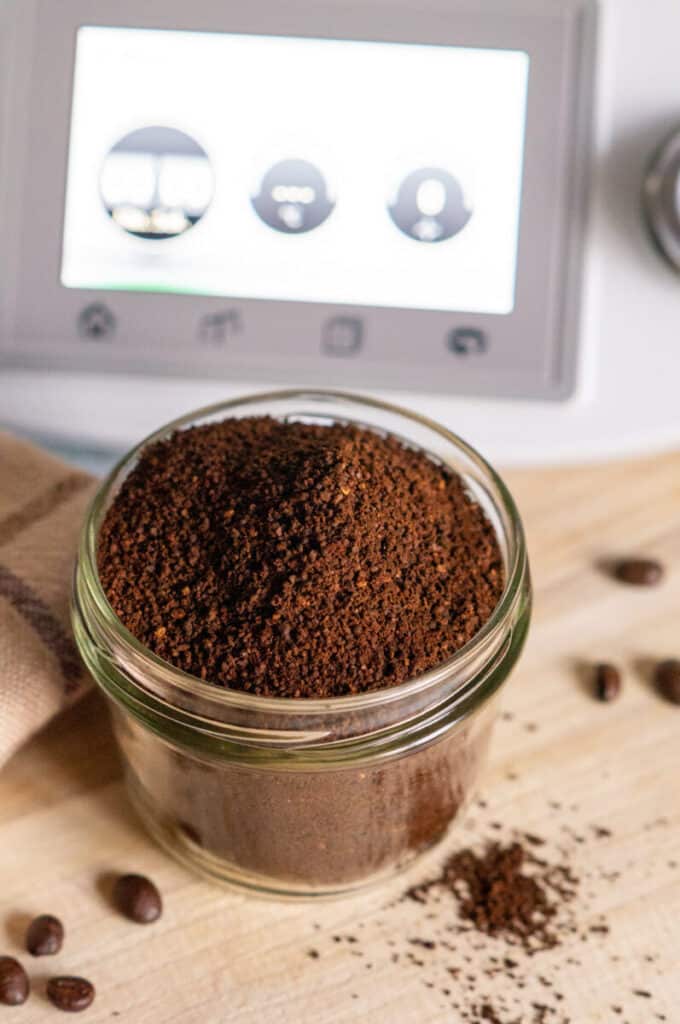
Grinding coffee in the Thermomix® takes 45 seconds. Place 250 g of coffee beans in the mixing bowl, set to speed 9, and you are done. The ground coffee is fine enough for filter coffee and keeps well in screw-top jars. Three grind levels are possible, depending on speed and duration. We have been doing this for years whenever we want freshly ground beans and do not want a separate grinder taking up space in the kitchen.
Grinding Coffee in the Thermomix®
Ingredients 0 / 1 ✓
- 250 g coffee beans
Instructions 0 / 3
-
1
Grind the coffee beans.
Place the coffee beans in the mixing bowl and grind for 45 sec / speed 9.
-
2
Fill into jar.
To store, fill into an airtight screw-top jar.
-
3
For perfect filter coffee: 15 g of ground coffee per 200 ml of hot water (95 °C).
Tip: Adjust the grind level to suit your brewing method. The finer the grind, the more aromatic the coffee will be when brewed. Espresso needs a very fine grind, while regular filter coffee can be a little coarser.
Video
Nutrition per serving
45 seconds at speed 9: the standard grind for filter coffee
Place 250 g of coffee beans in the mixing bowl and grind for 45 seconds at speed 9. This produces a fine powder with the right consistency for filter coffee and pour-over methods. Do not fill more than 250 g per batch, otherwise the Thermomix® will grind unevenly and coarse pieces will remain at the top. If you need more, simply run two batches.
Coarse, fine, very fine: 3 grind levels in the Thermomix®
Depending on your brewing method, you can control the grind level by adjusting the speed and duration:
The general rule is: the longer the water stays in contact with the grounds, the coarser the grind can be. A French press steeps for several minutes, so a coarse grind works well. Filter coffee runs through more quickly, so a finer grind is needed. Mocha and espresso require the finest grind. For espresso from a portafilter machine, the Thermomix® is only partly suitable: portafilter machines need a very consistent, fine grind, and the Thermomix® blade produces slightly irregular particles compared to a dedicated espresso grinder. For filter coffee, French press and mocha, the Thermomix® works perfectly.
Why the blade determines the grind level
The Thermomix® is a blade grinder, not a burr grinder. The blade smashes the beans rather than grinding them uniformly between two surfaces as a disc or conical grinder would. There are two practical consequences worth knowing before you start grinding.
First, the fineness depends entirely on the time. At 45 seconds on speed 9, the blade strikes the beans long enough to produce a consistent filter powder. Second, the result will never be quite as uniform as from a good burr grinder. That is exactly why the 250 g limit matters: in an overfilled mixing bowl, the blade barely reaches the top beans, and the powder ends up dust-fine at the bottom and coarse at the top. We prefer to run two batches of 250 g rather than one batch of 500 g that comes out unevenly.
Grind in short intervals to preserve the aroma
This is the one point that most guides leave out, and it makes the biggest difference. When the blade runs for 45 seconds continuously, friction heats the powder noticeably. Heat drives out the delicate aromatic oils, and the coffee tastes flatter and slightly bitter afterwards. A proper espresso grinder is built to keep the powder cool. The Thermomix® is not.
Our solution: for finer grind levels, do not run the full 45 seconds in one go. Instead, grind in two or three intervals, for example twice 20 seconds at speed 9, removing the lid briefly between runs and pushing the powder down from the sides with the spatula. This keeps the temperature low, ensures the blade reaches all the beans, and preserves the aroma. For a coarse French press grind (4 seconds), this does not matter, as very little heat builds up.
Three common mistakes when grinding coffee in the Thermomix®
Too much at once: coarse at the top, dust at the bottom
The most common mistake. Filling the mixing bowl with 400 or 500 g gives an uneven result: the powder near the blade becomes dust-fine while whole bean halves remain at the top. When brewed, the uneven grind extracts inconsistently and the coffee tastes partly sour, partly bitter.
Our solution: No more than 250 g per batch. For a larger quantity, run two or three clean batches. It takes no more than two extra minutes in total.
Grind level and brewing method do not match
Fine grounds in a French press clog the filter and make the coffee cloudy and bitter. Coarse grounds in a pour-over filter run through too quickly and produce a watery cup. The brewing method determines the grind level, not chance.
Our solution: Follow the table above. French press: coarse (4 seconds, speed 7). Filter coffee: fine (45 seconds, speed 9). Mocha: very fine (1 minute, speed 10). If in doubt, start a little coarser and adjust on the next batch.
Coffee oil and coffee smell linger in the mixing bowl
Dark, oily beans leave a film and a strong smell in the mixing bowl. If you then make a smoothie or a dough without a thorough clean, the coffee flavour comes through.
Our solution: Rinse with hot water immediately after grinding and clean with a little washing-up liquid. For stubborn smells, blending a handful of dry bread or half a lemon briefly at speed 5 before rinsing normally works well. The blade itself is not damaged by coffee, as beans are softer than sugar or ice.
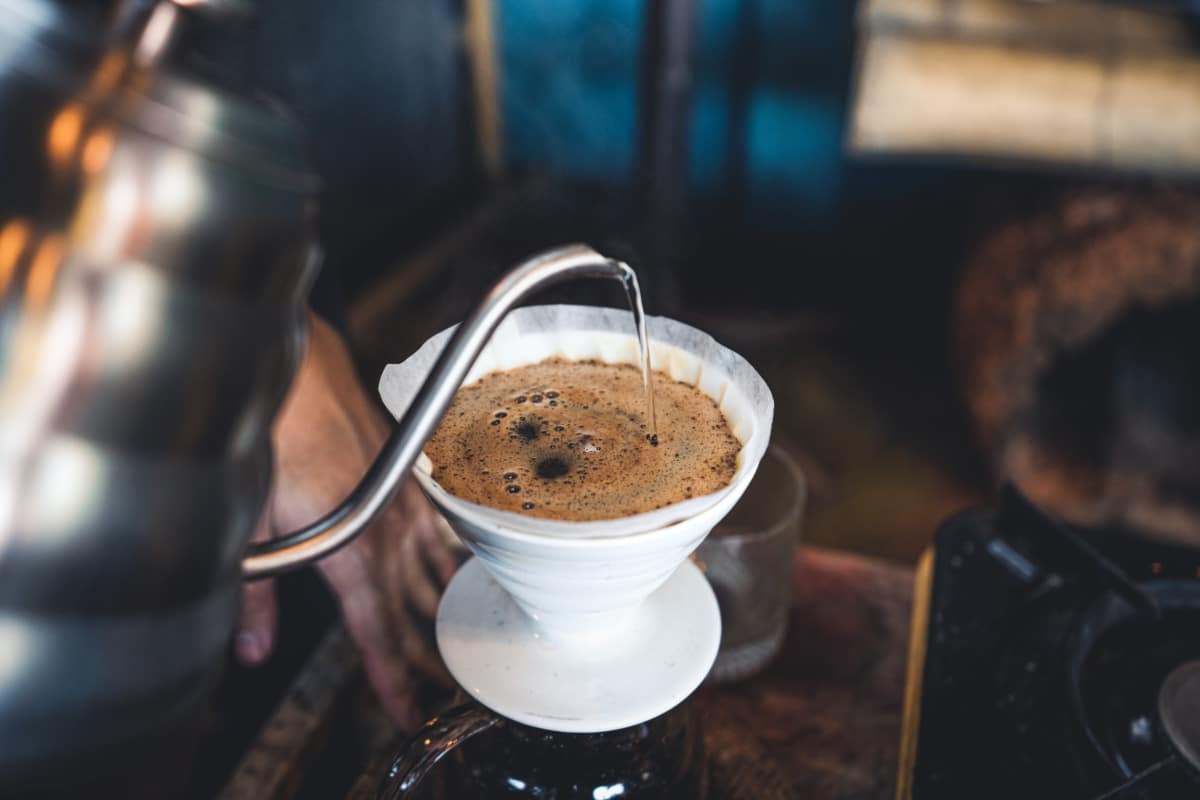
15 g of grounds per 200 ml of water: the ratio for filter coffee
As a general guide: 15 g of ground coffee per 200 ml of hot water (not boiling, around 95 °C). This produces a strong cup. For a milder result, use 12 g. The 250 g of beans from the recipe is enough for around 16 cups of coffee. One advantage of the Thermomix®: it weighs the beans directly in the mixing bowl, so no separate set of scales is needed.
French press, mocha or brew directly in the mixing bowl
The basic recipe can be adapted to suit your favourite brewing method:
- French press: Grind the beans for just 4 seconds at speed 7. A coarse grind that does not slip through the plunger and steeps for 4 minutes.
- Mocha and Turkish coffee: Grind for 1 minute at speed 10 to a very fine powder. The finer the grind, the better the coffee dissolves in the cup.
- Brew directly in the mixing bowl: Grind 3 to 4 tablespoons of beans for 40 seconds at speed 10, add 1000 g of water, steep for 7 min / 100°C / speed 1, then pour through a fine sieve.
- Ground coffee in bulk: If you prefer not to grind fresh every morning, try making iced coffee powder in bulk with the Thermomix®.
From ground coffee to a finished cup
Freshly ground coffee is the starting point for a whole range of Thermomix® recipes. For a milky coffee or cappuccino, we froth the milk using our milk foam recipe made in the Thermomix®. For a cold treat in summer, espresso ice cream from the Thermomix® is hard to beat. And for an evening drink, a coffee cream liqueur made in the Thermomix® is well worth making, and freshly ground coffee makes all the difference there too.
Screw-top jar, dark storage, use within 2 weeks
Fill the ground coffee into an airtight screw-top jar straight away. Store in a dark place at room temperature, not in the fridge (moisture is the enemy). Use within 2 weeks, as the coffee loses a noticeable amount of aroma after that. Whole beans keep significantly longer, which is why we only grind as much as we will drink in 1 to 2 weeks.
If you do grind a larger batch: freezing the powder in small portions is the best way to preserve the aroma. Frozen, it keeps for around 3 months, and you do not even need to thaw it before brewing. It goes straight from the freezer into the filter.
Frequently asked questions about grinding coffee in the Thermomix®
More coffee ideas from the mixing bowl: cappuccino powder made in the Thermomix® and iced coffee powder in bulk for a quick coffee fix.