Bärenfang depends on a temperature limit that many recipes simply ignore: honey loses measurable aroma above around 40°C, and beekeepers advise staying well below that. That is exactly why we add the honey to the vodka in our Thermomix® at a gentle 37°C / speed 1. Anyone who sets 60 or 80°C here will not get a proper Bärenfang, just a flat honey liqueur with a caramel note.
Bärenfang is an East Prussian farmhouse liqueur. Vodka or grain spirit, plenty of honey, a few spices, and that is all there is to it. In Masuria, the liqueur was prepared after the honey harvest in earthenware crocks and set aside for weeks. We make it today in half an hour of active work, but we still need the six weeks of maturing time. The Thermomix® solves the old water bath problem: getting the honey cleanly and gently into the alcohol without the aromatic oils breaking down.
Bärenfang Honey Liqueur with the Thermomix®
Ingredients 0 / 6 ✓
- 150 g water
- 1 star anise
- 1 allspice berry
- 1 vanilla pod
- 500 g vodka
- 300 g honey
Instructions 0 / 5
-
1
Heat the water.
Weigh the water into the mixing bowl and heat for 5 minutes / Varoma / speed 1.
-
2
Add the spices.
Add the star anise, allspice and vanilla pod to the mixing bowl and leave to infuse, covered, for 20 minutes.
-
3
Cook the spices.
Remove the spices from the liquid, then add the vodka and honey to the mixing bowl and stir for 5 minutes / 37°C / speed 1.
-
4
Sterilise the bottle.
In the meantime, sterilise the liqueur bottle with hot water.
-
5
Bottle the liqueur.
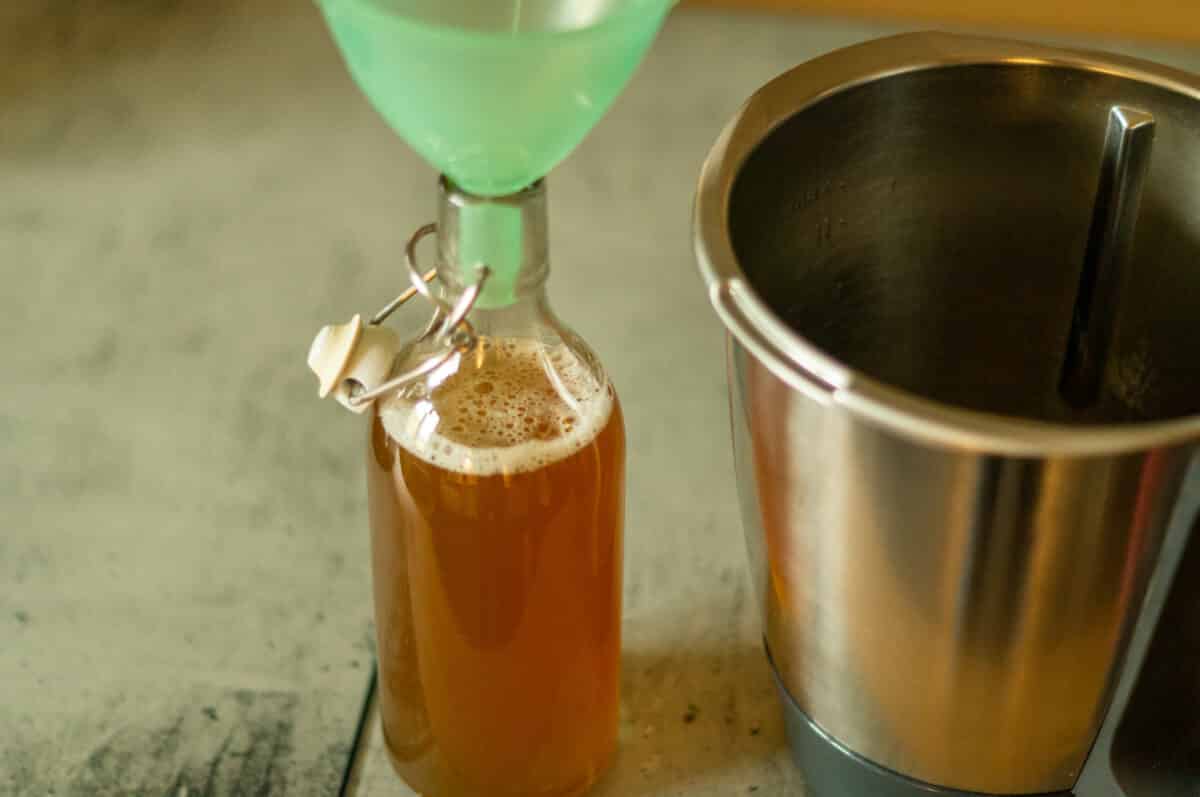
Pour the honey liqueur into the bottle and leave to rest in the fridge for at least 6 weeks. Shake the bottle from time to time to dissolve any streaks that form.
Tips:
After preparing the liqueur you can strain it by passing it through a coffee filter. The more times you repeat this, the clearer the liqueur will become. This is a matter of personal taste.
Stored in a cool place, the liqueur will keep for approximately one year.
Nutrition per serving
Why the honey must not get hot
The principle is straightforward: honey consists of around 80 per cent sugars, with the rest being water, enzymes, essential oils and HMF precursors. As soon as we heat honey, two things happen. First, the delicate floral aromas evaporate because they are highly volatile. Second, the HMF value (hydroxymethylfurfural) rises sharply, an indicator of heat damage that the German honey regulation even governs. At 40°C this takes weeks, at 60°C only hours, at 80°C just minutes.
For our recipe this means: we bring the spices up to temperature separately using the water. The water goes into the mixing bowl for 5 minutes / Varoma / speed 1, because we have no aromatics to protect at that stage, and we want to infuse the star anise, allspice and vanilla pod as hot as possible. The honey only comes in later, and only at 37°C / speed 1, so barely lukewarm. Just warm enough to dissolve in the vodka, but cool enough that the bees’ work is preserved.
The spices carry the character
The original Bärenfang usually features juniper berries, cloves and cinnamon. We prefer a slightly softer variation: 1 star anise, 1 allspice berry and a whole vanilla pod. The star anise provides the anise depth familiar from old herbal bitters, the allspice brings a warm, clove-like note without the sharpness, and the vanilla rounds everything off in a way that works equally well with a light linden honey and a dark forest honey.
The quantities matter: just one allspice berry, just one star anise pod. Doubling them kills the honey. Bärenfang should taste of honey, with the spices sitting in the background. That is also why we really keep to the 20 minutes infusing time in the warm water and then remove the spices from the liquid before the vodka goes in. This way the aroma profile stays balanced rather than turning more bitter with every day in the bottle.
Which honey makes which liqueur
The choice of honey decides almost everything in a Bärenfang. 300 g is a generous amount, and the liqueur turns out sweet but not cloying. We like to use runny linden honey from a local beekeeper, which gives a bright, floral character. For something stronger, woodland or fir honey works well and makes the liqueur almost amber in colour with a faint resinous note. Acacia honey is the mildest option and tastes almost like a sweet vodka with a vanilla finish.
What we do not recommend is crystallised honey that you first have to soften in the microwave. The heat damage has already happened before it even goes into the mixing bowl. If the honey has already set solid, simply place the jar in a warm water bath at well under 40°C overnight to re-liquefy it. This is not essential, but it is our standard approach in winter when most honeys turn solid.
Vodka or grain spirit, it makes a difference
The recipe uses 500 g of vodka, which combined with the honey and the spiced liquid gives around one litre of liqueur at about 19 to 20 per cent alcohol by volume. We use a mid-price vodka at 37.5 or 40 per cent. Cheap inferior vodka comes through and masks the honey note. Premium vodka is not worth it either, because the honey drowns out its finer nuances anyway.
Anyone wanting to recreate the East Prussian version exactly should use double grain spirit instead of vodka. It tastes slightly rounder and suits woodland or heather honey better. Vodka is the neutral stage, grain spirit brings its own character. Both work, and the ratio stays the same.
The six weeks are non-negotiable
Straight after bottling, the liqueur tastes of honey in vodka, meaning two components sitting side by side. Only with time do the aromas merge. Six weeks is the minimum, and three months makes it noticeably rounder. In the first week, streaks often form at the bottom of the bottle; these are fine honey particles that still need to bind together. We shake the bottle roughly every two days, and the streaks dissolve again.
Anyone who wants the liqueur perfectly clear can filter it through a coffee filter after the six weeks. One pass gives a light clarification, two to three passes make it almost water-clear. We prefer it slightly hazy, because the particles carry honey aroma. Clear-filtered it looks more refined but tastes a little flatter. That is a matter of taste, not right or wrong.
When we drink the Bärenfang
Bärenfang is classically a winter liqueur. Ice-cold from the freezer in small shot glasses, alongside a slice of stollen or gingerbread, it fits perfectly in December. In summer we have also tried it over vanilla ice cream, one tablespoon is enough, and the ice cream tastes of honey punch. Over hot tea, a splash in black tea with lemon, that is our cold-and-flu version.
Anyone who enjoys more homemade liqueurs made with the Thermomix® will find the full range on our site. Our egg liqueur made with the Thermomix® works with the same temperature discipline, just applied to egg yolk rather than honey. The Eierschleck is the sweeter cream liqueur version of that. Completely different in character is our After Eight liqueur made with the Thermomix®, which with its chocolate-mint profile belongs more in the dessert corner, and for chocolate fans we also have a chocolate egg liqueur in our collection.
One litre keeps for a year
Bärenfang keeps for a very long time thanks to its high honey and alcohol content. Stored in a dark, cool place in a well-sealed bottle, we reckon on about one year without any loss of quality. In the fridge it becomes more viscous, which many people like because it coats the tongue in a more oily way. At room temperature it stays more liquid and the aroma comes through a little more directly.
We fill the liqueur into sterilised bottles. Rinse with hot water, swill briefly with a little vodka, then fill immediately. This prevents any introduced yeasts from re-fermenting the liqueur. One small bottle in the fridge for drinking, the rest in a dark cupboard. That way we have Bärenfang all year round from a single batch.
Bitter, cloudy, undissolved: what the symptoms mean
Honey will not dissolve properly: This happens when the vodka was fridge-cold or the 37°C was not reached. Fix: stir the mixing bowl contents again for 2 minutes / 37°C / speed 1. Do not go hotter. Better to stir twice briefly than once too warm.
Liqueur tastes bitter after three weeks: The spices stayed in the liquid too long, or there was one allspice berry too many. Next time, really remove the spices after the 20 minutes and keep the allspice below pea size.
Liqueur turns very cloudy: With cold honey and a cold room, some glucose can crystallise out. Stand the bottle briefly in lukewarm water (under 35°C!), then swirl. The cloudiness will disappear again.
Our recipe versus the Vorwerk version
Goes well with: cheesecake and apple cake.
In the wider recipe world, a Bärenfang typically uses 500 g of honey to 1 litre of grain spirit, with honey and water brought together to 37°C and no spices. The result is very sweet, almost syrupy, and tastes more of honey in schnapps than the East Prussian original from Königsberg, where Teucke and Koenig were already working with spices in the 15th century. We deliberately go with 300 g of honey to 500 g of vodka and brew the star anise, allspice and vanilla separately in the hot water. This gives us the warm spice that defines Bärenfang, while the honey stays at 37°C below the heat threshold at which the bees’ work evaporates. Less sweet, more character, closer to Masuria.
More classic liqueurs from our kitchen: egg liqueur, Eierschleck, After Eight liqueur and chocolate egg liqueur.