We make rhubarb compote every year from the end of April, as soon as the first firm stalks appear at the market. The season runs until the end of June, after which the rhubarb becomes woody and should no longer be harvested. That exact window determines how the compote tastes in the end.
We usually cook the compote in two batches: once in early May with the first tender rhubarb for eating straight away on vanilla pudding, and once in June in a larger quantity for the store cupboard jars. The 700 g in the recipe fills exactly one 1,000 g jar, perfect as a family-sized portion over several days.
Rhubarb Compote with the Thermomix®
Ingredients 0 / 8 ✓
- 1 vanilla pod
- 200 g water
- 80 g sugar
- 15 g cornflour
- 700 g rhubarb
- 1 tbsp lemon juice
- 1/2 tsp cinnamon
- 100 g raspberries frozen or fresh
Instructions 0 / 4
-
1
Prepare the vanilla pod.
Halve the vanilla pod, scrape out the seeds and add both the seeds and the pod to the mixing bowl.
-
2
Mix the ingredients.
Add the water, sugar and cornflour and mix for 4 sec / speed 3.
-
3
Add the rhubarb.
Wash the rhubarb, trim both ends and peel carefully, then cut into 2 cm pieces. Add to the mixing bowl along with the lemon juice, cinnamon and raspberries and cook for 9 min / 100°C / reverse direction / gentle stir setting.
-
4
Fill into jars.
Meanwhile, rinse preserving jars with boiling water. Remove the vanilla pod, fill the rhubarb compote into the jars, seal and store in a cool, dark place until ready to serve.
Tip: The raspberries are mainly there for colour. You can leave them out or replace them with strawberries.
Video
Nutrition per serving
Reverse direction instead of speed 1: why the direction of rotation makes all the difference
The most important point in this recipe comes down to a single word in the instructions: reverse direction. The blades rotate backwards, leading with the blunt edge, so they push the rhubarb through the bowl rather than cutting it. If you switch to the normal forward direction, you will end up with a smooth puree after 9 minutes at 100°C instead of a compote with recognisable pieces.
We combine the reverse direction with the gentle stir setting. This low speed is enough for the water, sugar and cornflour to circulate evenly around the rhubarb pieces without anything catching on the bottom. Higher speeds are not possible in reverse direction as the Thermomix® locks this automatically. That limitation is actually an advantage when making compote.
To peel or not to peel: the 2 cm rule of thumb
Young rhubarb in April and early May is usually thinner than 2 cm and only needs washing and trimming. The skin is still soft enough to break down completely in 9 minutes at 100°C. From late May onwards the stalks grow thicker, and once they reach around 2 cm the red outer skin becomes fibrous. It does not soften during cooking but stays as tough strands in the compote. We peel those stalks with a vegetable peeler or pull the skin away from the top end using a knife.
With particularly thick stalks from late June, the need to peel goes even deeper than the skin. If white fibres cling to the blade when you cut through a stalk, the rhubarb is too old for a chunky compote and is better suited to a cake or a syrup. For our recipe the rule is: choose firm, glossy stalks that give nothing when pressed with your thumb.
The acidity and how 80 g of sugar balances it
Rhubarb contains between 1.2 and 1.5% acid, mainly malic acid with a little oxalic acid. That is more than blackcurrants. The 80 g of sugar to 700 g of rhubarb is our deliberate lower limit. It keeps the characteristic rhubarb flavour intact so the compote does not taste like preserved strawberries. If you prefer it noticeably sweeter, go up to 100 g of sugar. Honey and agave syrup both work, though we reduce the quantity to 60 g in those cases because their sweetness is higher than regular caster sugar.
The seeds of a vanilla pod round off the sharp edge further. Vanilla does not contribute sweetness of its own, but it shifts the perception of acidity on the palate. Vanilla sugar or vanilla paste work as substitutes. Add both a little later than the pod, as they cook off more quickly without it. We never leave out the 1 tbsp of lemon juice in the recipe. It stabilises the colour and stops the compote turning brown during heating.
Mix the cornflour in first, do not add it to hot compote
We add the 15 g of cornflour to the mixing bowl together with the 200 g of water and the sugar, before the rhubarb goes in. This order is a deliberate choice in the recipe. First mix for 4 seconds at speed 3, then add the rhubarb. This way the cornflour dissolves completely in the cold water. If you add it later when the bowl is already warm, lumps form immediately that the reverse direction cannot break up.
As the compote cools, the cornflour continues to thicken. Immediately after the 9 minutes of cooking, the compote in the jar often looks quite liquid. After three to four hours in the fridge it will have reached the typical compote consistency, thick enough to sit on pudding or yoghurt without sliding off. For a noticeably thicker result, go up to 20 g of cornflour, which gives something closer to a tart filling.
Raspberries as a colour boost, not a main ingredient
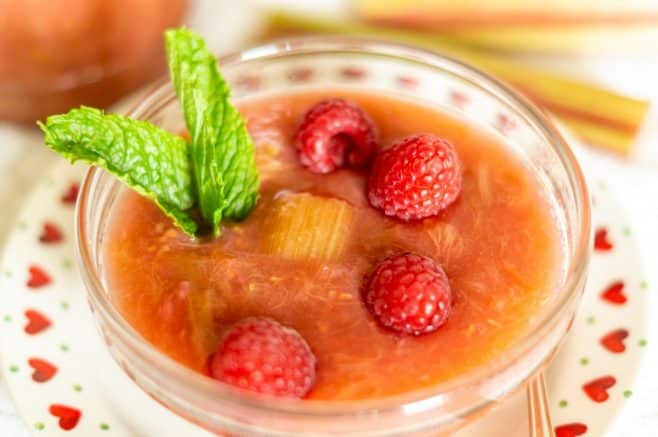
Rhubarb naturally cooks down to a pale beige tone, and even red varieties lose much of their colour during cooking. The 100 g of raspberries in the recipe are our colour trick. They give the deep pink that most people associate with rhubarb compote, without dominating the flavour. Frozen raspberries work just as well as fresh ones. In May, fresh raspberries from domestic growers are not yet available anyway.
If you leave the raspberries out, you get a light, almost cream-coloured compote with a purer rhubarb flavour. That is not a mistake but a choice. Strawberries instead of raspberries make the compote sweeter and the pieces slightly more watery. Redcurrants intensify the acidity further and pair better with very sweet accompaniments such as rice pudding or semolina.
What you can build with this
Rhubarb compote is the base for at least three more spring desserts for us. On Thermomix® rice pudding it is the classic combination, the sweet rice base balancing the sharpness perfectly. Layered on vanilla paste pudding it becomes what many patisseries sell as a rhubarb and vanilla layered dessert. And with a little homemade vanilla sugar over Greek yoghurt it makes a quick breakfast that tastes far better than anything from the chilled cabinet.
How long it keeps in the jar and in the freezer
Filled straight into jars rinsed with boiling water and sealed immediately, the compote keeps in the fridge for around two weeks. Remove the vanilla pod before filling, otherwise the flavour becomes resinous over time. We write the date directly on the lid because we often have several jars on the go in the fridge at once.
For longer storage we fill the compote into freezer bags or ice cube trays and freeze it in portions. It keeps for up to 8 months this way, which is handy when we fancy rhubarb compote on pudding in November. When thawed it loses a little firmness, but you will not notice that on pudding or rice pudding. Leaving it open in a jar at room temperature is out of the question, as the high sugar content means it will start to ferment within a few hours.
Three ways to vary the basic recipe
- With apple instead of raspberries: replace 200 g of rhubarb with peeled diced apple. The compote becomes milder, the acidity shifts, and the texture becomes slightly thicker. Goes well with pancakes or Kaiserschmarrn.
- Sharpened with ginger: add 1 cm of fresh ginger, finely grated, along with the rhubarb. This gives a warmer, almost wintry character. Good with roast lamb or as an accompaniment to strong cheese.
- With elderflower cordial instead of sugar: use 100 g of elderflower cordial instead of 80 g of sugar, and reduce the water to 150 g. A classic May combination found in bakeries everywhere as a rhubarb and elderflower tart.
If you are looking for more spring recipes with the Thermomix®, we also have guides for rice pudding, homemade vanilla paste and vanilla sugar.