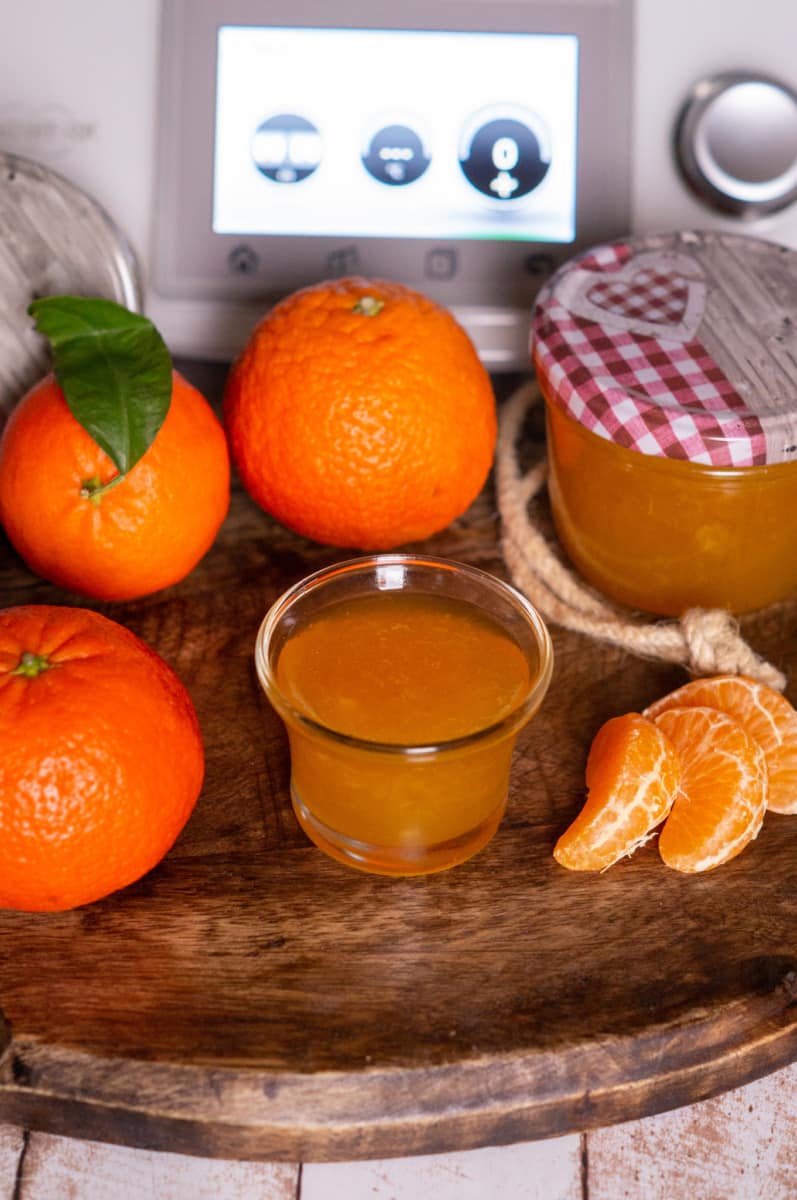
Mandarin marmalade made with the Thermomix® takes 25 minutes and yields about 600 g (one large screw-top jar, 20 tablespoons). 500 g of freshly squeezed mandarin juice, 260 g of jam sugar 2:1, 1 tsp of vanilla and 2 tbsp of Licor 43. The 2:1 ratio is not a coincidence: mandarins are low in pectin (the setting agent), so they need more sugar than strawberries or redcurrants.
We make this marmalade mainly during the mandarin peak season from October to February, when the fruit is cheap and sweet (clementines at around 1.50 Euro/kg, organic mandarins at around 3 Euro/kg). Compared to shop-bought marmalade, the homemade version costs about 2 Euro per 600 g jar. And the bonus: you know exactly which alcohol is in it, or whether there is any at all.
Mandarin Marmalade with the Thermomix®
Ingredients 0 / 4 ✓
- 500 g mandarin juice freshly squeezed
- 1 tsp vanilla extract
- 2 tbsp Licor 43
- 260 g jam sugar 2:1
Instructions 0 / 3
-
1
Squeeze the mandarins.
Squeeze the mandarins and add the juice and pulp to the mixing bowl.
-
2
Cook the marmalade.
Add the remaining ingredients and cook for 10 min / 100°C / speed 2, then finish cooking for 5 min / 95°C / speed 2.
-
3
Fill the mandarin marmalade into jars.
Meanwhile, sterilise the preserving jars and lids with boiling water.
Do a set test, then fill into the prepared jars and seal.
Tip: Instead of Licor 43, you can also use Amaretto.
Video
Nutrition per serving
Why jam sugar 2:1 and not 1:1 or 3:1
Mandarins contain little natural pectin (the setting agent found in fruit). For strawberries or raspberries, jam sugar 3:1 (one part sugar to three parts fruit) is enough because those fruits already contain some pectin. With mandarin juice and no peel, you need more setting agent.
2:1 (260 g to 500 g juice): The standard. Good set, moderate sweetness. Works every time.
3:1 (170 g to 500 g juice): Less sweet, but the risk that the marmalade will not set. Only works if you add 1 tbsp of lemon juice (which brings the acidity needed for the pectin reaction).
1:1 (500 g to 500 g juice): Very sweet, almost a jelly. Keeps longer (more sugar means more preservation), but the sweetness dominates.
Without jam sugar, using normal sugar and separate pectin: only for marmalade experts, because the amount of pectin then needs to be measured individually.
Licor 43 or Cointreau, Amaretto, Prosecco
Licor 43: the classic choice. Sweet, lightly vanilla-flavoured (made from 43 herbs and spices, hence the name), it brings out the mandarin aroma without overpowering it.
Cointreau: orange liqueur, intensifies the citrus note. Slightly drier than Licor 43.
Amaretto: adds a marzipan-almond note. Works particularly well in the version with mandarin zest.
Grand Marnier: a premium option, elegantly bitter, great for a marmalade to give as a gift.
Whisky (1 tbsp): unusual, adds a smoky note, for a grown-up marmalade.
Prosecco (50 ml): lighter in alcohol, with a touch of acidity. Brings a hint of champagne-brunch feeling.
Without alcohol: leave out the liqueur and add an extra 1 tsp of ground vanilla or 1 tbsp of orange blossom water. Works just as well and is child-friendly.
Why only juice and not mandarins with the peel
Mandarin peel contains essential oils that release bitter compounds (limonin, naringin). In marmalade, this can tip the flavour towards grapefruit bitterness. So: peel the mandarins, then juice them.
If you still want a zesty peel flavour, add only the finely grated yellow zest of 1 organic mandarin. The white inner pith (albedo) is the bitter part. Only use organic mandarins, as conventional ones are often treated with wax and preservatives.
Sterilising: 10 min in boiling water or oven at 100°C
The marmalade will only keep for a long time if the jars are germ-free. Three methods:
Boiling water: Place jars and lids in a pot of boiling water for 10 minutes. Remove with clean tongs, place on a clean tea towel and fill immediately.
Oven: Place jars in the oven at 100°C for 15 minutes. Sterilise lids separately in boiling water (the rubber seals cannot handle 100°C of dry heat).
Dishwasher: Run on the hottest cycle without the drying programme, then fill the jars while still hot straight after the cycle. The quickest method for 4 to 6 jars.
After filling, place the jars upside down for 5 minutes (the heat sterilises the lid and creates a vacuum). Then turn them the right way up and leave to cool on a tea towel.
Set test: 1 tsp on a cold plate
If you are not sure whether the marmalade will set, do a set test: place 1 tsp of the hot marmalade on a cold plate (chilled in the fridge for 5 minutes beforehand), wait 1 minute, then push it with your finger. If a skin forms, the marmalade is ready. If not, cook for 2 minutes longer.
Why not just open the jar and check: because the marmalade only sets fully as it cools. The final consistency is not reached until after 12 hours. In the pot, it is still liquid.
Variations: orange-mandarin, cinnamon-clove, pure vanilla
Orange-mandarin mix: 250 g mandarin juice and 250 g orange juice. Slightly more tart, and easier to find in summer (oranges are available year-round).
Christmas variation: Add 1 cinnamon stick, 2 cloves and 1 star anise during cooking, then remove before jarring. Great for festive market gifts.
Mandarin and ginger: Add 1 tsp of freshly grated ginger. A sharp, sweet combination.
Pure vanilla: Use the seeds of a vanilla pod (instead of extract) and add the scraped pod during cooking. Premium flavour, with visible vanilla flecks.
Mandarin marmalade keeps for 6 months
With proper sterilisation and a vacuum seal: 6 months at room temperature in a cool, dark place. Once opened: 4 weeks in the fridge, always using a clean spoon. Signs of mould: white or green spots on the surface, or a sour smell.
If you label the jar with the date, you always know where you stand. Tip: stick on a small label (for example, ‘Mandarin Marmalade, January 2026’). Also makes a lovely gift wrapped with a square of fabric over the lid.
Goes well with: Brioche and pancakes.