Salsa is all about texture. If you blend the tomatoes, peppers and onion too finely in the Thermomix®, you end up with a pasta sauce rather than a Tex-Mex dip for tortilla chips. We find that the line between the two comes down to just a few seconds at speed 5.
We have been making this salsa dip in the Thermomix® for years, in large batches, whenever the tomato glut hits or we find tinned chopped tomatoes at a good price. Eight jars of 200 g is the standard batch, and the acid-heat balance is calibrated precisely for that quantity. Using less vinegar, less salt or less chilli might sound like a good idea, but it kills the Tex-Mex character and dramatically shortens the shelf life.
Salsa Dip with the Thermomix®

Ingredients 0 / 10 ✓
- 1 onion
- 3 garlic cloves
- 3 red pointed peppers
- 800 g chopped tomatoes from a tin
- 150 g white wine vinegar
- 40 g cornflour
- 4 tsp salt
- 2 tsp vegetable stock powder
- 3 pinches pepper
- 1 tsp chilli powder
Instructions 0 / 4
-
1
Chop the ingredients.
Peel the onion, halve it and place it in the mixing bowl. Peel the garlic and add it to the mixing bowl. Wash the pointed peppers, remove the seeds, halve them and add them to the mixing bowl. Add the tomatoes and chop for 7 sec / speed 5.
-
2
Add all remaining ingredients.
Add the remaining ingredients and stir together for 10 sec / speed 3.
-
3
Cook the salsa dip.
Cook the salsa for 15 min / reverse direction / 100°C / speed 2.5.
-
4
Fill into jars.
In the meantime, sterilise the preserving jars with boiling water. Fill the salsa into the jars while still hot, screw on the lids and leave upside down for 10 minutes to cool.
Tip: If you prefer a smoother salsa, increase the speed in step 1.
Video
Nutrition per serving
Why this salsa dip has more chunks than most
The key moment is step 1: onion, three garlic cloves, three red pointed peppers and 800 g of tinned chopped tomatoes all go into the mixing bowl together. Seven seconds at speed 5 is exactly the point at which the pepper breaks down into small pieces, the onion remains visible and the tomatoes keep their texture. One second more and you have tomato sauce. If you want a smoother dip, increase to speed 6 or extend to nine seconds, but we recommend starting at the lower end and adding more time if needed.
The second small variable is the cornflour. 40 g sounds like very little, but it does two things at once: it absorbs the water that comes out of the tomatoes during cooking, and it gives the dip the slightly thick consistency that holds up even after three weeks in the jar. Without cornflour the dip separates in the jar, with water collecting at the top and tomato pulp settling at the bottom. With cornflour, everything stays stable.
The acid-heat balance is essential, not optional
150 g of vinegar to 800 g of tomatoes sounds like a lot when you first read it. But the quantity is deliberate: vinegar preserves. In a dip designed to keep for several weeks on the shelf, acid is what keeps mould and bacteria at bay. If you reduce it, you will need to store the dip in the fridge and use it within a week.
Four teaspoons of salt and two teaspoons of vegetable stock powder provide the base flavour, one teaspoon of chilli powder and three pinches of pepper add the accent. If you want it hotter, add a fresh jalapeño in step 1, deseeded or with seeds depending on your preference. Fresh heat behaves differently to powder: it is rounder, more fruity and is controlled by the number of chillies rather than the measuring spoon. For a child-friendly version, use half a teaspoon of chilli and leave out the fresh chilli.
Cooking on reverse direction saves the texture
Step 3 is where many salsas made in the Thermomix® go wrong. 15 minutes at 100°C is needed so that the cornflour swells and the dip is hot enough to fill the jars cleanly. But on normal direction at the same speed and time, the blade breaks up everything we carefully chopped into chunks. Reverse direction at speed 2.5 turns the blade blunt-side first so it stirs rather than cuts. The salsa stays chunky, cooks through and does not stick to the bottom.
We have tested this multiple times: on normal direction with the same speed and time you get a smooth tomato cream, fine in taste but no longer a salsa dip. Reverse direction here is not a comfort feature, it is a must.
Sterile jars are the difference between three days and a year
A salsa dip filled hot into an unrinsed jar keeps for three days in the fridge. The same dip in a sterile preserving jar keeps for a year in a cool, dark cupboard. Sterilising takes us ten minutes and involves two steps: rinse the eight jars and lids with boiling water, place them on a clean tea towel and leave to drain. Alternatively, put the jars in the oven at 120°C for ten minutes.
When filling, the salsa must still be hot, ideally straight after the 15 minutes. Fill each jar to within one centimetre of the rim, screw on the lid, turn upside down and leave for ten minutes. The vacuum that forms as the jar cools pulls the lid down and keeps the salsa airtight for months. A audible “pop” when you open the jar for the first time is the sign that everything worked correctly.
How we use the salsa dip
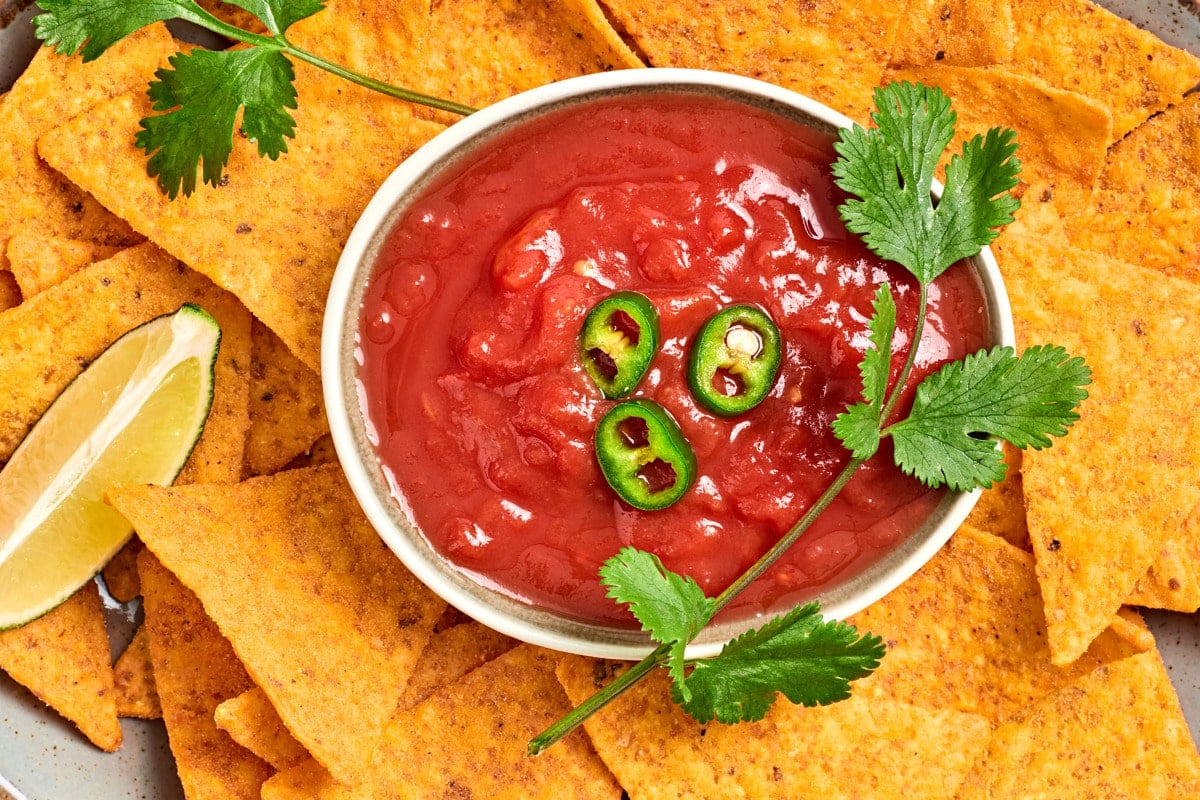
The classic use is a Tex-Mex spread: a jar of salsa alongside our Guacamole with the Thermomix® and a bowl of sour cream. Tortilla chips for dipping, and that is it. If you want to make your own chips, we have a recipe for Chilli Cheese Nachos that work brilliantly with this salsa as a topping.
Outside of Tex-Mex, we use this dip as a base for wraps and burritos, as a side to grilled meat or as a spread on a cheese sandwich. A jar also goes into our Chilli con Carne when the tomato quantity in the recipe runs a little short. The same trick works for Chilli con Carne with Rice: stir two tablespoons of salsa in at the sweating stage and you get instant Tex-Mex flavour with no extra effort.
What can go wrong and how to spot it
Three problems come up with this recipe regularly. All of them can be avoided in advance.
First: the dip turns out too runny. The cause is almost always that the cornflour was forgotten, or that the 15-minute cooking time was not kept. The starch needs heat to thicken. If you get impatient after ten minutes, you end up with tomato soup rather than salsa. Fix: mix the cornflour into two tablespoons of cold water, add it to the mixing bowl and cook for a further five minutes at 100°C on reverse direction at speed 2.5.
Second: the dip tastes flat. Tinned tomatoes vary in acidity and sweetness. If the salsa seems bland after cooking, it is missing either salt, acid or heat. We always taste two minutes before the end of the cooking time and adjust with half a teaspoon of salt, a splash of vinegar or a pinch of chilli. Seasoning at the end is essential, not optional.
Third: the layers separate in the jar. If after a week on the shelf you find water at the top and tomato pulp at the bottom, the cornflour did not swell sufficiently. This happens when the salsa was too cool when filled into the jars. Next time, fill straight after the cooking step without any pause.
Opened jars in the fridge, unopened jars in the cupboard
An unopened jar keeps for a year in a cool, dark cupboard at room temperature. We store our stock on the cellar shelf and write the filling date on the lids. Once a jar is opened, it goes into the fridge and should be used within three to four days. The contents look the same after three days as on day one, but the acid-salt barrier no longer works reliably in an open jar.
Freezing does not work well for this salsa dip. The tomato pieces become watery when defrosted and the texture breaks down. If you want a larger supply, it is better to make a double batch and fill it into more jars.
Anyone who wants to make more Tex-Mex classics with the Thermomix® will find the right accompaniments here: Guacamole, Chilli con Carne and Chilli Cheese Nachos.