Béchamel sauce with the Thermomix® is ready in 20 minutes, and anyone who has made it this way rarely goes back to the hob. The principle is simple, though it hides one key technique: the roux must stay white.
A roux has three stages: white, blonde, brown. For béchamel you need only the white stage, which is the window of 1 to 2 minutes when butter and flour are heated together without the mixture taking on any colour. On the hob this is a constant battle: heat too high, the roux goes blonde and tastes nutty instead of neutral. Heat too low, the flour does not cook through and the sauce tastes floury. The Thermomix® holds a steady temperature at speed 1 and stirs continuously without stopping. That is why the sauce turns out so reliably.
Béchamel Sauce with the Thermomix®

Ingredients 0 / 6 ✓
- 60 g butter
- 60 g plain flour (Type 405)
- 600 g milk
- 1 tsp salt
- 1 pinch nutmeg
- 1 tsp freshly ground pepper
Instructions 0 / 3
-
1
Melt the butter.
Add the butter to the mixing bowl and melt for 2 min / 100°C / speed 1.
-
2
Add the flour.
Add the flour and cook for 2 min / Varoma / speed 1.
-
3
Cook the béchamel sauce.
Add the remaining ingredients and cook for 10 min / 90°C / speed 3.
Tip: Depending on what you are using the sauce for, you can add a squeeze of lemon or 1 tsp of vegetable stock powder.
Video
Nutrition per serving
The Roux: Keeping It White
The first step is the butter: melt 60 g for 2 min / 100°C / speed 1. The butter must be completely liquid before the flour goes in. Solid pieces in the flour lead to lumps that will not dissolve later.
Then the flour: add 60 g plain flour and cook for 2 min / Varoma / speed 1. Varoma here means the Thermomix® brings the mixing bowl to maximum temperature so the flour sweats vigorously. The mixture begins to bubble gently and smells of warm starch, not toasted aromas. That is the target. As soon as a nutty smell appears, the roux has gone one step too far.
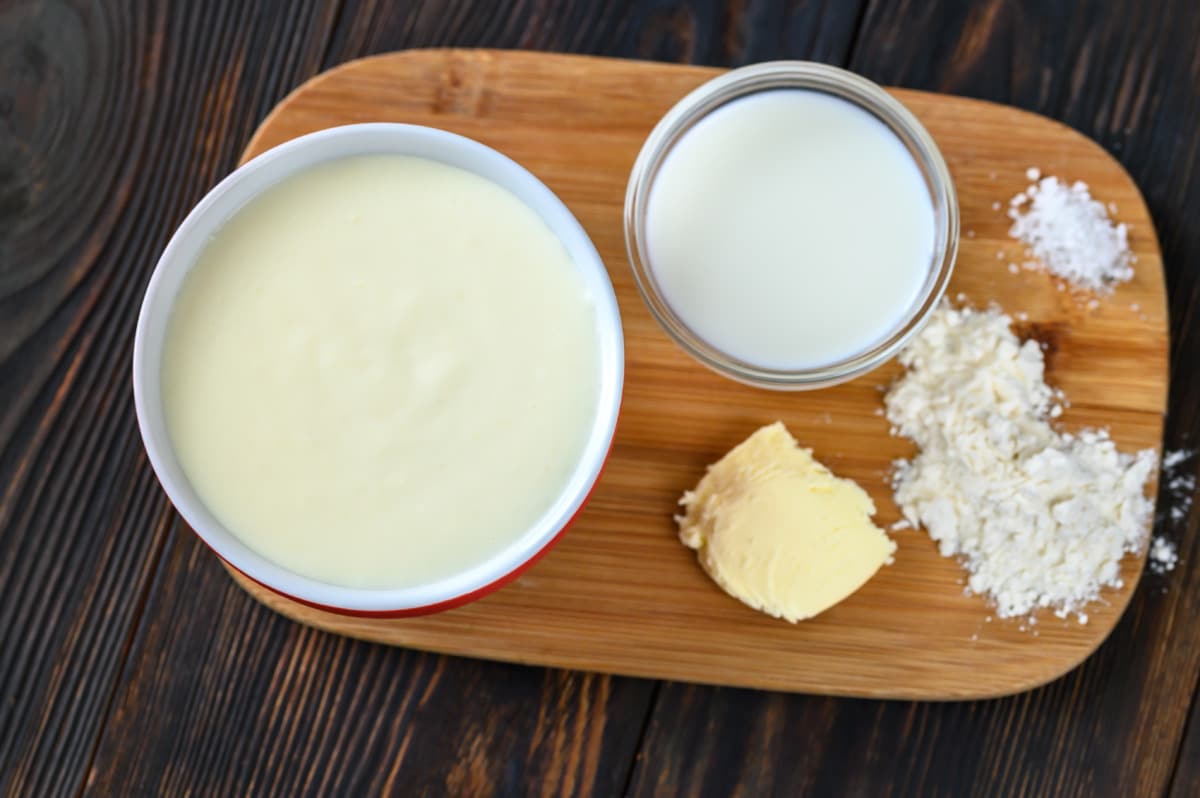
Next: add 600 g milk, salt, nutmeg and pepper and cook for 10 min / 90°C / speed 3. Speed 3 stirs the milk evenly into the roux without splashing. 90°C rather than 100°C stops the milk from catching on the bottom. At the end of the cooking time you have a silky smooth béchamel that coats the back of a spoon slowly.
Two notes on seasoning: nutmeg is a classic addition to any béchamel, but a pinch is enough. It is not a background flavour, it dominates instantly if you use too much. White pepper instead of black makes visual sense when you want a pale sauce without dark specks. In terms of taste, black pepper is slightly stronger.
We do not pre-warm the milk, by the way. Cold milk works just as well in the Thermomix® because it heats up gradually. On the hob that would be a problem.
If the Sauce Turns Out Too Thin or Too Thick
Béchamel thickens as it cools. What flows nicely in the mixing bowl will set considerably firmer on the plate. We therefore let the sauce stay slightly thinner in the Thermomix® than we want it to be at the end. As a guide: the sauce should flow slowly off the spatula in the mixing bowl, neither dripping nor stretching.
Too thin after cooking: reduce for another 2 to 3 minutes at 90°C / speed 3. Too thick the next day: add a splash of milk and warm for 3 minutes at 80°C / speed 2. The consistency comes back.
The only real source of error remains the roux. If you do not let the butter melt completely before adding the flour, and if you cook the flour for less than 2 minutes, you will end up with a sauce that tastes floury. That cannot be cooked out afterwards. Simply stick to the timings next time.
As a Base for Bakes and Lasagne
The béchamel in this recipe is the standard version: 60 g butter and 60 g flour to 600 g milk. This gives a medium-thick sauce that goes straight with vegetables or pasta.
For lasagne we recommend more flour: 80 g instead of 60 g, everything else stays the same. A thinner béchamel runs between the pasta sheets and collects at the bottom. The thicker version stays where it belongs. Our vegetable lasagne recipe with the Thermomix® uses exactly this variation.
For pasta bakes or gratin, the béchamel becomes a Mornay sauce: after cooking, stir in 100 g grated cheese and melt for 1 minute at 80°C / speed 2. Emmental, Gruyère or Gouda all work well. Our courgette and potato gratin with the Thermomix® shows how the sauce integrates into a gratin.
Goes well with: lasagne, cauliflower and broccoli.