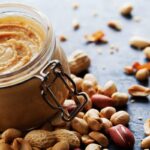
We have been making peanut butter with the Thermomix® for years: no sugar, no palm oil, and no preservatives. Three ingredients are enough, and the mixing bowl does the rest in under ten minutes.
We made this recipe for the first time because the jars from the supermarket were too sweet and most brands add palm oil. Now we know exactly what goes into each jar: 500 g peanut kernels, a pinch of salt, and not a single additive in the first grinding step. Only after that does a little peanut oil help achieve a creamier result. If you are patient, you can even work without any oil at all and simply blend for longer.
Peanut Butter with the Thermomix®
Ingredients 0 / 3 ✓
- 500 g peanut kernels
- 120 g peanut oil
- 1 pinch salt
Instructions 0 / 3
-
1
Grind the peanuts.
Place the peanuts in the mixing bowl and grind for 1 minute / speed 10.
-
2
Mix the ingredients.
Add the remaining ingredients and mix for 3 minutes / 50°C / speed 5.
-
3
Fill into jars.
Fill into sterilised jars, screw on the lids and place upside down for 5 minutes.
Tip: If you want crunchy peanut butter, chop 80 g of your peanuts first for 3 seconds / speed 5 and add them back in the second step shortly before the end.
This peanut butter is intentionally made without added sugar. If you prefer a sweeter peanut butter, simply add honey, cane sugar, or another sweetener of your choice.
Video
Nutrition per serving
Why this recipe works so well in the Thermomix®
Grinding in stages rather than going full power from the start. Peanuts do not release their oil straight away. If you go straight to speed 10 for three minutes, you end up with hot, crumbly powder and an overworked motor. We grind the 500 g of peanuts for one minute at speed 10 first, so the kernels break and the cell walls open up. Only then do we work in the oil gradually.
Frictional heat as a helper, not an enemy. At 50°C in the second step, the mixture warms gently. This makes the peanut oils more fluid and they combine with the ground nut to form a smooth paste. Without this warmth the butter stays gritty, especially if the peanuts come straight from a cool store cupboard.
The mixing bowl geometry beats any pestle and mortar. The conical mixing bowl constantly forces the peanuts back towards the blade. In a flat-bottomed blender the ground mixture would stick to the walls. That does not happen here, and that is why 500 g works in a single batch.
Where peanut butter goes dry or oily
Giving up too early and adding extra oil
After 60 seconds the mixture looks like coarse flour. This is exactly where most people stop and pour in more oil. That works, but it is not necessary if you follow the recipe properly. Our solution: Wait for the full minute at speed 10. If you do not want an extra oil boost, blend for two further minutes at speed 5 without adding anything and let the peanuts’ natural oil do the work. It takes longer, but gives the purest result.
Using roasted peanuts with a salt coating
The supermarket shelves are mainly full of roasted and salted peanuts. If you use those, you end up with over-seasoned butter and lose control of the salt level. Our solution: Buy plain, unsalted peanut kernels, ideally without shells and without the thin inner skin. The pinch of salt in the recipe is enough to bring out the natural flavour without making the butter taste salty.
Using less than 300 g
With 200 g of peanuts the blades struggle to reach the mixture. The paste flies up to the bowl wall and sticks there. Our solution: Use at least 400 g, and ideally the full 500 g from the recipe. Leftovers keep perfectly well for three weeks in the fridge, so the larger batch is well worth it.
Toasting beforehand adds more flavour
If you want to deepen the character of the butter, toast the peanuts dry beforehand. We spread the 500 g on a baking tray and put them in the oven at 160°C fan for 8 to 10 minutes. As soon as the kernels are golden brown and smell nutty, take them out and let them cool completely. Putting them in the mixing bowl while still warm is a classic mistake. The frictional heat from grinding comes on top, and the butter turns bitter. Toasting shifts the flavour noticeably towards caramel and makes the difference between a decent and a very good peanut butter.
Variations we actually make
Crunchy with pieces. Roughly chop 80 g of the peanuts separately for 3 seconds at speed 5, set them aside, and add them back shortly before the end of the second step. This keeps the pieces noticeable so they do not get blended in.
Chocolate peanut butter. Add 30 g of cocoa powder and 40 g of honey in the second step along with the oil. Note: honey makes the butter stickier and shortens its shelf life, but it tastes like a milder praline cream.
Spicy variation. Add 1/2 tsp smoked paprika and a pinch of cayenne pepper in the second step. This works brilliantly in Asian peanut sauces or as a spread on sourdough with tomatoes.
Sweeter with honey or cane sugar. We like the butter plain, but 30 g of honey or 25 g of cane sugar makes it more child-friendly. Mix honey in during the second step; it is best to grind cane sugar briefly with the peanuts first, otherwise it stays grainy.
What we pair with this peanut butter
On fresh sourdough with banana it is a classic. If you enjoy sweet spreads, our Datella, homemade Nutella®, and the low-carb version are also worth trying. In smoothies we add a tablespoon of peanut butter to banana, oat milk, and cocoa. It also makes a regular appearance in curries and Asian stir-fries, because it thickens the sauce and adds depth at the same time.
3 months in the fridge, oil separates on top
Fill straight into sterilised screw-top jars, screw on the lids and place upside down for 5 minutes. This creates a vacuum and significantly extends the shelf life. In the fridge the butter keeps perfectly well for three to four weeks, provided the jar is clean and only a dry spoon goes in. At room temperature it reaches its limit after about ten days, because peanut oils go rancid relatively quickly. If you are making a larger batch, freeze the butter in portions. It sets firm in the freezer but thaws overnight in the fridge and becomes creamy again.
If a small layer of oil forms on top after a few days, that is not a sign of spoilage. It is the mark of an honest peanut butter made without stabilisers. Simply stir well before use.
Goes well with: Toast bread and oat biscuits.