Varoma® lemon cake with the Thermomix® needs no oven. We steam the batter for 60 minutes in the Varoma bowl while 1300 g of water boils below. The result is a moister cake than anything from an oven, because the moist heat does not dry out the batter.
The recipe only works with a loaf tin that fits precisely. The tin must fit inside the Varoma bowl and leave enough clearance at the top for the lid. We use a loaf tin 20 cm long. Larger tins will not fit, and smaller ones let the batter rise too high so the centre stays raw while the outside is already overdone.
Varoma® Lemon Cake with the Thermomix®

Ingredients 0 / 8 ✓
- 200 g sugar
- 1 1/2 lemon organic, unwaxed
- 130 g butter + a little extra for the tin
- 2 eggs
- 100 g plain flour (Type 405)
- 25 g cornflour
- 1 tsp cream of tartar baking powder
- 1300 g water
Instructions 0 / 8
-
1
Pulverise the sugar.
Add sugar to the mixing bowl, pulverise for 20 sec / speed 10 and set aside.
-
2
Juice the lemons.
Wash the lemons, grate the zest from one lemon and juice both lemons. Set aside a little lemon juice for the glaze. Cut the butter into pieces.
-
3
Mix the eggs.
Add lemon juice and zest together with 130 g icing sugar, butter and eggs to the mixing bowl and combine for 30 sec / speed 5.
-
4
Mix the batter.
Combine flour, cornflour and baking powder, add to the mixing bowl and mix for 20 sec / speed 5.
-
5
Fill the loaf tin.
Grease the loaf tin, spread the batter inside and cover tightly with cling film. Secure the cling film with a rubber band.
-
6
Steam the cake.
Place the baking tin in the Varoma bowl and close the lid. Add water to the mixing bowl, set the Varoma in place and cook for 1 hour / Varoma / speed 1.
-
7
Mix the glaze.
Meanwhile, stir the remaining icing sugar together with the remaining lemon juice to make a glaze.
-
8
Serve the lemon cake.
Turn the lemon cake out of the tin and brush with the glaze.
Tip: You can also leave the lemon cake to cool completely, cut it into slices and brush each slice individually with the glaze.
Video
Nutrition per serving
Why cornflour instead of plain flour alone
The recipe combines 100 g flour with 25 g cornflour. The cornflour absorbs the moisture from the steam and stops the cake turning soggy. Using only flour makes the batter too dense, because flour behaves differently in steam than it does in a dry oven. The cornflour gives the open crumb you expect from a good lemon cake.
If you do not have cornflour, use 125 g flour. The cake will be firmer and less airy, but it will still work. Potato starch or maize starch both work equally well.
Pull the cling film taut and secure it with a rubber band
The loaf tin is covered with cling film and the film is held in place with a rubber band. This is not a suggestion, it is essential. Without the film, steam condenses directly on the batter and makes the surface wet. The cake will not form a firm crust and will fall apart when you turn it out.
The cling film must sit taut. If it lies loosely on top, condensation collects in the folds and drips back onto the batter. The rubber band keeps the film in place even as the steam builds up.
Make your own icing sugar instead of buying it
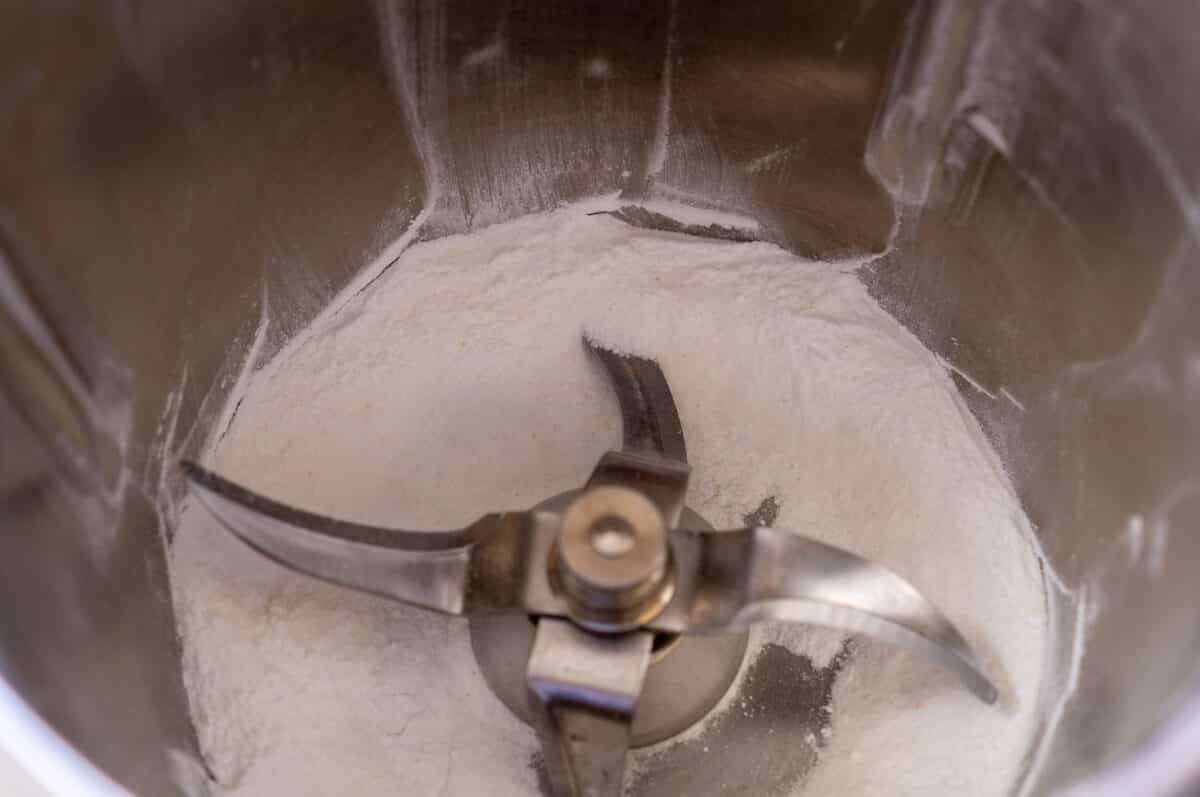
We pulverise 200 g of sugar for 20 seconds at speed 10 to make icing sugar. This saves you buying a bag and gives you exactly the right amount with no leftovers. Shop-bought icing sugar often contains maize starch as an anti-caking agent. Home-pulverised sugar is purer and dissolves more quickly in the batter.
Of the 200 g icing sugar, 130 g go into the batter. The rest is stirred together with lemon juice to make the glaze. If you use shop-bought icing sugar, use the same quantity.
Dividing the lemon juice between the batter and the glaze

From 1 1/2 lemons you get about 60 ml juice. Roughly 40 ml go into the batter and the rest is set aside for the glaze. The exact quantity is not critical, but you need at least 2 tbsp juice for the glaze. If your lemons yield little juice, use 2 whole lemons instead.
The zest of one lemon is grated and goes entirely into the batter. More zest makes the cake too bitter. The essential oils in the zest are concentrated and one lemon is enough for the flavour.
1 hour Varoma at speed 1
The cake steams for exactly 60 minutes at Varoma and speed 1. Less and the centre stays doughy, more and the edges become too dry. The Varoma setting corresponds to a steam temperature of around 120 °C. That is considerably lower than the 180 °C in an oven, which is why the cake needs an hour rather than 40 minutes.
1300 g of water in the mixing bowl is calculated so that the water keeps steaming for the entire cooking time. Less water and the mixing bowl runs dry, more water is not needed.
Applying the glaze warm or cold
You can brush the glaze onto the warm cake straight after steaming. The glaze will soak into the cake slightly, making it even moister. Or you can leave the cake to cool completely, cut it into slices and brush each slice individually. The glaze then stays on the outside and the cake gets a shiny finish.
Both methods work. We usually brush the individual slices, because each one gets an even coat of glaze and nothing flakes off during transport.
How long the cake keeps
The lemon cake keeps for 3 to 4 days at room temperature in an airtight tin. Because of the moisture from steaming, it dries out more slowly than a cake from the oven. In the fridge it becomes firmer and tastes less aromatic when cold. If you do refrigerate it, take it out 30 minutes before serving.
Freezing works without the glaze. Apply the glaze only after thawing, otherwise the coating becomes soggy when it defrosts. Frozen slices keep for 2 months. To thaw, simply leave at room temperature for 1 to 2 hours.
Goes well with: vanilla ice cream.
You can find more Thermomix® steaming recipes in our Varoma® guide. There we show how to get the best out of the Varoma and which dishes work especially well with it.