Flower butter from the Thermomix® is ready in 10 minutes and makes 6 servings. Here is how: blend 125 g room-temperature butter with 3 tbsp dried flower petals, 1 tsp chilli flakes, 1/4 tsp salt and a squeeze of lemon juice for 4 seconds at speed 4, scrape down with the spatula, then blend again for 4 seconds at speed 3. Shape into a log and chill for 60 minutes. The most important rule: the butter must be at room temperature (18 to 22 °C), otherwise it will clump and the petals will not distribute evenly.
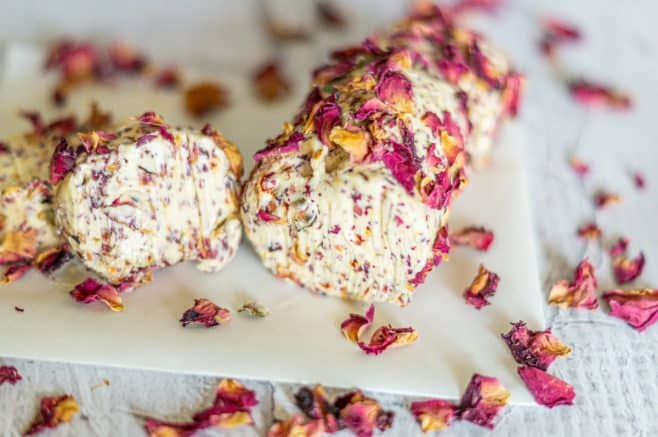
We make flower butter regularly for barbecues and as a small homemade gift. The Thermomix® distributes the petals far more evenly than any hand method, and the butter is ready in two short blending pulses. For a herby companion, our herb butter from the Thermomix® works perfectly alongside it.
Flower Butter from the Thermomix®

Ingredients 0 / 5 ✓
- 3 tbsp Dried flower petals or 20 g fresh flowers
- 1 tsp Chilli flakes
- 1/4 tsp Salt
- 125 g Butter
- 1 squeeze Lemon juice
Instructions 0 / 3
-
1
Blend the ingredients.
Place flower petals, chilli flakes, salt, butter cut into pieces and lemon juice into the mixing bowl and blend for 4 sec / speed 4.
-
2
Blend again.
Scrape down with the spatula and blend for a further 4 sec / speed 3.
-
3
Shape the butter.
Shape the butter into a log, wrap in cling film or greaseproof paper and leave to firm up in the fridge.
Tip: If you are using fresh petals, place them in the mixing bowl after washing and drying, then chop for 5 sec / speed 5. Add the remaining ingredients afterwards.
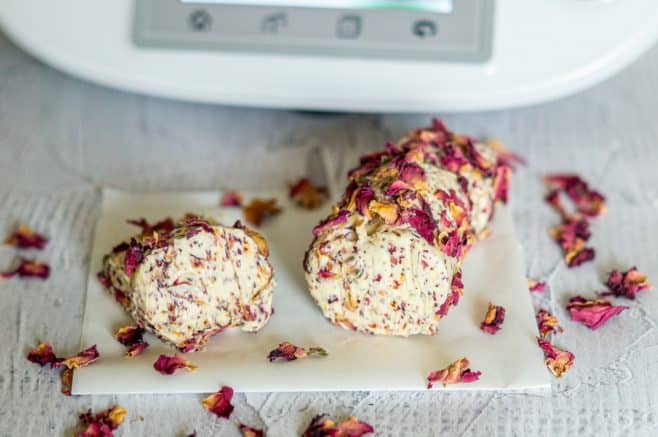
It looks very pretty if you roll the butter log in fresh petals before slicing.
Video
Nutrition per serving
Room-temperature butter and two short blending pulses
The whole trick lies in the temperature and the brief blending time. At 18 to 22 °C the butter is soft enough for the 3 tbsp of petals to be worked in evenly in 4 seconds at speed 4. Cold butter straight from the fridge will clump and the petals will stick to the bowl wall. We take the 125 g of butter out at least an hour beforehand.
Two short pulses are better than one long one. After the first blend, we scrape the mixture down from the bowl wall with the spatula and blend for another 4 seconds at speed 3. This gives a creamy butter without reducing the petals to powder. Anyone who blends for longer than 10 seconds will end up with a grey, mushy paste rather than a butter with visible flowers.
Fresh flowers need an extra step. They contain more moisture and will not break down finely enough otherwise. We place 20 g of fresh flowers in the mixing bowl first and chop them for 5 seconds at speed 5, then add the butter and the rest of the ingredients. Dried flowers, by contrast, keep the consistency more stable and colour the butter less.
Which edible flowers belong in the butter
Only use edible flowers, never decorative blooms from a florist. Those are often treated with pesticides or dyes and do not belong in food. Organic flower blends from the spice aisle are safe, as are flowers from your own unsprayed garden. Daisies, cornflowers, marigolds, pansies, violets, roses, mallows and nasturtiums are classic edible varieties.
The flavour varies considerably. Rose petals taste more intense and slightly perfumed, daisies are mild and nutty, nasturtiums are peppery and sharp. Lavender takes over most quickly: with 3 tbsp of a flower blend, 1 tsp of lavender is enough, otherwise the butter will taste like soap. Sunflower and cornflower petals are very mild and contribute mainly colour.
The season matters too. Daisies are available from March to November, violets from April to October, nasturtiums from late May through October, and roses abundantly from summer into autumn. Anyone who wants to make flower butter year-round can reach for dried organic flowers out of season.
Three common mistakes that cost you the look
Cold butter straight from the fridge
Straight from the fridge the butter is too firm, it clumps when blending and the petals stay at the sides instead of distributing. Our solution: take the 125 g of butter out at least 60 minutes beforehand until it yields slightly to finger pressure. If you are in a hurry, you can nudge it for 20 seconds at speed 1 without any temperature, but do not warm it, otherwise it will turn greasy.
Blended for too long
Anyone who blends for more than 10 seconds or chooses too high a speed will shatter the petals to powder. The butter turns greyish and looks like a mushy paste. Our solution: stick to the exact values, that is 4 seconds at speed 4 and again 4 seconds at speed 3. Two short pulses are always better than one long one.
Too much lavender or chilli
Lavender and chilli can tip the flavour quickly towards bitter or overly hot. Our solution: for lavender, use at most 1 tsp per 3 tbsp of flower blend, and for chilli, exactly 1 tsp of flakes. It is better to use a little less the first time and increase after tasting. The chilli flakes provide a contrast to the floral note, so the butter does not taste too perfumed.
Sweet variation and savoury adaptations
Sweet flower butter: swap the salt for 1 tsp icing sugar and leave out the chilli flakes. This version goes beautifully with enriched plaited bread or a nut loaf. This variation is missing from most other recipes entirely.
With fresh herbs: chop 20 g of chives, parsley and dill together with the flowers for 5 seconds at speed 6, then add the butter. The result is a herb and flower butter that goes well with grilled meat.
Spicier: blend in 1/2 an extra chilli or 1/2 tsp smoked paprika. Lactose-free: replace the butter with lactose-free butter. The quantities and times stay the same.
What other Thermomix® recipes do differently
Other Thermomix® recipes often use fresh flowers and longer blending times, for example 3 seconds at speed 6 to chop and then 10 seconds at speed 4. Some also add 1 tsp of lemon zest. We deliberately use dried flowers combined with chilli flakes: this keeps the consistency more stable, colours the butter less and gives a savoury contrast rather than a purely floral note.
Seasoning approaches vary across sources. Many stick to a plain flower and salt butter, while others mix in fresh herbs such as chives, parsley and dill. Violets, nasturtiums and marigolds are popular for extra colour. Our chilli accent is the exception and precisely the touch that sets this butter apart.
Shape into a log rather than spooning
Shape the finished butter into a log, wrap it in cling film or greaseproof paper and chill for at least 60 minutes. Only slice it after that, otherwise the shape will collapse. If you roll the log in fresh petals before slicing, you get a clean result: the outer flowers stay in place when you cut and each slice has a petal border.
What else to serve the butter with beyond bread
We use flower butter well beyond the breakfast table. On warm grilled bread or baguette it melts and releases a floral note. On grilled corn or asparagus it stands in for regular herb butter. A slice on a hot steak adds both flavour and gloss. On a cold buffet, the butter log with its petal border also makes a striking impression.
Related recipes to explore: herb butter, tomato butter and homemade butter from the Thermomix®.
How long flower butter keeps
Stored in a sealed container, flower butter keeps for around 14 days in the fridge. The squeeze of lemon juice helps: the citric acid stabilises the fat structure and prevents the butter from turning greyish during storage. It stays spreadable as a result.
Freezing works well. We freeze the finished log wrapped in cling film, or spread the butter flat into a freezer bag and break off portions later. It keeps for around 3 months this way. To thaw, place it in the fridge overnight and leave it at room temperature for 10 minutes before serving.
Frequently asked questions about flower butter from the Thermomix®
Goes well with: baguette.