Most shop-bought baking sprays are roughly half propellant. What actually lands on the tray is a thin layer of vegetable oil with lecithin or emulsifiers, while the rest disappears into the air. We have been making our own release paste from three ingredients for years, all of which live in every baking kitchen, and we apply it with a brush. It is more precise, considerably cheaper, and needs no aerosol can.
We keep a small jar of it permanently in the fridge, right next to the cake tins. As soon as we bake, we grab the pastry brush and coat the tin. Curled-up baking paper, dusting flour over the worktop, or wondering whether there is enough butter in the bundt tin are things of the past. And nothing sticks any more, whether that is dough bread on a stick or meat on a skewer.
Baking Release Paste with the Thermomix®
Ingredients 0 / 3 ✓
- 100 g flour
- 100 g sunflower oil
- 100 g coconut fat
Instructions 0 / 2
-
1
Mix the ingredients.
Add all the ingredients to the mixing bowl and mix for 40 seconds / speed 4.
-
2
Store.
Transfer to a sealable container and store in the fridge.
Usage: Spoon a little baking release paste into a baking tin and spread it evenly with a pastry brush.
Video
Nutrition per serving
Why these three ingredients and not just oil
The combination of 100 g flour, 100 g sunflower oil and 100 g coconut fat is no accident. Each ingredient has a clear purpose, and that is precisely why the paste works so reliably.
- Sunflower oil is the liquid base. It has a neutral flavour, stays stable up to 200 °C and remains liquid even in the fridge. Olive oil does not work here because it has its own flavour and becomes thick when cold.
- Coconut fat is the trick against drip residue. Solid at room temperature, it melts in the oven from around 25 °C and keeps the paste clinging to the sides of the tin rather than pooling at the bottom. Without the coconut fat, the pure oil would simply run down vertical walls.
- Flour is the invisible release layer. During baking, the flour and fat form a thin crust between the dough and the tin. That crust lifts away cleanly after baking. Classic buttering and flouring a tin does essentially the same thing, just in two steps.
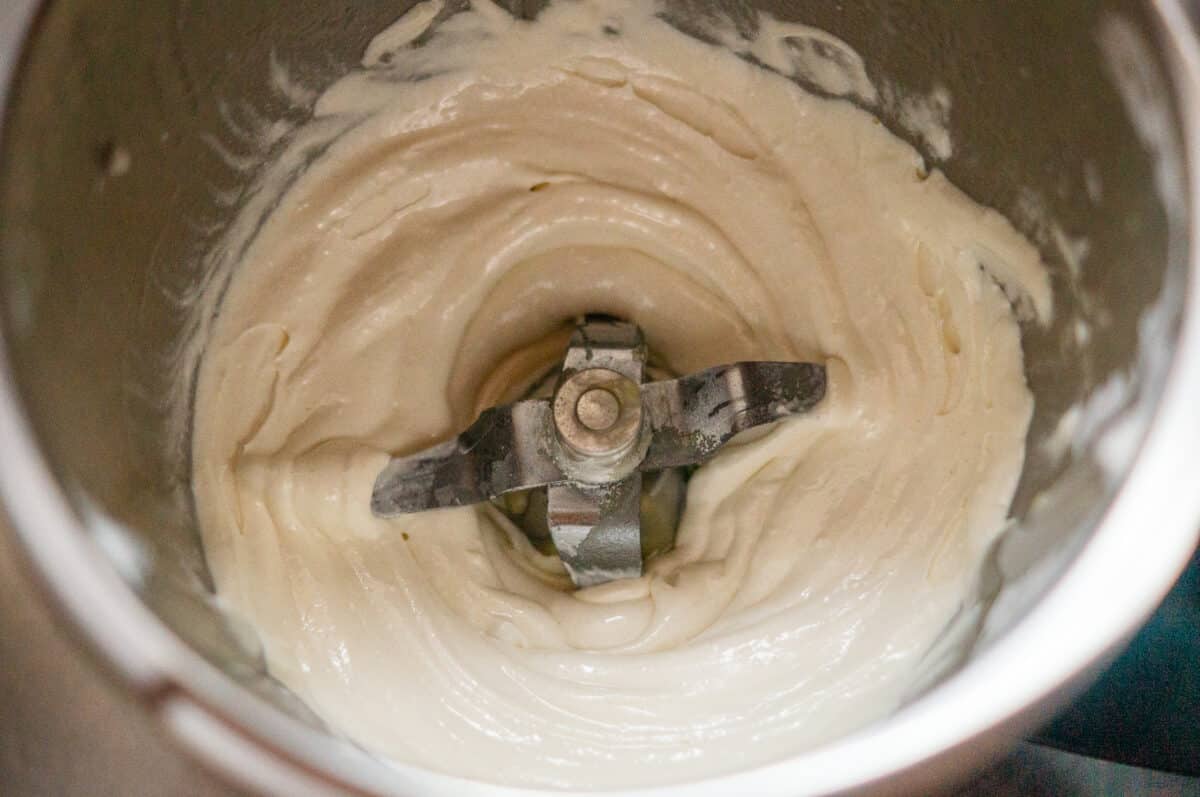
In the Thermomix®, the mixture becomes smooth in one go. 40 seconds at speed 4 is all it takes, and then there is a spreadable, pale paste in the mixing bowl. Without a blender, you would be at it longer with a whisk and rarely get such an even consistency, because the coconut fat tends to float in lumps through the oil.
How to apply the paste correctly
The paste belongs in the tin with a pastry brush, not with your finger and not poured straight from the jar. We use a silicone brush because it does not shed bristles and washes up easily. With the brush, the paste reaches grooves and corners that sprays often miss. This is the decisive point especially with bundt tins, madeleine trays and mini bundt moulds.
A very thin layer is enough. When you hold the tin up to the light it should shine, not look white. A thick layer does not give better results, it just leaves a greasy crust on the edge of the cake. For a baking tray, about one level teaspoon of paste is sufficient.
Where the paste makes the biggest difference
- Bundt tins and shaped moulds. This is where the flour in the mixture pays off. Pure butter tends to burn and stick in the grooves, while the flour and fat paste releases cleanly when you turn the cake out.
- Baking trays for biscuits. Instead of baking paper, a thin layer directly on the tray is enough. It saves paper and gives the biscuits a crisp base because they are in direct contact with the tray.
- Dough bread sticks and skewers. Brush the tip before threading on the dough or meat. The dough or meat comes away from the wood or metal without tearing once cooked.
- Loaf and bread tins. With uncoated tins, the paste works much more reliably than plain fat, especially with wet doughs such as courgette cake, which tend to stick.
When the paste goes lumpy or too dry
The paste is lumpy rather than creamy
If the coconut fat comes cold from the cupboard, it takes longer to soften. Our solution: Add the coconut fat in rough chunks to the mixing bowl and warm it for 2 minutes / 37°C / speed 1 before mixing, then add the flour and oil and mix for 40 seconds / speed 4. The result is noticeably smoother.
The cake still sticks
Most of the time this is down to too little paste or uneven application. Our solution: Use the brush to go over every grooved spot individually, especially in bundt tins. With very wet or sugary doughs, dust the tin with a little flour on top of the paste to create a second release layer.
The paste flavours the bake and the cake gets a greasy edge
This only happens when too much paste ends up in the tin. Our solution: Two thin coats rather than one thick one. Anyone who wants to avoid any flavour at all can replace the sunflower oil with refined rapeseed oil, which is even more neutral.
With butter, coconut fat or as a baking spray
- Gluten-free. Rice flour works just as well as wheat flour. Maize flour also gives a clean release layer but leaves a slight yellowish tint.
- For sweet bakes. Anyone who wants a completely neutral flavour can swap the sunflower oil for a flavour-neutral rapeseed oil. The consistency stays the same.
- For savoury bakes. A pinch of salt in the paste works well when we use the release paste for pizza or bread. For sweet cake we leave the salt out.
- Vegan. The basic recipe is vegan by nature, as sunflower oil and coconut fat are both plant-based. Anyone who thinks of butter in the traditional sense can rest assured that there is nothing animal in here.
Which bakes we use the paste for
We use the paste mainly for classics that we bake often. For a marble cake from a bundt tin it is essential. It also reliably prevents sticking with lemon cake and courgette cake. Anyone who bakes biscuits regularly saves a great deal of baking paper by using the paste directly on the tray.
2 weeks in the fridge, well sealed
We transfer the finished paste into a sealable jar and keep it in the fridge. At 4 to 7 °C it keeps easily for several months, because neither flour nor refined oil nor coconut fat spoils quickly. In the fridge the paste becomes firmer, at room temperature it softens. Both are normal. If it is too firm, stand the jar next to the preheated oven for a moment and it becomes easy to pick up with a brush again.
Freezing is not necessary and not worthwhile either, as the coconut fat develops a coarser texture when thawed. One batch made from 300 g is enough for around 30 baking sessions. The cost per use amounts to a few pence compared to a bought spray, and the aerosol can in the bin disappears entirely.
More basic recipes from the Thermomix® that save time every day include making your own breadcrumbs and our overview of the 9 best baking tins.