Jam in the Thermomix® is ready in 25 minutes, cooked at 100°C on speed 1. The basic principle: 1000 g of fruit, setting sugar in the ratio that suits the fruit, and 2 tbsp of lemon juice. What most people overlook is that the right ratio depends on the pectin content of the fruit, and that is exactly what determines whether your jam sets properly or not.
We have been making jam in the Thermomix® regularly for years and have learned precisely one lesson that matters more than anything else: the most common reason jam stays runny is not the cooking time, but choosing the wrong setting sugar ratio for the particular fruit.
Basic Jam Recipe with the Thermomix®
Ingredients 0 / 3 ✓
- 1000 g fruit of your choice e.g. mixed forest berries
- 500 g 2:1 setting sugar or 330 g 3:1 setting sugar
- 2 tbsp lemon juice
Instructions 0 / 4
-
1
Prepare the fruit.
Wash the fruit, remove any stones or seeds, and add to the mixing bowl in pieces. (Berries can go in whole.)
-
2
Cook the jam.
Add the setting sugar and lemon juice, mix for 10 sec / speed 4, then cook for 15 min / 100°C / speed 1.
Keep an eye on the jam to make sure it does not foam too vigorously. Reduce the temperature to 95°C if needed.
In the meantime, sterilise the jars and lids with boiling water.
-
3
Setting test.
Do a setting test: drop a small amount of jam onto a cold saucer. If it sets within 1 minute, it is ready to fill into jars. If it is still too runny, cook for a further 2 to 3 minutes.
-
4
Fill the jars.
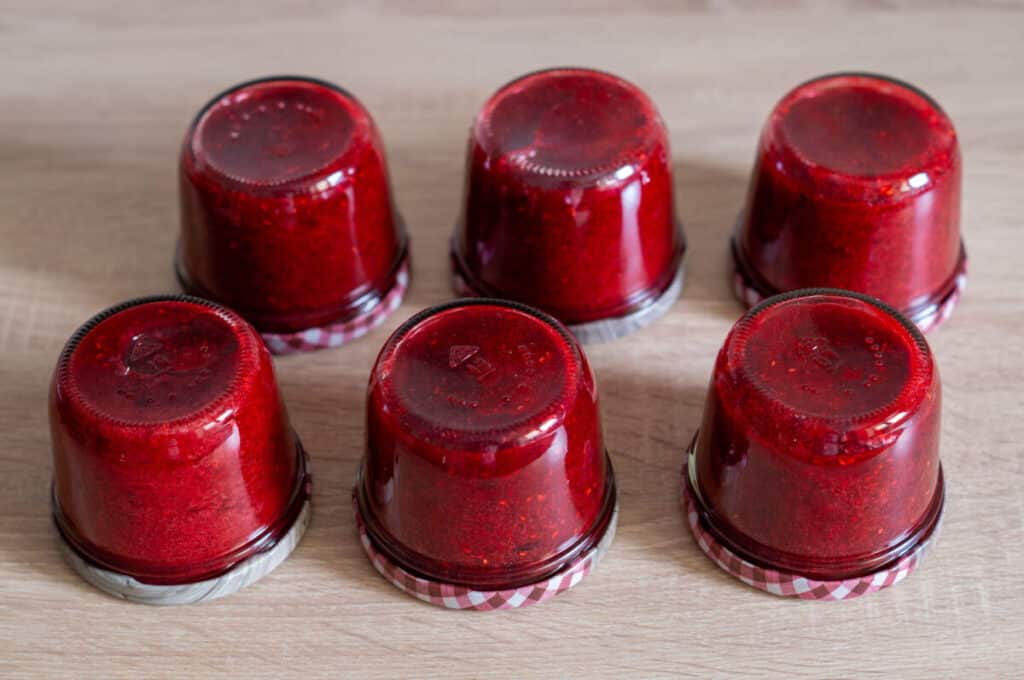
After filling, turn the jars upside down for 5 minutes. Store the jam in a cool, dark place.
Tip: For large pieces of fruit, we recommend leaving the setting sugar and the fruit to macerate for a few hours. This allows the sugar to draw into the fruit pieces properly.
You can flavour your jam with vanilla, cinnamon, or a splash of liqueur to taste.
If you prefer a smooth jam, blend it before filling into jars for 8 seconds / speed 8.
Video
Nutrition per serving
Pectin and setting sugar: why the fruit determines the ratio
Pectin is the natural gelling agent found in fruit. The more pectin a fruit contains, the less setting sugar it needs to set. We group fruit into two categories for this purpose:
High-pectin fruits such as quinces, redcurrants, gooseberries, and apples work well with 3:1 setting sugar, meaning 330 g per 1000 g of fruit. The result is firm and less sweet, without needing more sugar.
Low-pectin fruits such as strawberries, cherries, raspberries, and plums need more help to set. We recommend 2:1 setting sugar for these, meaning 500 g per 1000 g of fruit. Using 3:1 with these fruits risks a jam that stays too soft after cooling.
Our basic recipe uses 2:1 as standard, making it a safe starting point for most fruits. For high-pectin fruits you can switch to 3:1 and get a more intensely fruity, less sweet jam.
The foaming point at 100°C
We cook the jam at 100°C on speed 1. Speed 1 moves the contents of the mixing bowl gently enough to prevent sticking, but slowly enough to keep pieces of fruit intact. If you prefer a smoother jam, blend briefly on speed 8 for 8 seconds just before filling into jars.
Watch out for one thing: with a high sugar content, the jam can foam up noticeably around the 12-minute mark. If this happens, briefly reduce the temperature to 95°C and place the measuring cup loosely on top. That is enough to bring the foam under control without significantly extending the cooking time.
The setting test makes all the difference
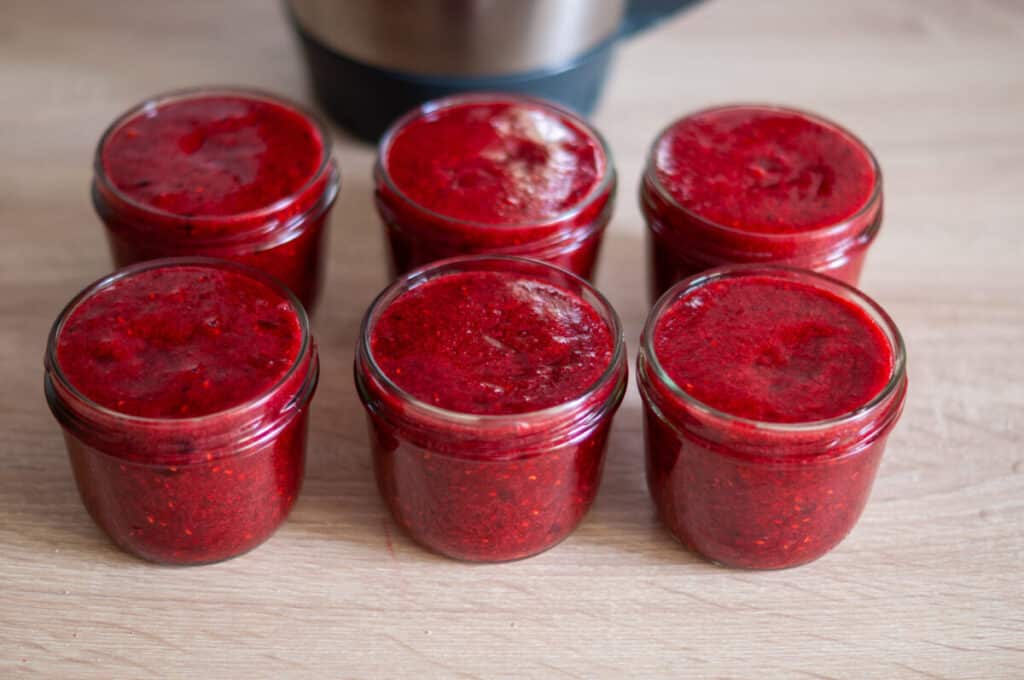
After 15 minutes we do the setting test. Drop a little jam onto a cold plate and wait 1 minute. If it forms a skin when you tilt the plate, it is done. If it stays runny, put the mixture back into the mixing bowl for 2 to 3 more minutes. The setting test is not an optional step. It is the only reliable way to make sure your jam sets in the jar and not on your breakfast toast.
Sterilising and inverting the jars
We pour boiling water over the jars and lids, which can be done conveniently during the cooking time. After filling, the jars are immediately turned upside down for 5 minutes. This pushes air out of the headspace and kills any remaining bacteria on the inside of the lid. Skipping this step noticeably reduces the shelf life. Stored in a cool, dark place, your jam will keep for up to one year.
Two ways to use this basic recipe
This basic recipe is our foundation for all fruit-specific variations. If you want to see how it works in practice for low-pectin fruit: our Strawberry Jam with the Thermomix® shows exactly how the 2:1 ratio behaves with strawberries and what makes that fruit particularly tricky. For cherries, which are especially challenging because of their low pectin content, we have a dedicated Cherry Jam with the Thermomix® recipe.
If you want to make jam without setting sugar at all, our Jam without Setting Sugar with the Thermomix® is the guide you need. It uses natural pectin from apple pieces, which extends the cooking time but significantly reduces the sugar content.
Goes well with: bread rolls and pancakes.