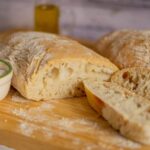
Ciabatta with the Thermomix® takes 14 hours in total (15 minutes of active work, plus 12 hours overnight proving, plus 1 hour final proving, plus 25 minutes baking) and makes 2 Italian loaves (roughly 250 g each). The ingredients are 500 g type 550 flour, 360 g water, 15 g fresh yeast and 2 tbsp olive oil. The long overnight prove is not optional here. It is essential: only through that slow fermentation do you get the characteristic large, open holes of a genuine Italian ciabatta.
We bake ciabatta mainly for Italian evenings: alongside bruschetta toppings, with olive oil and balsamic vinegar as a side, or as a sandwich base with mozzarella, tomatoes and basil. Compared with a shop-bought ciabatta (2 to 3 euros for a bakery loaf or a supermarket par-baked version), the homemade ones come in at about 1 euro per loaf.
Ciabatta with the Thermomix®
Ingredients 0 / 6 ✓
- 360 g water
- 1 pinch sugar
- 15 g fresh yeast
- 2 tsp salt heaped
- 500 g flour, type 550
- 2 tbsp olive oil
Instructions 0 / 5
-
1
Dissolve the yeast.
Add water, sugar, yeast and salt to the mixing bowl and heat for 3 minutes / 37°C / speed 1.
-
2
Knead the dough.
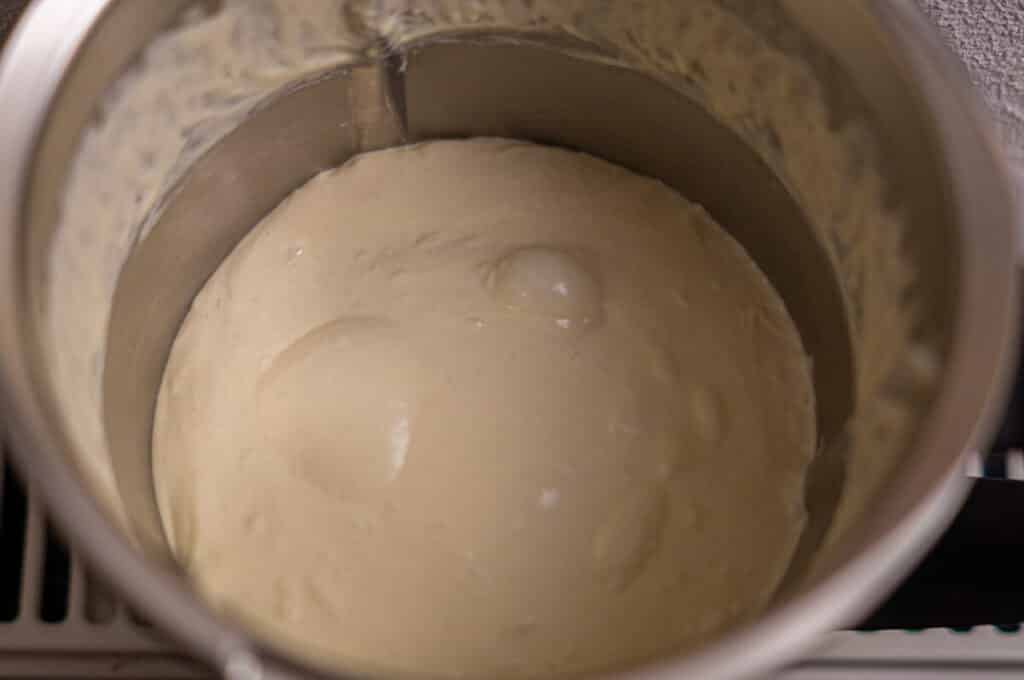
Add flour and olive oil and knead for 3 minutes / kneading mode. Transfer the dough to a bowl, cover, and leave to rest at room temperature for 12 hours (ideally overnight).
-
3
Second knead.
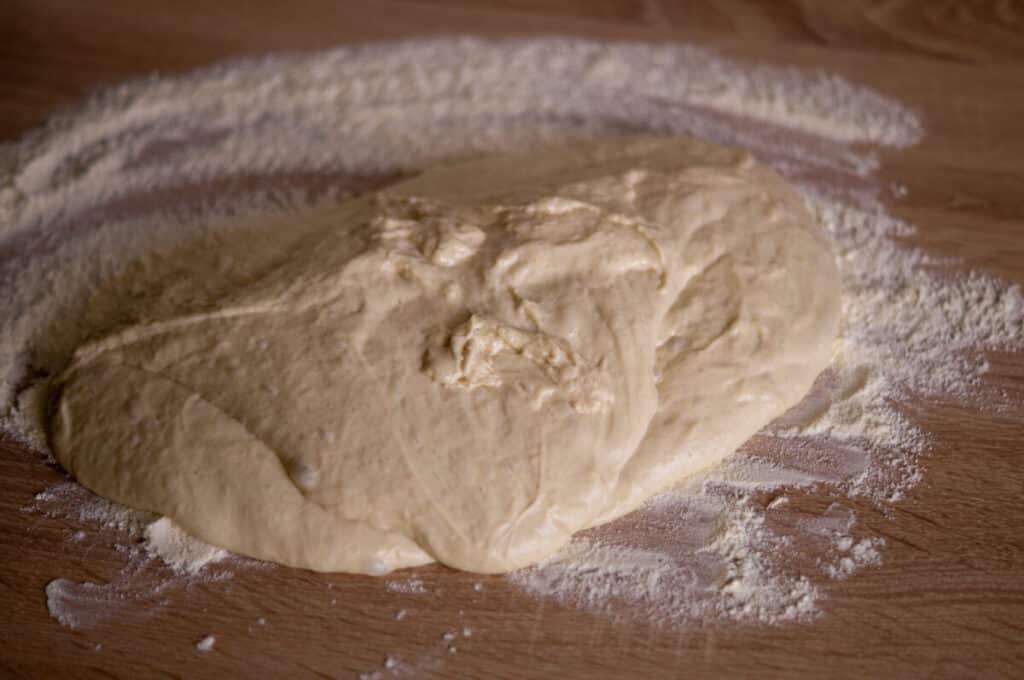
Knead the dough for 5 minutes / kneading mode, then leave it to prove again, covered, for 1 hour. The dough will be very soft, which is exactly as it should be. Line a baking tray with baking paper.
-
4
Shape the dough.
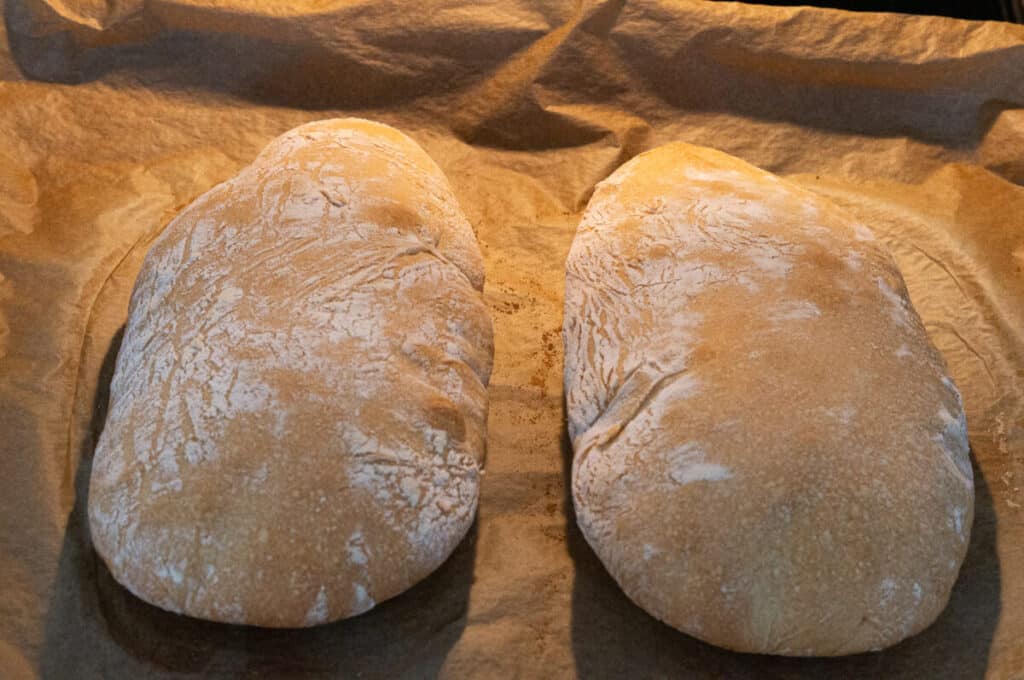
On a well-floured work surface, with well-floured hands, divide the dough into 2 pieces without kneading it further. Shape into two ciabatta loaves. Place the loaves on the baking tray and leave to prove, covered with a damp kitchen cloth, for 1 hour.
-
5
Bake.
Preheat the oven to 230°C top and bottom heat and bake the ciabattas for 20 to 25 minutes.
Tip: You can vary your ciabatta by adding olives or sun-dried tomatoes, cut into small pieces, in step 3.
Nutrition per serving
High hydration: 72 per cent water in the dough
360 g of water to 500 g of flour gives 72 per cent hydration. That is the key to the ciabatta crumb: a high water content creates a great deal of steam inside the dough during baking, which opens up the characteristic large, irregular holes.
A normal bread dough has 55 to 60 per cent hydration. For ciabatta, 70 to 75 per cent is standard, and some Italian bakers go up to 80 per cent. The dough therefore feels very sticky and soft, almost like pancake batter. That is intentional, not a mistake. Adding more flour would ruin the ciabatta structure.
Type 550 flour: why not type 405 or wholegrain
Type 550 flour has a medium gluten content and a slightly higher mineral content than type 405. The Italian original is made with type ‘0’ or ’00’ flour (comparable to German type 405 to 550). Type 550 is the best German approximation.
Type 405 gives a ciabatta that is too delicate and lacks bite. Wholegrain flour (type 1050 and above) produces compact loaves without large holes. If you want the authentic Italian version, look for Italian Tipo 00 flour at an Asian or Italian food shop (Caputo, De Cecco, around 2 to 3 euros per kg).
12 hours overnight proving: why so long
At room temperature (20°C), the dough develops fully over 12 hours. The yeast breaks down the sugar slowly, producing aromatic compounds (acetic acid, lactic acid) and CO2 bubbles. The result is a far more complex flavour than you get with a 2-hour prove.
In practice: prepare the dough in the Thermomix® in 15 minutes after dinner, cover the bowl with cling film, and by the next morning the dough is ready. If you want to speed things up, 2 hours at room temperature works, but the flavour and the open crumb will be noticeably less impressive.
Pro variation: 24 hours in the fridge (cold retardation). This gives even more flavour, but take the dough out 1 hour before baking to come up to temperature.
Fresh yeast or dried yeast
15 g of fresh yeast (one third of a standard cube) is the default. Fresh yeast (live yeast cultures) gives slightly more rise and flavour. You will find it in the chilled section of the supermarket in 42 g cubes (roughly 0.15 to 0.20 euros per cube).
With dried yeast (for those searching ‘ciabatta thermomix dried yeast’): one 7 g sachet of dried yeast is equivalent to 21 g of fresh yeast. So you need about 5 g of dried yeast to replace 15 g of fresh yeast. It works just as well. Simply mix the dried yeast directly into the water.
Important: do not mix the yeast directly with the salt before it has activated, as salt inhibits yeast. Follow this order: dissolve the yeast in water first, then add the salt, then the flour.
5 minutes on kneading mode and 1 hour final prove
After the 12-hour overnight prove, the dough is kneaded again for 5 minutes on kneading mode. This brings the developed gluten structure back into shape and redistributes the CO2 bubbles. Do not skip this step, or the ciabattas will come out flat.
Then comes the 1-hour final prove. Turn the dough out onto a floured work surface and, with floured hands, divide it into 2 pieces without kneading further. Shape gently into loaves, place on the baking tray, and leave to rest under cling film for 1 hour.
Important: do not press folds into the dough or create hard edges. Ciabatta is supposed to look rustic and irregular, not like a neat sandwich loaf.
230°C with steam for a golden crust
Preheat the oven to 230°C top and bottom heat (fan-assisted does not work as well here, as it dries the crust too quickly). Place a heatproof dish with boiling water on the oven floor: the steam keeps the crust moist at the start so the bread rises better. Remove the water dish after 10 minutes, then bake dry for the final 10 to 15 minutes to get the crispy crust.
If you skip the steam dish, spray the oven walls with a water spray bottle every 5 minutes. It sounds fiddly, but it makes the difference between ‘fine’ and ‘genuinely Italian’.
Variations: olives, herbs, wholegrain mix
Olive ciabatta: knead 100 g of pitted black olives (cut into pieces) into the dough. A Mediterranean classic.
Herb ciabatta: add 1 tsp dried rosemary and 1 tsp dried thyme. Add half a tsp of garlic powder for a garlic and herb variation.
Sun-dried tomato ciabatta: cut 50 g of sun-dried tomatoes into pieces and mix in. Press a few tomatoes onto the top of the dough before baking.
Wholegrain mix: use 350 g type 550 flour plus 150 g wholegrain spelt flour. More nutrients, slightly more compact structure.
Walnut ciabatta: fold 80 g of roughly chopped walnuts gently into the dough at the end. Goes particularly well with a cheese board.
What to serve with ciabatta
Classic alongside Italian dishes: with pasta, risotto, antipasti or soup. As a bruschetta base: slice, toast in the oven, and top with a tomato, garlic and olive oil mixture. As a sandwich with mozzarella, tomatoes and basil (a caprese sandwich).
Also lovely at breakfast with butter and jam, with olive oil and balsamic vinegar as a side, or frozen in batches to have ready for weekend breakfasts.
Ciabatta keeps for 2 days, or 3 months in the freezer
In a fabric or paper bread bag it stays crispy for 2 days. In a plastic bag the crust goes soft (moisture cannot escape). To bring the ciabatta back to crispy: bake in the oven at 180°C for 5 minutes and it will taste freshly baked again.
Freezing: freeze sliced or whole in freezer bags, keeps for 3 months. Defrost for 2 hours at room temperature, then warm in the oven at 180°C for 5 to 10 minutes. For slices, putting them straight from the freezer into a toaster also works well.