Crème brûlée in the Thermomix® stands or falls on one threshold: 70°C at speed 3 for exactly 7 minutes. Less time and the cream stays liquid; too hot and the egg yolks scramble into lumps. We show you how to nail this classic French vanilla cream with its caramelised sugar crust first time.
The cream is warmed and bound in the Thermomix®, then set in a water bath in the oven. To serve, we sprinkle the chilled surface with brown sugar and caramelise it with a blowtorch into a crisp crust. The combination of cold vanilla cream and hot sugar layer is what makes this dessert.
Crème brûlée in the Thermomix®

Ingredients 0 / 7 ✓
- 30 g sugar
- 5 egg yolks
- 2 tsp vanilla extract Or 2 sachets of vanilla sugar
- 400 g double cream
- 100 g milk
- water boiling
- 12 tsp brown sugar
Instructions 0 / 5
-
1
Mix the cream.
Insert the butterfly whisk, add all ingredients except the brown sugar and the boiling water to the mixing bowl and mix for 7 min / 70°C / speed 3.
-
2
Preheat the oven.
Preheat the oven to 150°C fan.
-
3
Add the water.
Divide the cream mixture among 6 crème brûlée ramekins, place them in a baking dish and fill with boiling water until the ramekins are half submerged.
-
4
Set in the oven.
Cover with foil and bake on the middle shelf for approximately 40 to 45 minutes. Leave the cream to cool completely in the fridge afterwards.
-
5
Caramelise.
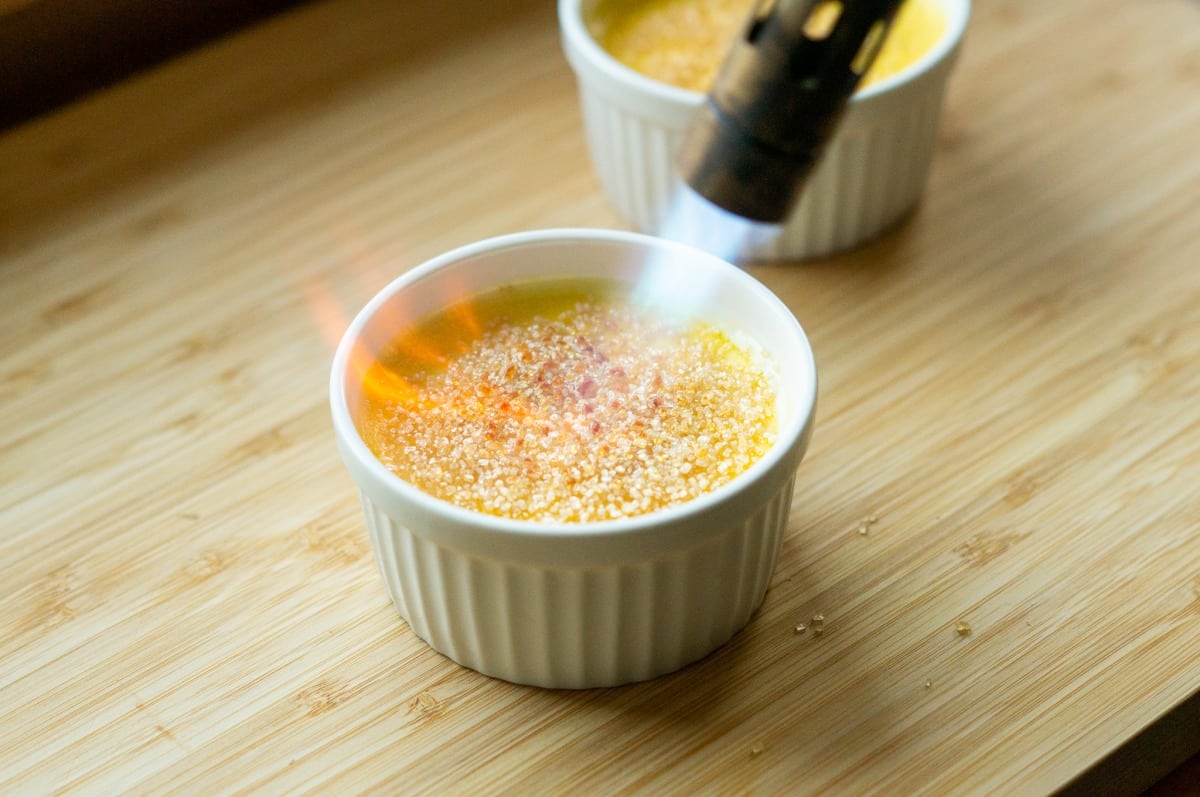
Before serving, sprinkle each cream with 2 tsp brown sugar and caramelise with a kitchen blowtorch.
Tip: Pop your crème brûlée in the freezer for a few minutes before caramelising the sugar, so the cream stays cold.
Video
Nutrition per serving
Why 70°C is the critical threshold
Egg yolks bind between 65°C and 75°C. Below that temperature the cream stays as thin as milk; above it the proteins curdle instantly into lumps. 70°C at speed 3 is the sweet spot: the mixture becomes thick enough to continue setting in the oven without forming clumps. The butterfly whisk moves the cream evenly so no hot spots develop.
After 7 minutes the cream has the consistency of a pourable vanilla sauce. It is not yet set, but the proteins are primed. In the water bath the cream then sets slowly and evenly at 150°C fan without the surface bubbling or browning.

Why a water bath instead of a direct baking tray
Crème brûlée is baked in a water bath inside a baking dish, not directly on a rack. The boiling water buffers the heat: the ramekins sit half submerged, so the temperature rises gently and evenly. Without a water bath the bottom half of the cream would set too quickly while the top is still liquid. The result would be an airy, porous texture instead of a smooth vanilla cream.
Covering with foil stops a skin forming on the surface. The cream should set evenly throughout, not dry out on top. After 40 to 45 minutes on the middle shelf the centre is still slightly wobbly. The cream continues to set in the fridge and is fully firm only after at least 60 minutes of chilling.
Brown sugar or white sugar for the crust
Brown sugar caramelises faster than white and adds a lightly malty note. We use 2 teaspoons per ramekin and spread them evenly over the chilled surface. The sugar should not be laid on too thickly, otherwise the outer layer burns before the inner layer melts. A thin, even coating is enough.
Hold the blowtorch close to the sugar and move it in circular motions until the surface bubbles and turns golden brown. Too brief and the sugar stays grainy; too long and it turns bitter. The caramelised crust hardens within seconds into a firm, crisp layer. If you do not have a blowtorch, you can caramelise the sugar under the oven grill, but watch carefully that the cream does not warm up.
Vanilla extract or vanilla sugar
We use 2 teaspoons of vanilla extract or alternatively 2 sachets of vanilla sugar. Vanilla extract gives a more intense flavour because it is more concentrated. Vanilla sugar works just as well but adds extra sugar, which slightly increases the sweetness. Scraping a fresh vanilla pod is the classic approach, but it costs more and takes more effort to extract the seeds.
The vanilla is stirred together with double cream, milk, sugar, and egg yolks in the mixing bowl. All ingredients go in cold, and the Thermomix® heats and binds them at the same time. This saves a step compared with the classic method, where milk and cream must be heated first, then tempered and combined with the egg yolks.
Why the cream should go in the freezer before caramelising
Before you caramelise the sugar, place the ramekins in the freezer for 5 to 10 minutes. The cold surface stops the cream warming up from the heat of the blowtorch. Crème brûlée is served ice-cold, the crust cracked hot. If the cream is lukewarm, the dessert loses its contrast.
We cover the ramekins with cling film in the fridge so they do not pick up any off-flavours. Crème brûlée keeps covered for 2 days, but the crust is only caramelised immediately before serving. Once caramelised, the sugar layer softens within a few hours and becomes sticky.
Serving with berry compote or plain
Crème brûlée is classically served on its own. If you want a touch of acidity alongside, you can add a strawberry compote or fresh berries. The vanilla cream is very rich, with 400 g of double cream to 100 g of milk, and a fruity element cuts through the richness.
More classic desserts:
Goes well with: Espresso.
- Rice pudding Thermomix®
- Herrencreme
- Advocaat chocolates
- Fluffy pancakes Thermomix®