We have been baking this mixed loaf in the Thermomix® at least twice a week for years. A whole cube of yeast to 1 kg of flour cuts the proving time down to 75 minutes, which fits easily into any daily routine.
The 3 minutes at 37°C with just 50 g of water activate the yeast fully before the flour goes in. This ensures the dough is penetrated evenly and the larger amount of yeast can do its work in just 75 minutes rather than the usual 2 to 3 hours needed with less yeast. Without this warm-up step the yeast stays unevenly distributed and the dough rises unevenly.
Easy Mixed Loaf (Hausbrot) with the Thermomix®
Ingredients 0 / 6 ✓
- 1 cube fresh yeast
- 670 g water
- 2 tsp salt
- 700 g strong wheat flour (type 1050 or similar high-extraction wheat flour) + extra for dusting
- 300 g rye flour (type 1150 or similar dark rye flour)
- 2 tsp bread spice mix
Instructions 0 / 9
-
1
Dissolve the yeast.
Place the yeast, 50 g water and salt in the mixing bowl and heat for 3 min / 37°C / speed 1.
-
2
Combine the bread ingredients.
Add the wheat flour, rye flour, 630 g water and bread spice mix to the mixing bowl and knead for 5 min / kneading mode until a smooth dough forms.
-
3
Knead the dough.
Turn the dough out onto a floured work surface and knead vigorously by hand once more. If the dough is too soft, work in a little extra flour. The dough should still have a slightly sticky consistency.
-
4
Prove the dough.
Cover the dough with a damp kitchen cloth and leave to prove at a warm spot for 1 hour, until the dough has roughly doubled in size.
-
5
Shape the dough.
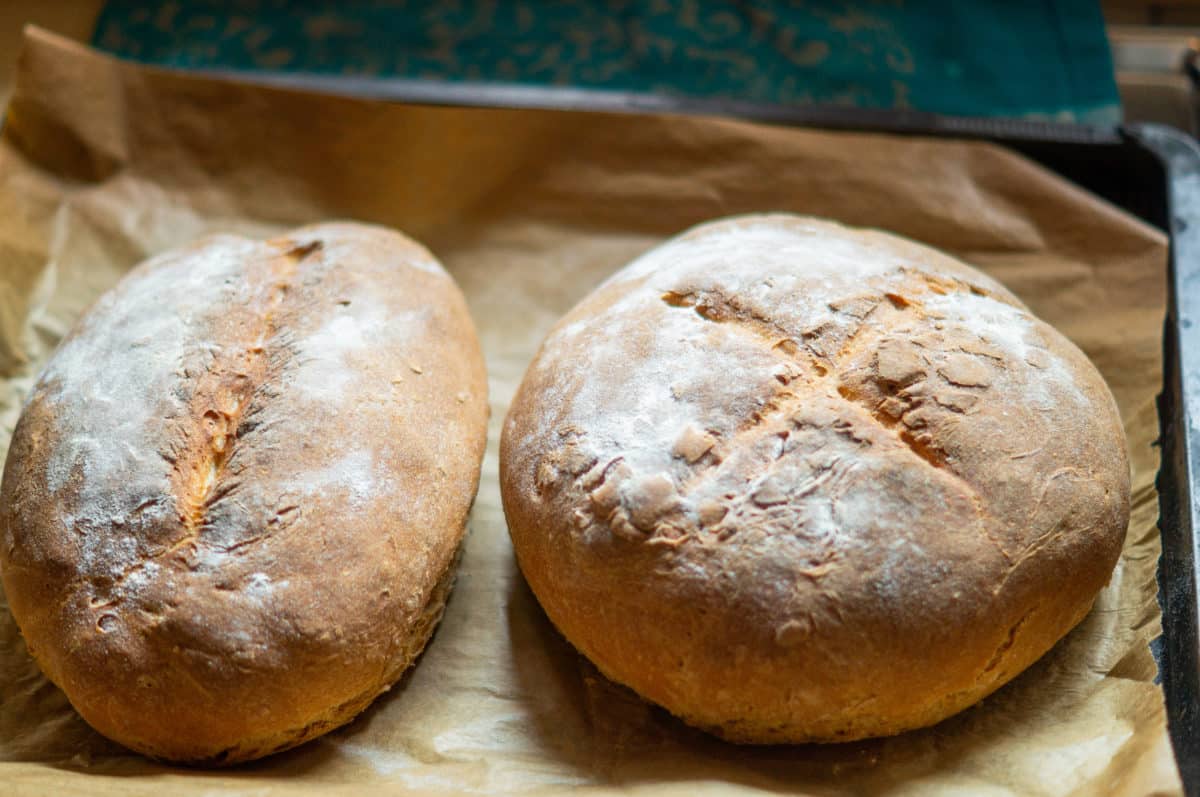
Knead the dough briefly with floured hands, divide it in half, shape into round or oval loaves, place on a baking tray lined with baking paper and leave to prove for a further 15 minutes.
-
6
Preheat the oven.
Preheat the oven to 230°C top and bottom heat.
-
7
Score the loaves.
Score the loaves and dust with a little flour.
-
8
Bake the loaves.
Fill a heatproof dish (e.g. a roasting tin) with water and place it on the bottom of the oven. Bake the loaves on the middle shelf for 15 minutes, then reduce the temperature to 200°C and continue baking for a further 30 minutes.
-
9
Check the loaves.
The bread is ready when it sounds hollow when tapped on the base.
Tip: Please keep an eye on the Thermomix® while it is kneading! It may "walk" during the kneading process, move across the worktop, and fall off. If the measuring cup in the mixing bowl lid lifts slightly, that is perfectly fine.
Video
Nutrition per serving
Why wheat type 1050 and rye type 1150
The flour blend of 700 g strong wheat flour (type 1050) and 300 g dark rye flour (type 1150) produces a classic mixed loaf. The wheat flour provides the gluten for structure, while the rye flour adds bite and keeps the bread fresher for longer. Type 1050 and 1150 are more coarsely milled than plain white flour, contain more minerals, and have a more robust flavour. If you only have type 405 or 550 to hand, you can bake with those, but the bread will be paler and less aromatic.
5 minutes on kneading mode is enough for smooth gluten
After the yeast warm-up, all the flours, the remaining water, and the bread spice mix go into the mixing bowl. 5 minutes on kneading mode works the dough into a smooth mass. The gluten in the wheat flour develops fully, the dough becomes elastic and is easy to shape later. Kneading for less time leaves the gluten incomplete and the dough tears when shaped. Kneading for longer achieves nothing, as the development is complete after 5 minutes.
After kneading in the Thermomix®, turn the dough out onto a floured work surface and knead vigorously by hand once more. If the dough is too soft, work in a little extra flour. The dough should still have a slightly sticky consistency. Too much flour makes the bread dry, too little causes the dough to spread.
75 minutes proving time in two stages
The dough needs to prove for 75 minutes in total: first 60 minutes in the bowl, then 15 minutes after shaping on the baking tray. In the first stage the volume doubles as the yeast produces CO2 and aerates the dough. We cover the dough with a damp kitchen cloth so it does not dry out. A warm spot speeds up the proving, but keep it below 30°C or the yeast will die.
After 60 minutes, knead the dough briefly with floured hands, divide it in half and shape into round or oval loaves. Place on a baking tray lined with baking paper and leave to prove for a further 15 minutes. If you have more time, you can reduce the yeast to a quarter of a cube, but you will then need to extend the proving time to at least 3 hours.
Steam and two-stage baking for a proper crust
Preheat the oven to 230°C top and bottom heat. Fill a heatproof dish, for example a roasting tin, with water and place it on the bottom of the oven. The steam keeps the surface of the loaves moist so the crust can develop evenly without cracking uncontrollably.
Score the loaves with a sharp knife before baking and dust with a little flour. The scores guide where the bread opens up, and the flour gives a rustic look. Bake the loaves for 15 minutes at 230°C, then reduce the temperature to 200°C and bake for a further 30 minutes. The bread is ready when it sounds hollow when tapped on the base.
Yoghurt, buttermilk, or whey instead of water
Instead of all 670 g of water, you can replace up to 200 g with yoghurt, buttermilk, or whey. This makes the bread moister and adds a slightly tangy note. The acidity in buttermilk and yoghurt reacts with the gluten and softens the dough. With whey the dough stays firmer and the bread comes out denser. The remaining 470 g must stay as water, otherwise the dough becomes too dry.
Storing and freezing the bread
Leave the bread to cool completely after baking before slicing. Store cut bread in a bread bin or a linen bag, not in plastic. Bread dries out in the fridge, at room temperature it keeps for 4 to 5 days. Freezing works well: slice the bread, pack into freezer bags and store at minus 18°C. Thaw individual slices in the toaster and toast until golden.
Goes well with: butter and cheese.
Also worth trying: Quick Ciabatta with the Thermomix®.
Related recipes: spelt rolls, spelt baguette, chia bread.