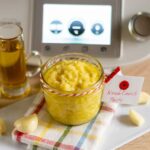
Garlic paste made with the Thermomix® takes just 20 minutes and fills one screw-top jar with roughly 250 g (the equivalent of 50 tsp, or 50 pre-peeled garlic cloves). 180 g garlic cloves (about 2 bulbs), 70 g olive oil, 1 tsp salt and 1 tsp lemon juice. The combination of oil, salt and acid is not just about flavour: it preserves the paste for weeks, so you will never again find a dried-out bulb lurking at the back of the fridge.
We make this paste mainly in summer, when fresh garlic is cheap at farm shops or the market (3 to 5 euros per 500 g). 1 tsp of paste equals roughly 1 garlic clove. That gives us 50 meals with a perfectly measured garlic note, without having to peel a single clove each time. The time saving is real: 2 seconds to open a jar instead of 5 minutes of chopping.
Garlic Paste with the Thermomix®
Ingredients 0 / 4 ✓
- 180 g garlic cloves peeled (approx. 3 bulbs)
- 70 g olive oil
- 1 tsp salt
- 1 tsp lemon juice
Instructions 0 / 3
-
1
Peel the garlic.
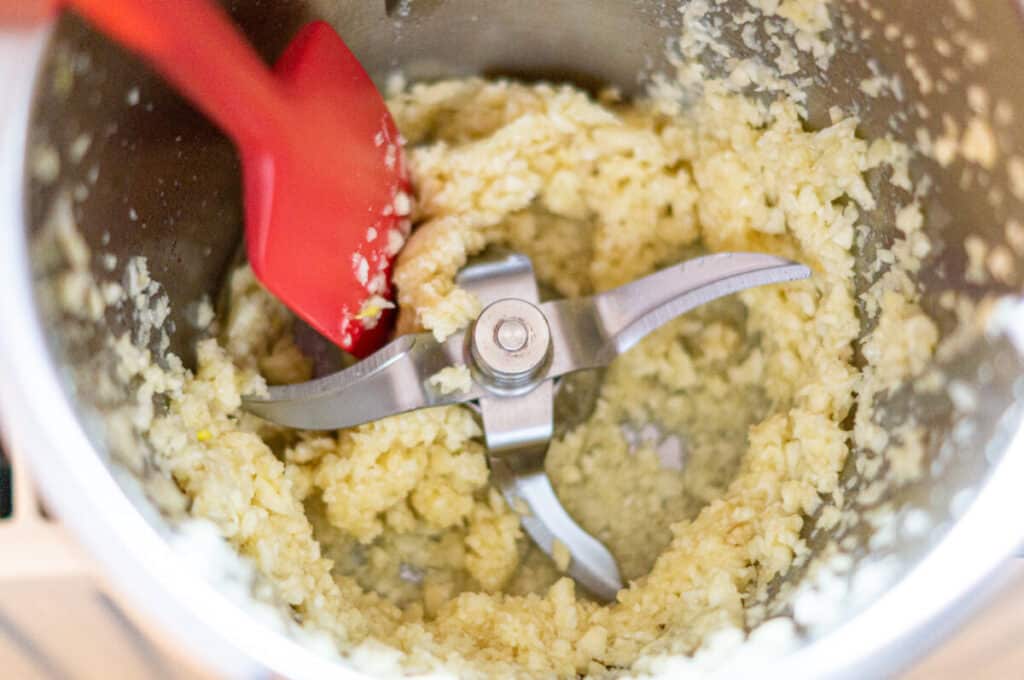
Peel the garlic and place it in the mixing bowl. Chop for 6 seconds / speed 9, then push down with the spatula.
-
2
Add the oil.
Add the remaining ingredients and mix for 6 seconds / speed 6. Push down with the spatula and mix for a further 6 seconds / speed 6.
-
3
Fill into jars.
Sterilise the screw-top jar and lid with boiling water, fill with the garlic paste and seal. Store the garlic paste in the fridge.
Tip: You can use the paste exactly like fresh garlic when cooking. Half a tsp of paste equals roughly one garlic clove. Try it with fried meat or spread it on fresh baguette.
The paste keeps in the fridge for at least one year. Make sure the garlic is always covered with oil!
The olive oil can cause the paste to turn green. If that bothers you, use sunflower oil or rapeseed oil instead.
Nutrition per serving
Why 180 g of garlic: a stock of 50 portions
180 g equals roughly 36 medium garlic cloves (2 bulbs). After peeling and blending, the finished paste with oil comes to about 250 g. That is enough for 50 uses (1 tsp per dish equals 1 fresh garlic clove). At normal consumption, a 5-week supply for a family.
If you get through more than that, simply double the quantities (360 g garlic, 140 g oil). Above 400 g, however, the mixing bowl becomes too full and the paste will not chop evenly.
Peeling garlic quickly: the trick with a peeler
Peeling 36 garlic cloves one by one takes 15 to 20 minutes. Three faster methods:
Silicone garlic peeler: a silicone garlic peeler (tube shape). Drop the cloves in, roll back and forth and the skins fall off. Takes about 30 seconds for 10 cloves.
Jar trick: put the garlic cloves in a sealable jar and shake vigorously. The skins loosen. Not as clean as the peeler, but free.
Hot water trick: drop the whole cloves into hot water for 30 seconds, then rinse with cold water. The skins slip off easily after that.
Why olive oil, salt and lemon juice
The combination is not accidental; it provides three layers of preservation:
Olive oil (70 g): seals the paste from oxygen. Micro-organisms need air. It also brings a Mediterranean flavour. Alternatives: sunflower oil (more neutral), rapeseed oil (healthier). Never use water or stock instead of oil (reduces shelf life to 3 to 4 days).
Salt (1 tsp): draws out moisture and inhibits bacterial growth. A salt content below 2 percent would not be enough, so 1 tsp per 250 g of paste equals roughly 2 percent.
Lemon juice (1 tsp): adds acidity (pH below 4.6), which prevents botulism bacteria from multiplying. Without acid there is an increased risk, as the anaerobic environment in oil is ideal for Clostridium botulinum. Apple cider vinegar or white wine vinegar work equally well.
Sterilising is essential: 2 methods
Garlic paste in unsterilised jars will spoil within 1 to 2 weeks. So: sterilise the jar and lid.
Method 1 (quick): rinse the jar and lid with boiling water, lift out with clean tongs and place on a clean tea towel to dry. Both clip-top preserving jars and screw-top jars work well.
Method 2 (thorough): boil the jar and lid in a pot of water for 10 minutes. Remove with a clean spatula or tongs.
Once filled with the paste: turn the jar upside down for 5 minutes to create a vacuum seal. This extends the shelf life to 4 to 6 weeks instead of 2 to 3 weeks.
Ice cube trick: 6 months shelf life
If you want to keep the paste for several months, spoon it into ice cube trays and freeze. Each cube is one portion (roughly 2 tsp). Once frozen, transfer to a freezer bag.
Benefit: keeps for 6 months and you can take out individual portions without opening the whole jar. Add directly from the freezer to a hot pan or sauce; it melts in 30 seconds.
Variations: Asian, herb and chilli
Asian garlic paste: add 1 cm of fresh ginger and 1 tbsp of soy sauce. Perfect for wok dishes and Asian marinades.
Herb paste: blend in 1 bunch of parsley or basil. A Mediterranean character, great for salad dressings and as a pesto base.
Chilli garlic paste: add 1 to 2 fresh chillies (deseeded). A spicy staple for Asian, Mexican and pizza dishes.
Wild garlic variation: in spring (April to May), replace 100 g of garlic with 100 g of wild garlic. Milder and fresher.
Garlic confit: whole cloves instead of paste, cooked in 200 g of olive oil in the oven at 90 °C for 45 minutes. Caramelised garlic, mild and slightly sweet.
How to use garlic paste
Pasta sauces: 1 tsp in tomato sauce, carbonara or aglio e olio. Dissolve in hot oil first, then build the sauce.
Marinades: for meat, fish or tofu. Mix with yoghurt and herbs for a souvlaki marinade.
Dressings: 1 tsp stirred into a vinaigrette or Caesar dressing.
Garlic butter: 100 g soft butter, 2 tsp paste and parsley. Serve on baguette, with steak or pasta.
Soups: 1 tsp in lentil soup, vegetable soup or bean soup. Adds depth.
Simple bread spread: 1 tsp straight onto wholemeal bread with sliced tomatoes. An Italian-style snack.
Useful kit
A silicone garlic peeler saves time at the peeling stage. A silicone spatula is handy for transferring the paste into preserving jars. For the ice cube variation, use ice cube trays with a lid, preferably silicone (the cubes pop out more easily).
Garlic paste: 4 to 6 weeks in the fridge, 6 months frozen
In a sterilised screw-top jar with a layer of olive oil on top, the paste keeps for 4 to 6 weeks in the fridge. Important: always use a clean spoon to scoop it out and seal the jar straight away. Top up the visible oil after each use (about 1 tbsp) to keep the paste sealed from oxygen.
Signs that the paste has gone off: spots of mould (white, green or black), a sour or yeasty smell (instead of garlic), or bubbles and gas forming in the jar. If in doubt, throw it away. The health risk is far greater than the cost of the paste.
Goes well with: Pasta, Bruschetta and Hummus.