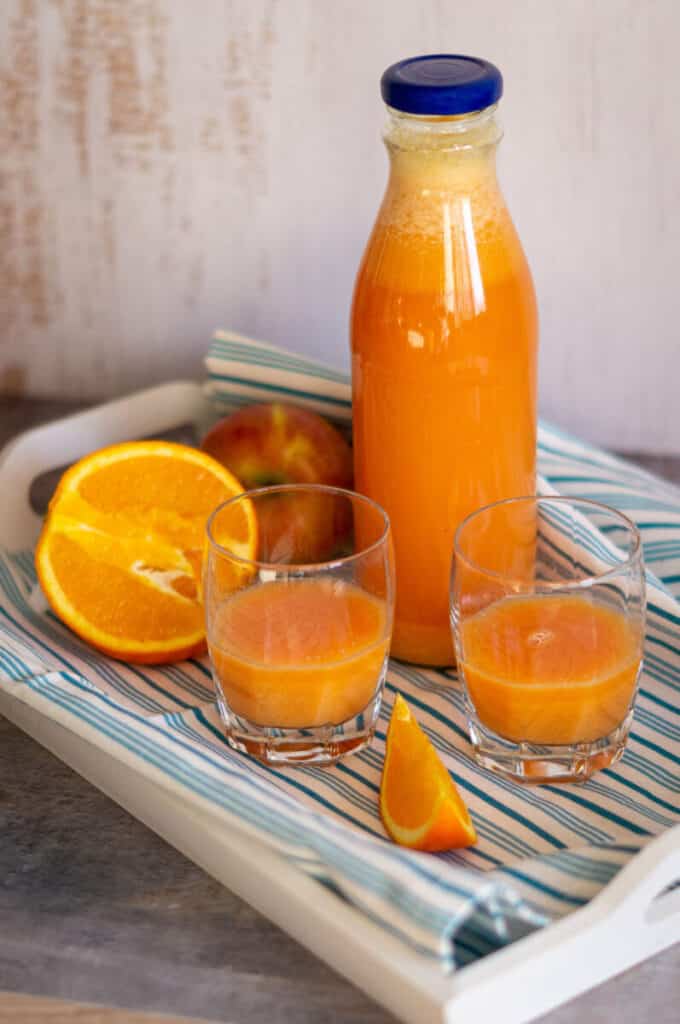
A ginger orange shot with the Thermomix® takes just 25 minutes and yields 1 litre, roughly 20 shots of 50 ml each. Here is how we make it: chop 250 g of ginger for 3 seconds at speed 8, then add the juice of 10 oranges and 5 lemons, 2 quartered apples, 50 g honey and 1 1/2 tsp turmeric and blend for 20 seconds at speed 10. Finally, pass through a fine sieve and fill into sterilised bottles.
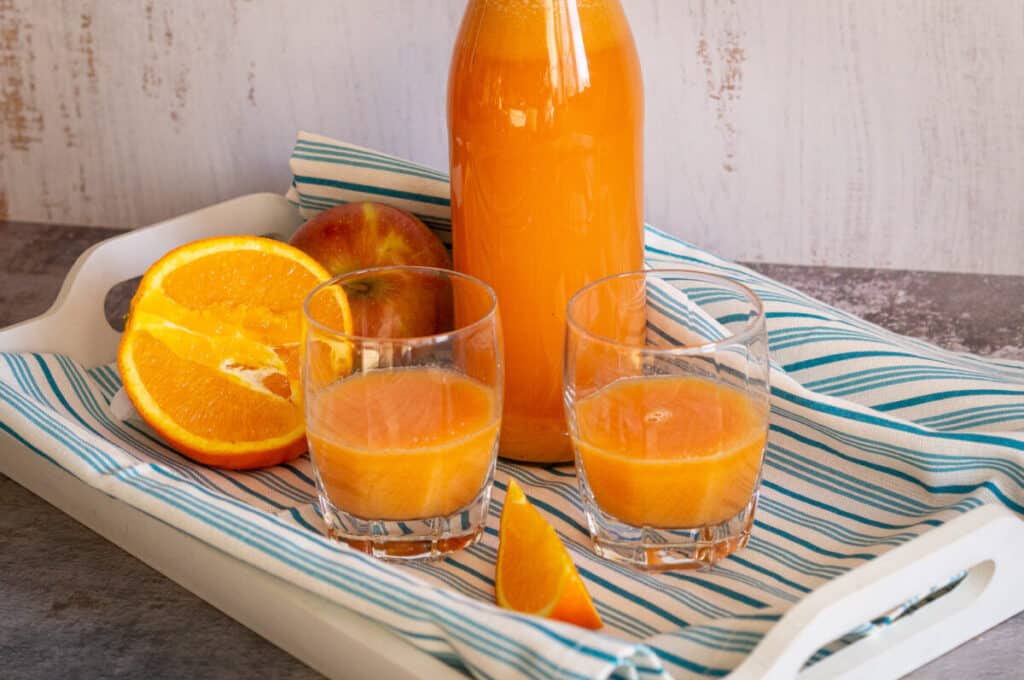
We make this shot almost every week during cold and flu season in a big batch. With 250 g of ginger to 10 oranges we deliberately keep the heat level high and end up with a full litre. That covers several days and saves having to blend a fresh batch every morning. If you prefer fresh juicing over blended shots, you will find our recommendations in our juicer guide.
Ginger Orange Shot with the Thermomix®

Ingredients 0 / 6 ✓
- 250 g ginger
- 10 juicing oranges approx. 800 g juice
- 5 lemons approx. 150 g juice
- 2 apples
- 50 g honey
- 1 1/2 tsp turmeric
Instructions 0 / 5
-
1
Peel the ginger.
Peel the ginger, cut into pieces, place in the mixing bowl and chop for 3 sec / speed 8, then push down with the spatula.
-
2
Juice the fruit.
Squeeze the oranges and lemons and add the juice to the mixing bowl.
-
3
Prepare the apples.
Wash the apples, quarter them, remove the seeds and core, and add to the bowl.
-
4
Add the spices.
Add the honey and turmeric, then blend for 20 sec / speed 10.
-
5
Bottle up.
Pass through a fine sieve and fill into sterilised bottles. Store in the fridge.
Tip: Adjust the ratio of fruit to suit your taste. Prefer something more bitter? Replace all or part of the oranges with grapefruit.
Nutrition per serving
Why 250 g of ginger and the mixing bowl make the shot so effective
The real difference lies in the quantity and the technique. Most recipes use 80 to 100 g of ginger, and the official Cookidoo recipe uses only thin slices for a single bottle. We go noticeably higher with 250 g per litre, which works out at around 12 g of ginger per 50 ml shot. That is a genuine daily dose, not a watered-down juice.
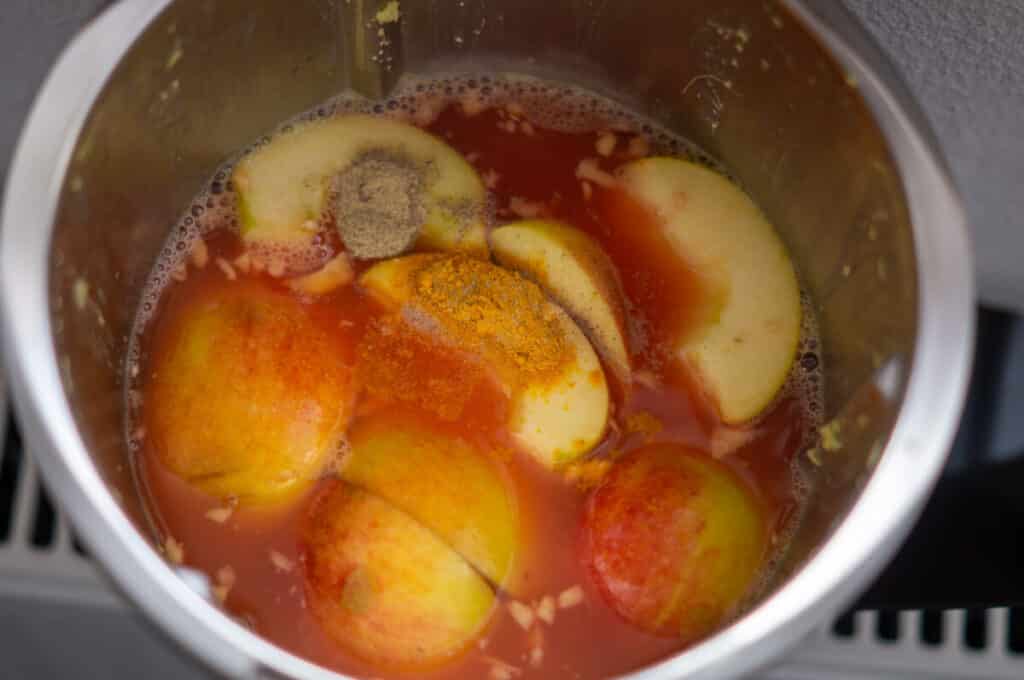
This is where the Thermomix® makes all the difference: we chop the ginger first for 3 seconds at speed 8 before any liquid goes in. Dry pieces break down cleanly that way. Only then do we add the juice, apples, honey and turmeric and blend everything for 20 seconds at speed 10. The high speed breaks open the fibres so that significantly more gingerols and essential oils end up in the glass than with simple blending. The honey and juice are never heated, so unlike ginger tea, the vitamin C and enzymes are fully preserved.
Common mistakes that cost you heat, vitamins and flavour
Peeling organic ginger and throwing away the gingerols
Many people peel the ginger completely. Yet most of the gingerols and essential oils sit just beneath the skin.
Our solution: With organic ginger we do not peel at all. We simply wash it thoroughly and cut it into 1 to 2 cm pieces. Only with conventionally grown ginger do we scrape the skin off with the back of a spoon, which is gentler on the flesh than a vegetable peeler.
The white pith of the lemon makes the shot bitter
If you throw whole lemons, pith and all, into the mixing bowl, you get bitter compounds in the drink that even the honey cannot cover up.
Our solution: We squeeze the oranges and lemons and add only the juice, no whole fruit pieces with pith or skin. The 5 lemons give around 150 g of juice, the 10 oranges around 800 g. Only the 2 apples go in quartered and deseeded. They are mild and add natural sweetness.
Turmeric without pepper is almost useless
The body absorbs curcumin from turmeric very poorly on its own. Without a little help, most of it ends up going to waste.
Our solution: Add a pinch of freshly ground black pepper along with the 1 1/2 tsp of turmeric. The piperine it contains significantly increases curcumin absorption, without the pepper being noticeable in the finished shot.
A coarse sieve leaves the shot stringy
Ginger has tough fibres. If you only strain the shot roughly or not at all, you end up with fibres between your teeth and an unpleasantly rough mouthful.
Our solution: We press the mixture through a fine sieve using the spatula. It takes two minutes longer but gives a smooth, drinkable shot. We do not throw away the pulp. It works well in a smoothie or a tea.
How to adjust the heat, sweetness and potency
With fresh turmeric: Instead of powder, chop 1 tsp of fresh turmeric root together with the ginger. The colour is more vivid and the flavour fresher. Note that the root will stain your hands and the mixing bowl yellow.
Milder for children: Increase the honey to 100 g and juice 2 extra oranges. The shot becomes fruitier and the heat fades back. Alternatively, dilute each shot with a little water.
Extra fiery: Add a pinch of cayenne pepper along with the turmeric. This gives an additional warming kick that is especially welcome at the first sign of a cold.
More bitter with grapefruit: If you prefer a sharper edge, replace all or part of the oranges with grapefruit. This lowers the sugar content and gives the shot a more grown-up character.
Recipes from the blog that pair well with an immune boost
The shot is just one piece of the puzzle. Anyone who regularly uses the Thermomix® for juicing and healthy drinks should take a look at our juicer guide covering the 7 best machines. A sharp knife makes peeling and cutting ginger and citrus fruit much easier. We also explain how the Thermomix® handles juicing and what functions it offers in our overview What is the Thermomix®.
How long your ginger shot stays fresh and full of vitamins
We fill the shot straight into sterilised, dark glass bottles. Dark glass protects the light-sensitive vitamin C. In the fridge it keeps for 5 to 7 days. The vitamin content drops a little with each day, but the flavour stays stable for longer.
For a longer supply we freeze the fresh shot in ice cube trays. Portioned this way it keeps for up to 3 months and loses very few vitamins because it is never heated. We take a cube out as needed and let it melt in a cup of hot water for a quick ginger tea. We drink the shot itself first thing in the morning on an empty stomach, or after breakfast if you have a sensitive stomach.