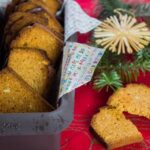
Gingerbread rusk from the Thermomix® is not a gingerbread that accidentally dried out. It is designed from the start as a twice-baked treat: first as a loaf, then as sliced pieces. It is only the second bake that turns it into rusk, and that is precisely the trick.
We have been baking this rusk every November for years, when the first cravings for gingerbread arrive but proper gingerbread would still be too sticky for afternoon tea. The slices keep for weeks in a biscuit tin, taste of honey, anise and clove, and go with everything served during Advent, from mulled wine to Earl Grey. That makes them a quiet, reliable companion throughout the whole pre-Christmas season, not a one-off highlight that goes stale after three days.
Gingerbread Rusk with the Thermomix®
Ingredients 0 / 14 ✓
- 10 g ginger
- 2 cloves
- 1 star anise
- 1/2 cinnamon stick
- 60 g brown sugar
- 120 g candied orange peel
- 240 g honey
- 110 g butter
- 2 eggs
- 160 g plain flour, type 550
- 110 g rye flour, type 1050
- 1/2 sachet baking powder
- 1 pinch salt
- 1 pinch nutmeg
Instructions 0 / 7
-
1
Chop the ginger.
Peel the ginger, place it in the mixing bowl and chop for 5 sec / speed 8, then set aside.
-
2
Grind the spices and warm through.
Place the cloves, star anise and cinnamon stick in pieces together with the sugar in the mixing bowl and grind for 20 sec / speed 10. Add the candied orange peel, honey and butter and stir for 2 min / 50°C / speed 1.
-
3
Preheat the oven.
Preheat the oven to 180°C (fan 160°C, gas mark 3).
-
4
Stir in the eggs.
Add the eggs and stir for 1 min / speed 4.
-
5
Mix the dough.
Add the plain flour, rye flour, baking powder, salt, nutmeg and ginger and mix for 10 sec / speed 4.
-
6
Bake the dough and leave to rest.
Pour into a loaf tin and bake on the middle shelf for 1 hour. Leave to cool, remove from the tin and rest for 24 hours.
-
7
Bake the rusk.
Preheat the oven to 180°C top and bottom heat (160°C fan, gas mark 3). Slice the rusk loaf into approximately 25 slices about 8 mm thick, place them on a baking tray lined with baking paper and bake for approximately 12 to 15 minutes. Switch off the oven and leave the rusk to cool with the oven door open.
Tip: Nicely wrapped, the gingerbread rusk makes a lovely gift to bring along.
Video
Nutrition per serving
Why gingerbread rusk belongs in the oven twice
- Spices freshly ground in the mixing bowl. Cloves, star anise and cinnamon stick go into the mixing bowl whole and are pulverised together with the brown sugar for 20 seconds at speed 10. Ready-ground powdered spices from a jar have often already lost their aroma, but here the essential oils are released only after grinding and go straight into the honey and butter. The difference is clear: it tastes of gingerbread, not of the idea of gingerbread.
- Honey and butter combined at 50°C. After grinding, the candied orange peel, 240 g of honey and 110 g of butter are added and stirred for 2 minutes at speed 1 at 50°C. This gentle warmth melts the butter without the honey caramelising or turning bitter. Anyone who has added honey to a hot pan knows the problem: it goes dark and develops a slightly resinous aftertaste. 50°C is the point at which everything emulsifies without anything burning.
- Twice baked rather than dried out. The dough first bakes for one hour at 180°C as a loaf. The loaf then rests for 24 hours at room temperature so the crumb firms up and slices cleanly. Only then are the slices (8 mm thick) baked again for 12 to 15 minutes at 180°C. They cool down in the switched-off oven with the door open. This second bake is not optional. It draws out the remaining moisture and creates the crisp bite that makes rusk rusk in the first place.
What the mixing bowl does with honey and egg white
Finely grinding gingerbread spices by hand takes half an hour with a pestle and mortar, or three passes with an electric spice grinder at different consistencies. In the mixing bowl, cloves, star anise, cinnamon stick and brown sugar are reduced to an even powder in 20 seconds at speed 10. The sugar helps: it carries the essential oils and prevents the spices from sticking to the blades.
The ginger is also chopped in the mixing bowl first (10 g, 5 seconds at speed 8) and set aside. Chopping it finely by hand takes longer and leaves more fibre. The eggs go in separately (1 minute at speed 4), and only then are the flours, baking powder, salt, nutmeg and the chopped ginger folded in for 10 seconds at speed 4. The order matters, because too long at too high a speed will over-work the flour and make the rusk tough.
Where gingerbread rusk breaks or stays soft
The rusk does not turn crispy
This happens when the slices are cut too thick or the second bake is cut short. At 8 mm the slices are thin enough for the heat to reach the centre in 12 to 15 minutes and drive off the remaining moisture. Even 12 mm slices need longer and go dark on the outside before the inside is dry.
Our solution: Keep to 8 mm (a ruler or a sharp bread knife helps) and make sure to cool the slices in the switched-off oven with the door open after baking. This final step is at least as important as the baking itself, because it is when the last moisture escapes from the slices into the oven cavity.
The loaf crumbles when sliced
Anyone who skips the 24-hour resting time because they cannot wait ends up with a soft, sticky loaf under the bread knife. The slices tear and the flour-to-honey ratio is not yet in balance.
Our solution: The 24 hours are not a suggestion but a necessity. If you want to shorten the wait, place the cooled loaf in the freezer for 1 to 2 hours before slicing. This firms up the crumb enough to cut clean slices without affecting the flavour. We prefer the full resting time, because the spices continue to spread through the dough during that period.
The honey burns on the bottom
Anyone who turns the temperature up in a hurry to melt the butter faster will recognise this: the honey goes too dark on the floor of the mixing bowl, tastes slightly bitter and adds a caramel note to the bake that has no place here.
Our solution: Stay at 50°C and run the full 2 minutes. Speed 1 is enough, because the honey and butter become liquid on their own from the warmth. Impatiently turning up to speed 3 or 4 only froths the mixture without making anything liquid any faster.
With almonds, chocolate or a glaze
- With a chocolate drizzle: Once cooled, melt 100 g of dark chocolate in the mixing bowl at 50°C (3 minutes, speed 2) and drizzle over the slices with a spoon. This gives gingerbread flavour and chocolate in one bite, without the slices going soggy.
- Fruity with cranberries: Add 80 g of dried cranberries or raisins to the dough along with the flour. They add a tart counterpoint that works especially well with tea.
- Nutty with hazelnuts: Add 60 g of roughly chopped hazelnuts or almonds to the mixing bowl together with the flour. They give extra bite and deepen the gingerbread profile. If using almonds, blanch them briefly or use ready-blanched almonds so the skins do not get in the way.
- With more warmth: A pinch of cardamom or allspice in addition to the gingerbread spices. We grind them directly with the other spices so the aroma stays consistent.
- Without candied orange peel: If you are not keen on candied peel, replace it with 100 g of finely grated organic orange zest plus an extra 20 g of honey. The freshness is different but the gingerbread profile remains.
Tea, mulled wine or eggnog as an accompaniment
During Advent we serve the gingerbread rusk in the classic way alongside tea or coffee. For a more festive spread, put together a small selection: rusk slices next to a jar of orange marmalade made in the Thermomix® make an easy breakfast for the weeks before Christmas. A spoonful of plum compote on a slice is another idea that picks up the honey flavour nicely.
For an Advent breakfast, the rusk goes well alongside our gingerbread hearts or our Elisenlebkuchen, because both share the same spice profile but bring different textures. At Advent we like to serve this as a small selection on a tiered stand, so everyone has their favourite gingerbread style to hand.
Weeks rather than days in the biscuit tin
Stored in an airtight tin in a cool, dry place, the gingerbread rusk keeps for several weeks. We add a small apple or a piece of bread if we want the slices to soften slightly after a few days, or leave the tin open if we want to preserve the crisp bite. Plastic containers are not ideal, as they trap moisture and the rusk turns soft.
Frozen, the slices keep for up to 3 months. We freeze them in portions in freezer bags and, when needed, warm them for 10 minutes at 150°C in the oven. After that they taste freshly baked, because the brief heat draws out the remaining moisture from the thawing process. The freshly baked loaf (before the second bake) does not freeze well, as the crumb collapses when thawed.
Goes well with: Cheese and butter.
Wrapped attractively in parchment paper with a ribbon, the slices make a classic gift to bring to an Advent coffee gathering. We often make double the quantity and share half with neighbours and family.